Skip navigation

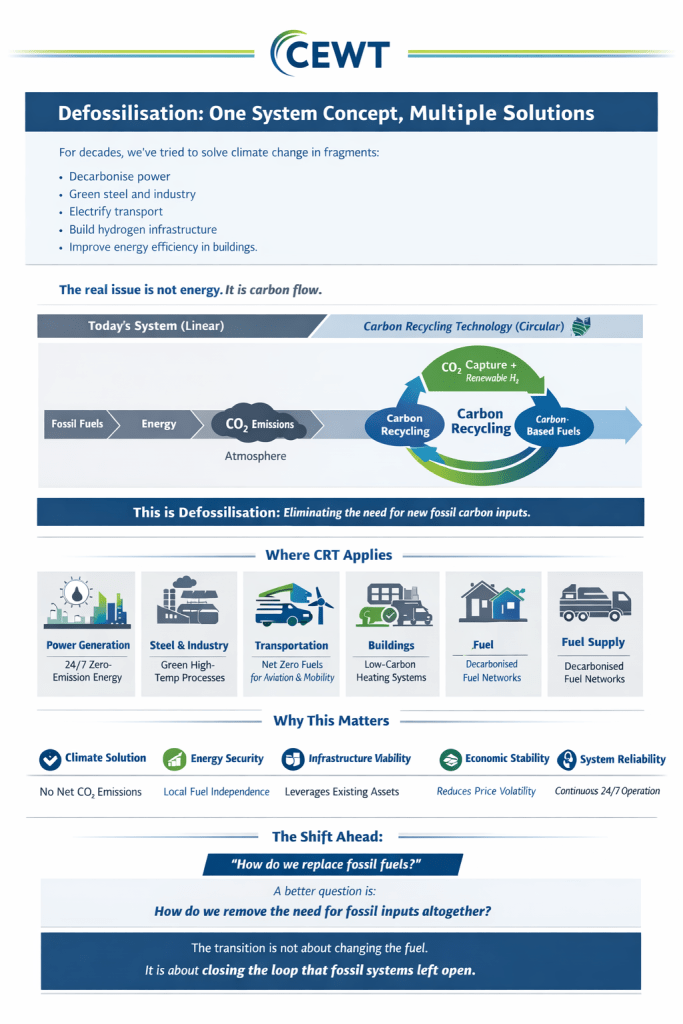
Defossilisation: One System Concept, Multiple Solutions

For decades, climate change has been approached as a series of separate challenges:
• Decarbonise power
• Green steel and industry
• Electrify transport
• Build hydrogen infrastructure
• Improve energy efficiency in buildings

Each pathway is valid — but also adds complexity, cost, and fragmentation.

What if the problem is not the lack of solutions, but the way we frame it?

The Real Issue: Carbon Flow

Today’s system is linear:
Fossil carbon → Energy → CO₂ → Atmosphere

This single flaw drives emissions, volatility, and dependency.

The Solution: Carbon Recycling Technology (CRT)

CRT creates a closed-loop system:
• Capture CO₂
• Combine with renewable hydrogen
• Convert back into fuel
• Reuse continuously

Carbon becomes a recyclable carrier.

Where CRT Applies

• Power Generation – 24/7 zero-emission energy
• Steel & Industry – Stable high-temperature processes
• Transport – Net-zero fuels for aviation and shipping
• Buildings – Reliable heating via existing infrastructure
• Logistics – Decarbonised fuel systems

Why This Matters

• Climate: No net CO₂ emissions
• Energy Security: Local fuel production
• Infrastructure: Uses existing assets
• Economics: Reduced volatility
• Reliability: Continuous operation

Final Thought

The transition is not about changing the fuel.
It is about closing the loop that fossil systems left open.

Defossilisation: One System Concept, Multiple Solutions

For decades, climate change has been approached as a series of separate challenges:
• Decarbonise power
• Green steel and industry
• Electrify transport
• Build hydrogen infrastructure
• Improve energy efficiency in buildings

Each pathway is valid — but also adds complexity, cost, and fragmentation.

What if the problem is not the lack of solutions, but the way we frame it?

The Real Issue: Carbon Flow

Today’s system is linear:
Fossil carbon → Energy → CO₂ → Atmosphere

This single flaw drives emissions, volatility, and dependency.

The Solution: Carbon Recycling Technology (CRT)

CRT creates a closed-loop system:
• Capture CO₂
• Combine with renewable hydrogen
• Convert back into fuel
• Reuse continuously

Carbon becomes a recyclable carrier.

Where CRT Applies

• Power Generation – 24/7 zero-emission energy
• Steel & Industry – Stable high-temperature processes
• Transport – Net-zero fuels for aviation and shipping
• Buildings – Reliable heating via existing infrastructure
• Logistics – Decarbonised fuel systems

Why This Matters

• Climate: No net CO₂ emissions
• Energy Security: Local fuel production
• Infrastructure: Uses existing assets
• Economics: Reduced volatility
• Reliability: Continuous operation

Final Thought

The transition is not about changing the fuel.
It is about closing the loop that fossil systems left open.

By Ahilan Raman
Managing Director

Clean Energy and Water Technologies Pty Ltd (CEWT)

A Reflection from the Field
After studying a wide range of energy transition pathways — renewables, hydrogen,
storage, and carbon capture — one insight has become increasingly clear:
This is not a technology problem. It is a system problem.
Individually, many of these solutions are impressive. Collectively, they struggle to deliver
What modern economies actually require: continuous power, industrial-scale heat,
meaningful storage, and economic viability.
Where Current Approaches Fall Short
As deployment scales, structural constraints become evident: intermittency, storage
limitations, hydrogen challenges, and fragmented system design. Each solution addresses
part of the problem, but the overall system remains incomplete.
A Shift in Perspective
Instead of replacing the existing system, the question becomes: what if we redesign it?
Fossil-based systems historically delivered reliability, energy density, and continuous
operation. The flaw was the one-way carbon flow leading to emissions.
Introducing Carbon Recycling Technology (CRT)
CRT is built on a simple idea: to recycle carbon rather than emit it.
Renewable electricity produces hydrogen, which combines with captured CO₂ to form
renewable natural gas. This fuel generates energy, and CO₂ is captured again, forming a
closed loop.
Why CRT Stands Out

CRT is not an isolated solution but an integrated system architecture. It enables
dispatchable renewable power, continuous industrial heat, high energy density storage, and
minimal fossil dependency.
Not a Claim — An Invitation
This is not a claim that CRT is the only solution. But solutions addressing the full system
deserve deeper attention. The transition depends on integration, not isolation.
A Shared Journey Forward
For any solution to scale, it must be technically sound, economically viable, and broadly
understood. Perspectives from all audiences are essential.
Closing Thought
The transition is not about choosing between hydrogen or hydrocarbons, but about
designing systems that work in reality.
CRT is one such approach — not a final answer, but a meaningful step forward.

CEWT | Clean Energy and Water Technologies Pty Ltd
Advancing system-level solutions for a defossilised future

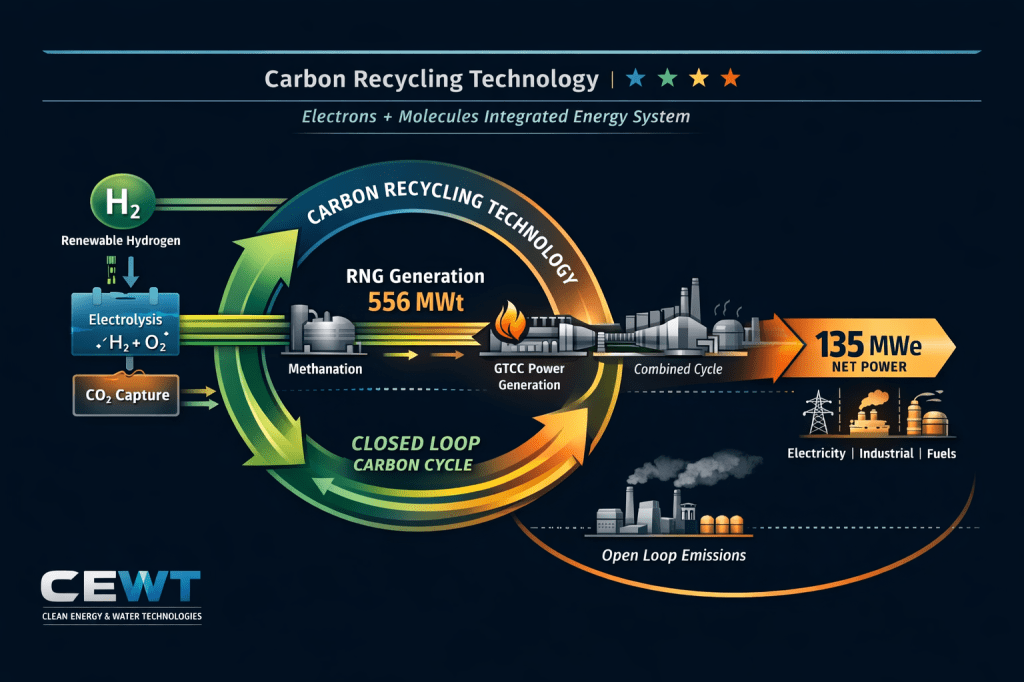
But the real question is:
What does the system look like when it is fully integrated?

This is Carbon Recycling Technology (CRT).

A closed-loop system where:

  • Hydrogen provides the energy
  • Carbon acts as a recyclable carrier
  • Energy is continuously circulated, not emitted

~556 MW of renewable fuel loop → 135 MW of continuous net power

The transition is not about replacing systems.

It is about closing the loop they left open.

The global energy transition is not failing due to a lack of technology.

It is failing because we are solving the wrong problem.

We are trying to replace fossil fuels with renewable energy, as if the challenge is a simple substitution.

It is not.

What we are attempting to replace is a deeply integrated system that has evolved over more than a century to deliver, without interruption:

• 24/7 electrical power
• 24/7 thermal energy
• 24/7 molecular fuels

This is not a fuel problem.

This is a system architecture problem.


The Constraint No One Wants to Admit

Modern economies do not run on energy availability.

They run on continuity.

• Steel plants do not wait for wind
• Chemical processes do not pause at sunset
• Transport systems do not operate on intermittency

Renewables generate energy.

But they do not, on their own, guarantee continuity.

And without continuity, full electrification — of industry, transport, and society — remains structurally constrained.


The Illusion of Current Solutions

We are surrounded by solutions that appear complete — but are, in reality, partial:

• Solar & Wind → scalable, but intermittent
• Batteries → essential, but short-duration
• Hydrogen → powerful, but difficult to store, transport, and deploy at scale
• Fossil fuels → reliable, but environmentally unacceptable

Each solves a piece of the puzzle.

None solves the system.

This is why progress feels slow despite massive investment.

We are optimising components — not redesigning the architecture.


There Is No Shortcut

The transition will not be achieved by choosing one pathway over another.

It will only be achieved by integrating them.

There is no alternative to this.

The future energy system must bring together, under one architecture:

• Renewable energy (as the primary input)
• Molecular energy carriers (for storage, transport, and industry)
• Long-duration storage (beyond batteries)
• Thermal systems (for high-grade heat)

This is not optional.

It is dictated by physics.


Carbon: Misunderstood, Not the Enemy

The transition narrative has made one critical mistake:

It has defined carbon as the problem.

The real problem is fossil carbon used once and discarded.

Carbon itself is not the issue — it is one of the most effective energy carriers we have.

If we stop extracting it and start recycling it, the equation changes completely.

In a closed-loop system:

• Renewable energy produces hydrogen
• Hydrogen combines with captured CO₂ to form stable fuels
• These fuels deliver energy on demand
• CO₂ is captured and reused again

Carbon is no longer waste.

It becomes a circulating asset within the energy system.


The Only Viable Path Forward

The energy transition will succeed only when we stop thinking in silos.

Not renewable vs fossil. Not electrons vs molecules. Not storage vs generation.

But as a single, integrated system.

A system where:

• Renewable energy drives the cycle
• Carbon circulates instead of accumulating
• Molecular fuels provide stability and flexibility
• Industry operates without interruption

This is how we achieve what every transition promises but has yet to deliver:

24/7, zero-emission energy at scale.


Conclusion

The energy transition is not stalled because of a lack of capital.

It is not stalled because of a lack of innovation.

It is stalled because we are trying to replace a system that must be redesigned.

Until that shift happens, progress will remain fragmented.

When it does, the path forward becomes clear.

Not by removing carbon.

But by redefining its role in a closed-loop energy system.


Clean Energy and Water Technologies Pty Ltd (CEWT)
Redesigning energy systems for a defossilised world