Skip navigation

Author Archives: ahilan@cewt.tech

Professional chemical engineer,specializing on clean energy and water technologies.He has more than 35 years of industrial experience in various process industries.Bulk of his experience were in R&D and commercialization.He has few innovative National and International patents on desalination and power generation. His latest patent is to store renewable energy such as solar, wind and geothermal in the form of SNG (synthetic natural gas) to generate base load power. You can eliminate the usage of fossil fuel and substitute with SNG with Zero Carbon emission. He is also a writer on Eastern philosophy, especially on Advaita Vedanta. He believes that science and Vedanta are two sides of the same coin. Science applies to this physical world, and it has its limitations. However, spirituality transcends science and the physical realm. It is your TRUE NATURE. Please check my LinkedIn profile.

(Zero Emission Power and Steel)

Using Carbon Recycling Technology (CRT) as the Core System Architecture

1. Introduction


The global energy transition is entering a new phase. The challenge is no longer simply reducing emissions from individual sectors.
The challenge is now systemic: how to simultaneously decarbonise and defossilise power generation, steelmaking, transport, and marine fuels while maintaining industrial reliability, economic competitiveness, and energy security.

Clean Energy and Water Technologies Pty Ltd (CEWT) proposes the ZEPS® Platform — Zero Emission Power and Steel — built around Carbon Recycling Technology (CRT) as an integrated energy and industrial architecture.

ZEPS® is not merely a standalone technology solution. It is a system-level platform designed to create a circular carbon economy where renewable electricity, hydrogen, captured CO₂, industrial heat, and renewable fuels operate together as a unified industrial ecosystem.

2. Why ZEPS® Matters


Traditional decarbonisation approaches often treat sectors independently:
• Power generation
• Steelmaking
• Transport
• Shipping
• Industrial heat

However, these sectors are deeply interconnected through energy flows, thermal integration, fuel systems, and infrastructure dependencies.

The ZEPS® platform recognises that the future transition cannot be solved through isolated technologies alone. Instead, it requires an integrated system architecture capable of:
• Producing reliable zero-emission power
• Supplying industrial heat
• Producing renewable fuels
• Supporting steel production
• Enabling long-duration energy storage
• Supporting transport and marine decarbonisation
• Recycling carbon rather than continuously extracting fossil carbon

This is where CRT becomes the enabling core architecture.

3. CRT as the Core Architecture


Carbon Recycling Technology (CRT) creates a closed carbon loop.

Renewable electricity is used to generate hydrogen. Captured CO₂ is combined with hydrogen through methanation to produce Renewable Natural Gas (RNG).
When RNG is used in power generation or industrial systems, CO₂ is produced again, captured again, and recycled continuously.

In this architecture:
• Hydrogen becomes the energy input
• Carbon becomes the recyclable carrier
• Renewable electricity becomes dispatchable industrial energy
• Fossil dependency is progressively eliminated

CRT therefore goes beyond “decarbonisation.”
It creates a pathway toward “defossilisation” — the removal of continuous dependence on fossil fuel extraction.

4. The ZEPS® Platform


The ZEPS® platform integrates multiple industrial sectors into one coordinated system:

A. Zero Emission Power
• Renewable electricity integrated with CRT
• Dispatchable baseload power generation
• Grid stability support
• Long-duration energy balancing
• Reduced dependence on imported fossil fuels

B. Zero Emission Steel
• Integration with DRI (Direct Reduced Iron) systems
• Hydrogen-rich reducing gases
• Renewable methane integration
• Industrial heat continuity
• Lower emissions steel production pathways

C. Transport Fuels
• Renewable methane for heavy transport
• Existing gas infrastructure compatibility
• Reduced transition friction for trucking and logistics sectors
• Lower lifecycle carbon intensity

D. Marine Fuel Applications
• Renewable methane as a scalable marine fuel
• Potential compatibility with LNG-based marine infrastructure
• Reduced maritime emissions
• Improved fuel security for shipping corridors

E. Industrial Heat
• Continuous high-temperature energy supply
• Thermal integration for industrial clusters
• Enhanced energy efficiency
• Reduced process instability

5. From Energy Transition to System Transition


One of the greatest challenges facing industrial decarbonisation is intermittency.

Heavy industries such as steel, refining, desalination, chemicals, and shipping require continuous energy availability.
Electricity-only approaches may struggle to provide:
• Long-duration storage
• High-temperature heat
• Fuel flexibility
• Seasonal energy balancing
• Industrial continuity

The ZEPS® platform addresses this challenge through renewable fuel circularity and carbon recycling.

This transforms renewable energy from intermittent electricity into reliable industrial infrastructure.

6. Decarbonisation vs Defossilisation


The term “decarbonisation” focuses primarily on reducing emissions.

The term “defossilisation” goes further.

Defossilisation means removing structural dependence on fossil carbon extraction itself.

This distinction is critical.

A system may reduce emissions temporarily while still remaining fundamentally dependent on fossil fuel extraction, fuel imports, geopolitical fuel risk, and volatile hydrocarbon pricing.

The ZEPS® platform aims to structurally replace this dependency by creating renewable circular fuel systems.

This is why CRT represents not merely an emissions technology — but an industrial architecture for long-term energy sovereignty and resilience.

7. Economic and Strategic Implications


The implications extend beyond emissions reduction.

The ZEPS® platform has the potential to support:
• Industrial competitiveness
• Domestic fuel security
• Grid resilience
• Strategic manufacturing
• Export competitiveness
• Circular carbon economies
• Long-term energy stability

Countries capable of integrating renewable power, industrial heat, steelmaking, and transport fuels into unified systems may become the industrial leaders of the next energy era.

8. Conclusion


The energy transition is increasingly revealing a deeper truth:

The future will not be shaped by isolated technologies alone.
It will be shaped by an integrated system architecture.

The ZEPS® Platform positions CEWT’s Carbon Recycling Technology (CRT) as the enabling core for a new industrial energy model — one capable of simultaneously supporting:
• zero-emission power,
• zero-emission steel,
• renewable transport fuels,
• marine fuel applications,
• and long-term industrial resilience.

This is not only a pathway to decarbonisation.

It is a pathway toward defossilisation.


Prepared by Clean Energy and Water Technologies Pty Ltd (CEWT)
2026
(Zero Emission Power and Steel)

Using Carbon Recycling Technology (CRT) as the Core System Architecture

1. Introduction


The global energy transition is entering a new phase. The challenge is no longer simply reducing emissions from individual sectors.
The challenge is now systemic: how to simultaneously decarbonise and defossilise power generation, steelmaking, transport, and marine fuels while maintaining industrial reliability, economic competitiveness, and energy security.

Clean Energy and Water Technologies Pty Ltd (CEWT) proposes the ZEPS® Platform — Zero Emission Power and Steel — built around Carbon Recycling Technology (CRT) as an integrated energy and industrial architecture.

ZEPS® is not merely a standalone technology solution. It is a system-level platform designed to create a circular carbon economy where renewable electricity, hydrogen, captured CO₂, industrial heat, and renewable fuels operate together as a unified industrial ecosystem.

2. Why ZEPS® Matters


Traditional decarbonisation approaches often treat sectors independently:
• Power generation
• Steelmaking
• Transport
• Shipping
• Industrial heat

However, these sectors are deeply interconnected through energy flows, thermal integration, fuel systems, and infrastructure dependencies.

The ZEPS® platform recognises that the future transition cannot be solved through isolated technologies alone. Instead, it requires an integrated system architecture capable of:
• Producing reliable zero-emission power
• Supplying industrial heat
• Producing renewable fuels
• Supporting steel production
• Enabling long-duration energy storage
• Supporting transport and marine decarbonisation
• Recycling carbon rather than continuously extracting fossil carbon

This is where CRT becomes the enabling core architecture.

3. CRT as the Core Architecture


Carbon Recycling Technology (CRT) creates a closed carbon loop.

Renewable electricity is used to generate hydrogen. Captured CO₂ is combined with hydrogen through methanation to produce Renewable Natural Gas (RNG).
When RNG is used in power generation or industrial systems, CO₂ is produced again, captured again, and recycled continuously.

In this architecture:
• Hydrogen becomes the energy input
• Carbon becomes the recyclable carrier
• Renewable electricity becomes dispatchable industrial energy
• Fossil dependency is progressively eliminated

CRT, therefore, goes beyond “decarbonisation.”
It creates a pathway toward “defossilisation” — the removal of continuous dependence on fossil fuel extraction.

4. The ZEPS® Platform


The ZEPS® platform integrates multiple industrial sectors into one coordinated system:

A. Zero Emission Power
• Renewable electricity integrated with CRT
• Dispatchable baseload power generation
• Grid stability support
• Long-duration energy balancing
• Reduced dependence on imported fossil fuels

B. Zero Emission Steel
• Integration with DRI (Direct Reduced Iron) systems
• Hydrogen-rich reducing gases
• Renewable methane integration
• Industrial heat continuity
• Lower emissions steel production pathways

C. Transport Fuels
• Renewable methane for heavy transport
• Existing gas infrastructure compatibility
• Reduced transition friction for trucking and logistics sectors
• Lower lifecycle carbon intensity

D. Marine Fuel Applications
• Renewable methane as a scalable marine fuel
• Potential compatibility with LNG-based marine infrastructure
• Reduced maritime emissions
• Improved fuel security for shipping corridors

E. Industrial Heat
• Continuous high-temperature energy supply
• Thermal integration for industrial clusters
• Enhanced energy efficiency
• Reduced process instability

5. From Energy Transition to System Transition


One of the greatest challenges facing industrial decarbonisation is intermittency.

Heavy industries such as steel, refining, desalination, chemicals, and shipping require continuous energy availability.
Electricity-only approaches may struggle to provide:
• Long-duration storage
• High-temperature heat
• Fuel flexibility
• Seasonal energy balancing
• Industrial continuity

The ZEPS® platform addresses this challenge through renewable fuel circularity and carbon recycling.

This transforms renewable energy from intermittent electricity into reliable industrial infrastructure.

6. Decarbonisation vs Defossilisation


The term “decarbonisation” focuses primarily on reducing emissions.

The term “defossilisation” goes further.

Defossilisation means removing structural dependence on fossil carbon extraction itself.

This distinction is critical.

A system may reduce emissions temporarily while still remaining fundamentally dependent on fossil fuel extraction, fuel imports, geopolitical fuel risk, and volatile hydrocarbon pricing.

The ZEPS® platform aims to structurally replace this dependency by creating renewable circular fuel systems.

This is why CRT represents not merely an emissions technology — but an industrial architecture for long-term energy sovereignty and resilience.

7. Economic and Strategic Implications


The implications extend beyond emissions reduction.

The ZEPS® platform has the potential to support:
• Industrial competitiveness
• Domestic fuel security
• Grid resilience
• Strategic manufacturing
• Export competitiveness
• Circular carbon economies
• Long-term energy stability

Countries capable of integrating renewable power, industrial heat, steelmaking, and transport fuels into unified systems may become the industrial leaders of the next energy era.

8. Conclusion


The energy transition is increasingly revealing a deeper truth:

The future will not be shaped by isolated technologies alone.
It will be shaped by an integrated system architecture.

The ZEPS® Platform positions CEWT’s Carbon Recycling Technology (CRT) as the enabling core for a new industrial energy model — one capable of simultaneously supporting:
• zero-emission power,
• zero-emission steel,
• renewable transport fuels,
• marine fuel applications,
• and long-term industrial resilience.

This is not only a pathway to decarbonisation.

It is a pathway toward defossilisation.


Prepared by Clean Energy and Water Technologies Pty Ltd (CEWT)
2026
One of the biggest misconceptions in the energy transition is that the challenge is simply generating more renewable electricity.

Increasingly, the real challenge is:

  • infrastructure integration
  • 24×7 reliability
  • cooling
  • resilience
  • lifecycle engineering
  • and industrial continuity.

This is becoming especially visible in the rapid growth of AI and hyperscale data centres.

Data centres do not operate on “average” power.
They operate on continuous infrastructure reliability.

That changes the engineering equation.

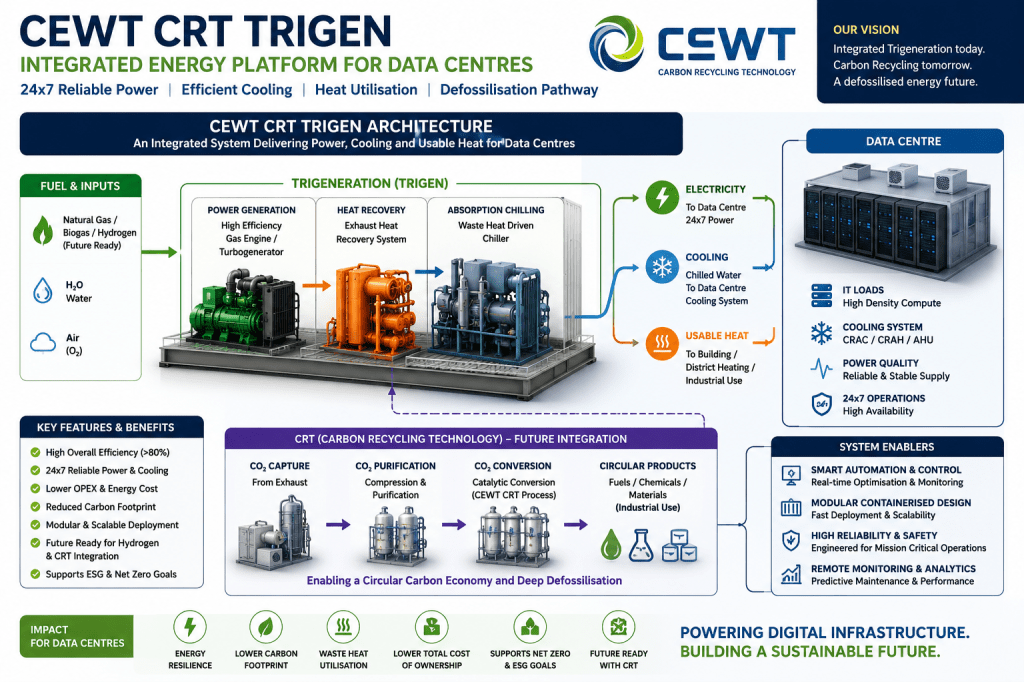
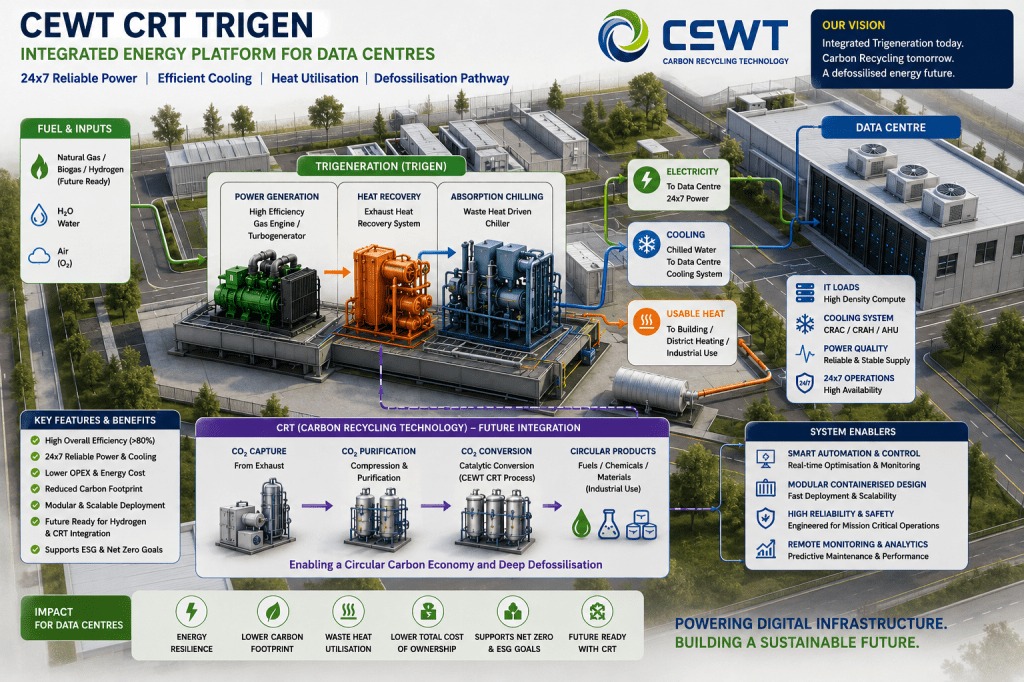
At CEWT, we have now completed the integrated engineering basis for the CEWT TriGen-CRT platform — a modular integrated energy architecture designed for:

  • continuous power generation
  • waste-heat recovery
  • absorption cooling
  • advanced automation
  • modular deployment
  • and future CRT-based defossilisation pathways.

The objective is not simply “lower emissions.”

The objective is:
24×7 industrial operation with a structured pathway toward defossilised infrastructure.

Importantly, the pilot platform is not intended merely as a demonstration unit.

It is intended as:
An operational proof-of-integration platform capable of supporting future commercial-scale deployment for data centres and industrial infrastructure.

The future of the transition may depend less on isolated technologies —
and more on how intelligently entire infrastructure systems are integrated.

The transition is not only electrical.

It is architectural.

DataCentres #EnergyInfrastructure #Trigeneration #Defossilisation #CRT #Cooling #AIInfrastructure #EnergyTransition #Infrastructure #CEWT

One of the biggest misconceptions in the energy transition is that the challenge is simply generating more renewable electricity.

Increasingly, the real challenge is:

  • infrastructure integration
  • 24×7 reliability
  • cooling
  • resilience
  • lifecycle engineering
  • and industrial continuity.

This is becoming especially visible in the rapid growth of AI and hyperscale data centres.

Data centres do not operate on “average” power.
They operate on continuous infrastructure reliability.

That changes the engineering equation.

At CEWT, we have now completed the integrated engineering basis for the CEWT TriGen-CRT platform — a modular integrated energy architecture designed for:

  • continuous power generation
  • waste-heat recovery
  • absorption cooling
  • advanced automation
  • modular deployment
  • and future CRT-based defossilisation pathways.

The objective is not simply “lower emissions.”

The objective is:
24×7 industrial operation with a structured pathway toward defossilised infrastructure.

Importantly, the pilot platform is not intended merely as a demonstration unit.

It is intended as:
An operational proof-of-integration platform capable of supporting future commercial-scale deployment for data centres and industrial infrastructure.

The future of the transition may depend less on isolated technologies —
and more on how intelligently entire infrastructure systems are integrated.

The transition is not only electrical.

It is architectural.

DataCentres #EnergyInfrastructure #Trigeneration #Defossilisation #CRT #Cooling #AIInfrastructure #EnergyTransition #Infrastructure #CEWTEWT TriGen-CRT platform — a modular integrated energy architecture designed for:

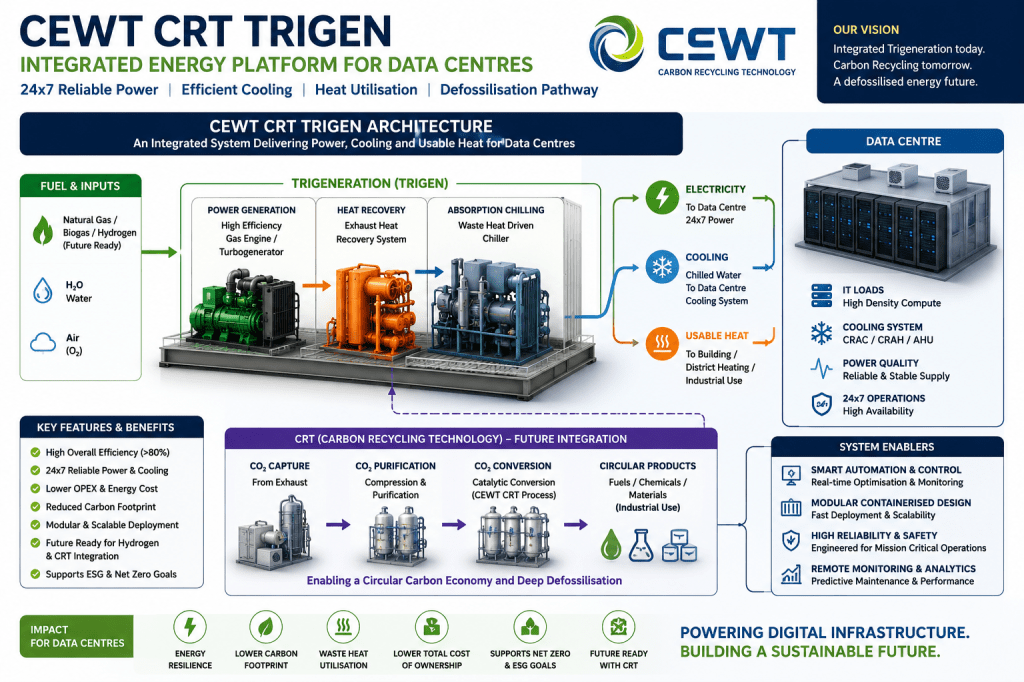
Clean Energy and Water Technologies Pty Ltd (CEWT) is now exploring opportunities to support data centres in Australia and overseas through integrated trigeneration systems.

By combining:
• Electricity generation
• Process heat recovery
• Absorption chilling for cooling

CEWT aims to help data centres improve overall energy efficiency while reducing emissions and dependence on conventional grid-only architectures.

Our broader vision is to integrate advanced carbon recycling and circular energy pathways into future industrial and digital infrastructure.

As the industry evolves, system architecture and energy continuity will become increasingly important.

We welcome discussions with:
• Data centre developers
• Industrial parks
• Energy infrastructure partners
• Investors and strategic collaborators

#DataCentres #Trigeneration #EnergyTransition #Cooling #DigitalInfrastructure #IndustrialDecarbonisation #CircularEconomy #CRT #CEWT #Australia

From Net Zero to Defossilisation: Rethinking the Energy Transition

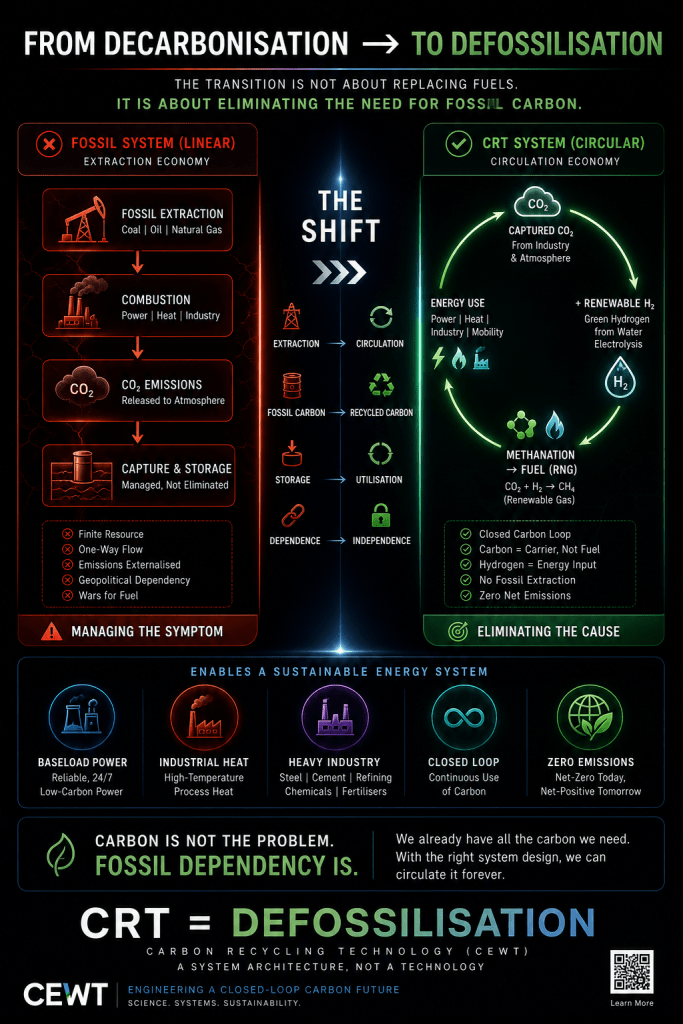
For decades, the global energy transition has been framed around a single objective: Net Zero.

It is a powerful goal. It has mobilised governments, industries, and capital at unprecedented scale. Yet, as we move deeper into implementation, a critical question is emerging:

👉 Are we solving the problem—or managing its symptoms?

## The Limitation of Net Zero

Net Zero, by definition, allows for continued emissions—provided they are balanced by offsets or removals.

In practice, this has led to:

– Continued dependence on fossil fuels 

– Increasing reliance on carbon credits and offsets 

– Complex accounting frameworks that often obscure physical realities 

While these mechanisms may reduce reported emissions, they do not fundamentally change the structure of our energy systems.

We are still operating within a linear model:

> Extract → Burn → Emit → Offset

## A Shift in Perspective: From Accounting to Systems

The energy transition is not just a challenge of replacing fuels. It is a challenge of redesigning systems.

If we step back, the core issue becomes clear:

> Carbon is not inherently the problem. 

> The problem is how we use—and lose—it.

In natural systems, carbon is continuously cycled. In industrial systems, it is extracted, used once, and discarded.

## Introducing Defossilisation

Defossilisation goes beyond Net Zero.

It is not about balancing emissions. 

It is about eliminating dependence on fossil inputs altogether.

The objective shifts from:

– Reducing emissions 

to 

– Redesigning systems so emissions no longer exist as waste

## Carbon as a Carrier, Not a Liability

At the heart of defossilisation is a simple but powerful idea:

> Carbon can function as a reusable energy carrier.

Instead of releasing CO₂ into the atmosphere, it can be:

– captured 

– combined with renewable hydrogen 

– converted into fuel 

– and reused within the system 

This creates a closed-loop energy cycle, where carbon continuously circulates rather than accumulates.

## The Role of Carbon Recycling Technology (CRT)

Carbon Recycling Technology (CRT) is designed around this principle.

Rather than treating CO₂ as an endpoint, CRT:

– captures CO₂ from industrial processes 

– converts it into renewable methane (RNG) 

– reintroduces it as fuel for power and heat 

The result is a self-reinforcing loop:

> CO₂ → Fuel → Energy → CO₂ → Fuel

In this model:

– Carbon is retained within the system 

– Fossil fuel input is progressively eliminated 

– Energy reliability is maintained 

## Why This Matters for Heavy Industry

Sectors such as:

– steel 

– cement 

– refining 

cannot rely solely on intermittent renewables or direct electrification.

They require:

– continuous energy 

– high-temperature heat 

– stable fuel supply 

Defossilisation through carbon recycling offers a pathway that:

– integrates with existing infrastructure 

– avoids full system replacement 

– maintains industrial continuity 

## Beyond Technology: A New Framework for Value

Moving toward defossilisation also requires a shift in how we measure progress.

Traditional metrics such as GDP or even emissions intensity do not capture:

– system resilience 

– energy security 

– long-term sustainability 

The next phase of the transition must focus on:

– system performance 

– circularity 

– resource efficiency

## From Transition to Transformation

The energy transition is often described as a process of substitution—replacing one fuel with another.

Defossilisation represents something deeper:

> A transition from linear consumption to circular systems.

It is not about choosing between:

– hydrogen or batteries 

– renewables or fuels 

It is about integrating them into coherent, closed-loop systems.

## Conclusion

Net Zero has been an essential starting point.

But as we confront the realities of implementation, it is becoming clear that balancing emissions is not enough.

The long-term solution lies in redesigning how energy systems function—so that:

– Carbon is no longer wasted 

– fossil inputs are no longer required 

– and industrial systems can operate sustainably without compromise 

> Defossilisation is not just an environmental goal. 

It is a systems transformation.

And technologies that enable carbon to circulate—rather than accumulate—may well define the next chapter of the global energy transition.

Ahilan Raman 

Managing Director 

Clean Energy and Water Technologies Pty Ltd (CEWT)

“Carbon is not the problem. Linear thinking is.”