Skip navigation

From Net Zero to Defossilisation: Rethinking the Energy Transition

For decades, the global energy transition has been framed around a single objective: Net Zero.

It is a powerful goal. It has mobilised governments, industries, and capital on an unprecedented scale. Yet, as we move deeper into implementation, a critical question is emerging:

👉 Are we solving the problem—or managing its symptoms?

## The Limitation of Net Zero

Net Zero, by definition, allows for continued emissions—provided they are balanced by offsets or removals.

In practice, this has led to:

– Continued dependence on fossil fuels 

– Increasing reliance on carbon credits and offsets 

– Complex accounting frameworks that often obscure physical realities 

While these mechanisms may reduce reported emissions, they do not fundamentally change the structure of our energy systems.

We are still operating within a linear model:

> Extract → Burn → Emit → Offset

## A Shift in Perspective: From Accounting to Systems

The energy transition is not just a challenge of replacing fuels. It is a challenge of redesigning systems.

If we step back, the core issue becomes clear:

> Carbon is not inherently the problem. 

> The problem is how we use—and lose—it.

In natural systems, carbon is continuously cycled. In industrial systems, it is extracted, used once, and discarded.

## Introducing Defossilisation

Defossilisation goes beyond Net Zero.

It is not about balancing emissions. 

It is about eliminating dependence on fossil inputs altogether.

The objective shifts from:

– Reducing emissions 

to 

– Redesigning systems so emissions no longer exist as waste

## Carbon as a Carrier, Not a Liability

At the heart of defossilisation is a simple but powerful idea:

> Carbon can function as a reusable energy carrier.

Instead of releasing COâ‚‚ into the atmosphere, it can be:

– captured 

– combined with renewable hydrogen 

– converted into fuel 

– and reused within the system 

This creates a closed-loop energy cycle, where carbon continuously circulates rather than accumulates.

## The Role of Carbon Recycling Technology (CRT)

Carbon Recycling Technology (CRT) is designed around this principle.

Rather than treating COâ‚‚ as an endpoint, CRT:

– captures COâ‚‚ from industrial processes 

– converts it into renewable methane (RNG) 

– reintroduces it as fuel for power and heat 

The result is a self-reinforcing loop:

> CO₂ → Fuel → Energy → CO₂ → Fuel

In this model:

– Carbon is retained within the system 

– Fossil fuel input is progressively eliminated 

– Energy reliability is maintained 

## Why This Matters for Heavy Industry

Sectors such as:

– steel 

– cement 

– refining 

cannot rely solely on intermittent renewables or direct electrification.

They require:

– continuous energy 

– high-temperature heat 

– stable fuel supply 

Defossilisation through carbon recycling offers a pathway that:

– integrates with existing infrastructure 

– avoids full system replacement 

– maintains industrial continuity 

## Beyond Technology: A New Framework for Value

Moving toward defossilisation also requires a shift in how we measure progress.

Traditional metrics such as GDP or even emissions intensity do not capture:

– system resilience 

– energy security 

– long-term sustainability 

The next phase of the transition must focus on:

– system performance 

– circularity 

– resource efficiency

## From Transition to Transformation

The energy transition is often described as a process of substitution—replacing one fuel with another.

Defossilisation represents something deeper:

> A transition from linear consumption to circular systems.

It is not about choosing between:

– hydrogen or batteries 

– renewables or fuels 

It is about integrating them into coherent, closed-loop systems.

## Conclusion

Net Zero has been an essential starting point.

But as we confront the realities of implementation, it is becoming clear that balancing emissions is not enough.

The long-term solution lies in redesigning how energy systems function—so that:

– Carbon is no longer wasted 

– fossil inputs are no longer required 

– and industrial systems can operate sustainably without compromise 

> Defossilisation is not just an environmental goal. 

It is a systems transformation.

And technologies that enable carbon to circulate—rather than accumulate—may well define the next chapter of the global energy transition.

Ahilan Raman 

Managing Director 

Clean Energy and Water Technologies Pty Ltd (CEWT)

“Carbon is not the problem. Linear thinking is.”
A System-Level Gap in Energy Policy and Finance

Ahilan Raman
Managing Director
Clean Energy and Water Technologies Pty Ltd (CEWT)

April 2026

Executive Summary

Australia has made significant progress in renewable energy deployment. However, fossil fuels remain structurally embedded in providing continuity and reliability. This highlights a critical gap: policy supports components, but not the system-level outcome of defossilisation.

The Current Model

Current frameworks focus on renewable generation, emissions reduction, and technology funding. While successful, they do not eliminate dependence on fossil fuels or system fragmentation.

The Structural Gap

Energy systems require continuity. Fossil fuels provide dispatchability, storage, and density. Renewable systems alone do not yet fully replicate these without additional layers.

Fragmentation

The transition is fragmented across generation, storage, backup, and carbon accounting, rather than forming a unified system.

Carbon Blind Spot

Carbon is treated as a liability. However, circular carbon systems could treat it as a recyclable carrier, enabling closed-loop systems independent of fossil inputs.

Policy Opportunity

Shift from renewable promotion to defossilisation. Enable integrated systems, align finance with outcomes, and support circular energy architectures.

Conclusion

The transition must move from scaling renewables to replacing fossil system functions. Defossilisation is the end state.

A System-Level Gap in Energy Policy and Finance

Ahilan Raman
Managing Director
Clean Energy and Water Technologies Pty Ltd (CEWT)

April 2026

Executive Summary

Australia has made significant progress in renewable energy deployment. However, fossil fuels remain structurally embedded in providing continuity and reliability. This highlights a critical gap: policy supports components, but not the system-level outcome of defossilisation.

The Current Model

Current frameworks focus on renewable generation, emissions reduction, and technology funding. While successful, they do not eliminate dependence on fossil fuels or system fragmentation.

The Structural Gap

Energy systems require continuity. Fossil fuels provide dispatchability, storage, and density. Renewable systems alone do not yet fully replicate these without additional layers.

Fragmentation

The transition is fragmented across generation, storage, backup, and carbon accounting, rather than forming a unified system.

Carbon Blind Spot

Carbon is treated as a liability. However, circular carbon systems could treat it as a recyclable carrier, enabling closed-loop systems independent of fossil inputs.

Policy Opportunity

Shift from renewable promotion to defossilisation. Enable integrated systems, align finance with outcomes, and support circular energy architectures.

Conclusion

The transition must move from scaling renewables to replacing fossil system functions. Defossilisation is the end state.

Clean Energy and Water Technologies Pty Ltd (CEWT)

Why Wind, Solar, and BESS Alone Cannot Fully Decarbonise Heavy Industry

Text Box: Renewables are necessary—but not sufficient.
They solve electricity, but not the full industrial system. CRT completes the system.

1.  The Difference We Keep Ignoring

Homes and businesses require flexible electricity. Heavy industry requires continuous

high-temperature energy, molecular fuels, and uninterrupted operation. These are fundamentally thermochemical systems.

2.  The Intermittency Constraint

Industrial processes cannot follow weather variability. Stability, continuity, and reliability are non-negotiable.

3.  The Scale Challenge

Full electrification demands massive overbuild of generation, transmission, and storage. This is a system design challenge, not just a technology deployment issue.

4.  Capital Flow vs System Need

Investment is heavily concentrated in components—solar, wind, batteries—while integrated industrial solutions remain underdeveloped.

5.  The Missing Layer

Heavy industry depends on hydrogen as an energy carrier and carbon as a structural element. Ignoring carbon integration leads to incomplete decarbonisation pathways.

6.  From Linear to Circular Systems

Current systems extract, use, and emit carbon. Future systems must capture, reuse, and recycle it continuously.

7.  CRT as the Integrating Layer

Carbon Recycling Technology integrates renewable hydrogen with captured CO2 to create a closed-loop system, enabling continuous industrial operation with reduced emissions.

Integration Perspective

Wind, solar and batteries form the foundation of a clean energy system. CRT does not replace them—it integrates with them, providing continuity, carbon reuse, and industrial compatibility. Together they form a complete pathway.

Text Box: Renewables are the foundation. CRT is the completion.

Clean Energy and Water Technologies Pty Ltd (CEWT)

Why Wind, Solar, and BESS Alone Cannot Fully Decarbonise Heavy Industry

Text Box: Renewables are necessary—but not sufficient.
They solve electricity, but not the full industrial system. CRT completes the system.

1.  The Difference We Keep Ignoring

Homes and businesses require flexible electricity. Heavy industry requires continuous

high-temperature energy, molecular fuels, and uninterrupted operation. These are fundamentally thermochemical systems.

2.  The Intermittency Constraint

Industrial processes cannot follow weather variability. Stability, continuity, and reliability are non-negotiable.

3.  The Scale Challenge

Full electrification demands massive overbuild of generation, transmission, and storage. This is a system design challenge, not just a technology deployment issue.

4.  Capital Flow vs System Need

Investment is heavily concentrated in components—solar, wind, batteries—while integrated industrial solutions remain underdeveloped.

5.  The Missing Layer

Heavy industry depends on hydrogen as an energy carrier and carbon as a structural element. Ignoring carbon integration leads to incomplete decarbonisation pathways.

6.  From Linear to Circular Systems

Current systems extract, use, and emit carbon. Future systems must capture, reuse, and recycle it continuously.

7.  CRT as the Integrating Layer

Carbon Recycling Technology integrates renewable hydrogen with captured CO2 to create a closed-loop system, enabling continuous industrial operation with reduced emissions.

Integration Perspective

Wind, solar and batteries form the foundation of a clean energy system. CRT does not replace them—it integrates with them, providing continuity, carbon reuse, and industrial compatibility. Together they form a complete pathway.

Text Box: Renewables are the foundation. CRT is the completion.

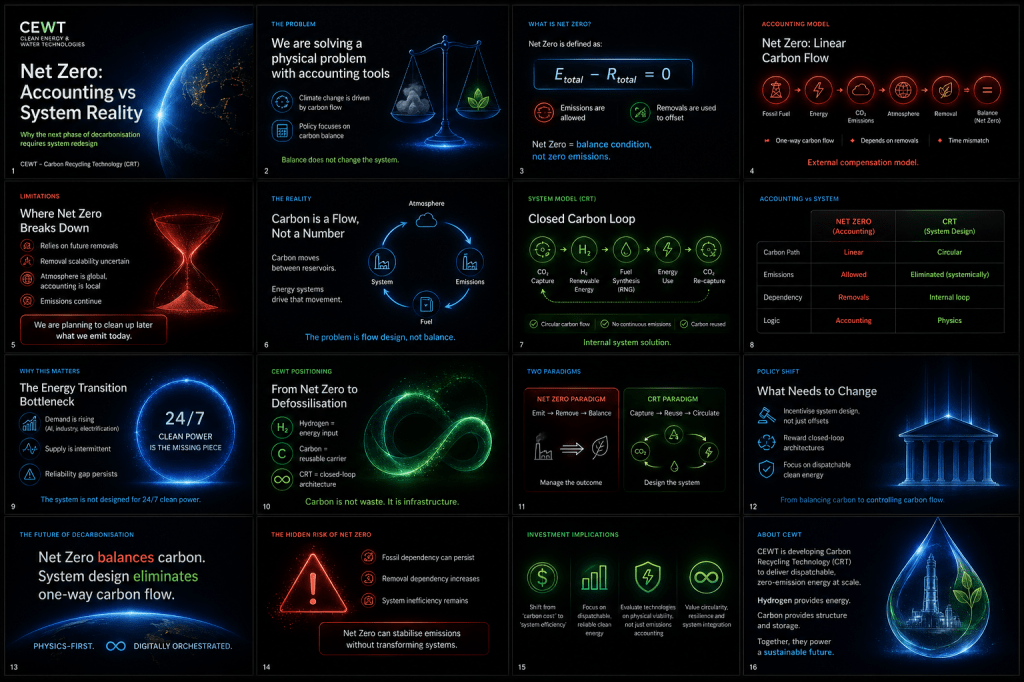
Reality

  • Why the next phase of decarbonisation requires system redesign
  • CEWT – Carbon Recycling Technology

The Problem

  • We are solving a physical problem with accounting tools.
  • Balance does not change the system.

What is Net Zero?

  • Net emissions = Emissions – Removals = 0
  • Net Zero is a balance condition, not zero emissions.

Accounting Model

  • Fossil → Energy → COâ‚‚ → Atmosphere → Removal → Balance
  • External compensation model.

Limitations

  • Relies on future removals
  • Emissions continue
  • Time mismatch
  • Global atmosphere vs local accounting.

Physical Reality

  • Carbon is a flow between systems.
  • The problem is flow design, not balance.

System Model (CRT)

  • COâ‚‚ Capture → Hâ‚‚ → Fuel → Energy → COâ‚‚ →

Re-capture

  • Closed carbon loop.

Comparison

  • Net Zero: Linear, dependent on removals
  • CRT: Circular, internal loop, physics-based.

Why It Matters

  • Energy demand rising
  • Supply intermittent
  • Reliability gap persists.

CEWT Position

  • Hydrogen = energy
  • Carbon = carrier
  • Closed-loop architecture.

Two Paradigms

  • Emit → Remove → Balance
  • vs
  • Capture → Reuse → Circulate

Policy Shift

  • Incentivise system design
  • Reward closed loops
  • Focus on firm clean power.

Closing

  • Net Zero balances carbon.
  • System design eliminates one-way carbon flow.

We are not short of technology.

We are stuck because we are solving a system problem with component thinking.

We optimise electrolysers, batteries, carbon capture, and renewables. Each improvement matters. But the system itself remains unchanged.

Energy is not a collection of components. It is a flow system governed by thermodynamics — energy and mass must balance.

Today’s system is linear: extract carbon, burn fuel, emit CO₂.

We try to fix this with add-ons, offsets, and partial substitutions.

But the architecture remains the same.

The real blind spot is the closed-loop design.

Nature operates in cycles. Carbon cycles. Water cycles. Balanced flows.

Our energy system does not.

Experts are not the problem. Structure is.

Disciplines optimise their own layers: chemical engineering, power systems, economics.

But no one owns the full system architecture.

Finance and policy reinforce this.

Assets are evaluated individually.

Policies are fragmented into hydrogen, CCS, and renewables.

But real systems do not operate in silos.

We don’t need more isolated innovation.

We need system architecture thinking.

That means asking different questions:

Does this close the carbon loop?

Does it provide reliability, not just generation?

Does it reduce dependency on external inputs?

The transition today is based on substitution.

Replace fossil fuels. Offset emissions.

But substitution keeps the same structure.

The next step is defossilisation.

Removing the one-way carbon flow entirely.

History shows progress comes from system shifts, not component upgrades.

The future of energy will not be defined by the best component.

It will be defined by the best architecture.

We are not short of technology.

We are stuck because we are solving a system problem with component thinking.

We optimise electrolysers, batteries, carbon capture, and renewables. Each improvement matters. But the system itself remains unchanged.

Energy is not a collection of components. It is a flow system governed by thermodynamics — energy and mass must balance.

Today’s system is linear: extract carbon, burn fuel, emit CO₂.

We try to fix this with add-ons, offsets, and partial substitutions.

But the architecture remains the same.

The real blind spot is the closed-loop design.

Nature operates in cycles. Carbon cycles. Water cycles. Balanced flows.

Our energy system does not.

Experts are not the problem. Structure is.

Disciplines optimise their own layers: chemical engineering, power systems, economics.

But no one owns the full system architecture.

Finance and policy reinforce this.

Assets are evaluated individually.

Policies are fragmented into hydrogen, CCS, and renewables.

But real systems do not operate in silos.

We don’t need more isolated innovation.

We need system architecture thinking.

That means asking different questions:

Does this close the carbon loop?

Does it provide reliability, not just generation?

Does it reduce dependency on external inputs?

The transition today is based on substitution.

Replace fossil fuels. Offset emissions.

But substitution keeps the same structure.

The next step is defossilisation.

Removing the one-way carbon flow entirely.

History shows progress comes from system shifts, not component upgrades.

The future of energy will not be defined by the best component.

It will be defined by the best architecture.y the Energy Transition is Stuck in Component Thinking

HAVE WE LEARNED ANYTHING FROM HORMUZ?
A System-Level Reflection on Energy Security, Sovereignty, and Design

The Strait Is Not the Problem

The Strait of Hormuz is not just a narrow passage of water. It is a mirror reflecting the structural fragility of the global energy system.

Nearly 20% of the world’s oil passes through this chokepoint. One disruption can cascade across economies with price volatility and supply constraints.

And yet, the response remains: secure more supply, diversify imports, build larger reserves. These are not solutions—they are symptoms.

The Illusion of Energy Security

Energy security has long been treated as a logistics problem: move fuel, protect routes, stabilise price.

But a system dependent on continuous external fuel flows is inherently insecure—regardless of whether the fuel is oil, gas, LNG, or hydrogen.

The Structural Blind Spot

The global energy system is linear: Extract → Transport → Consume → Emit.

This creates geopolitical exposure, economic volatility, and systemic instability.

A Shift from Supply to System Design

What if energy security is not about protecting supply chains—but eliminating the need for them?

This means shifting from fuel supply chains to closed-loop energy systems.

From Linear to Circular Energy Architecture

Linear Model: Extract → Transport → Burn → Emit.

Closed-Loop Model: Capture → Convert → Reuse → Repeat.

Carbon becomes a recyclable carrier, hydrogen an enabler of circularity, and dependency is reduced.

Energy Sovereignty Redefined

True sovereignty comes when systems produce their own energy, recycle emissions, and operate independently of fragile supply chains.

The Lesson We Keep Ignoring

Hormuz is not the root problem. It is the symptom of a system designed around dependency.

The Strategic Question

Are we still trying to secure the old system—or ready to build a new one?

Closing Reflection

The future of energy will not be determined by who controls supply routes, but by who eliminates the need for them.

Clean Energy and Water Technologies Pty Ltd (CEWT)
Carbon Recycling Technology (CRT) – Enabling Closed-Loop Energy Systems

HAVE WE LEARNED ANYTHING FROM HORMUZ?

A System-Level Reflection on Energy Security, Sovereignty, and Design

The Strait Is Not the Problem

The Strait of Hormuz is not just a narrow passage of water. It is a mirror reflecting the structural fragility of the global energy system.

Nearly 20% of the world’s oil passes through this chokepoint. One disruption can cascade across economies with price volatility and supply constraints.

And yet, the response remains: secure more supply, diversify imports, build larger reserves. These are not solutions—they are symptoms.

The Illusion of Energy Security

Energy security has long been treated as a logistics problem: move fuel, protect routes, stabilise price.

But a system dependent on continuous external fuel flows is inherently insecure—regardless of whether the fuel is oil, gas, LNG, or hydrogen.

The Structural Blind Spot

The global energy system is linear: Extract → Transport → Consume → Emit.

This creates geopolitical exposure, economic volatility, and systemic instability.

A Shift from Supply to System Design

What if energy security is not about protecting supply chains—but eliminating the need for them?

This means shifting from fuel supply chains to closed-loop energy systems.

From Linear to Circular Energy Architecture

Linear Model: Extract → Transport → Burn → Emit.

Closed-Loop Model: Capture → Convert → Reuse → Repeat.

Carbon becomes a recyclable carrier, hydrogen an enabler of circularity, and dependency is reduced.

Energy Sovereignty Redefined

True sovereignty comes when systems produce their own energy, recycle emissions, and operate independently of fragile supply chains.

The Lesson We Keep Ignoring

Hormuz is not the root problem. It is the symptom of a system designed around dependency.

The Strategic Question

Are we still trying to secure the old system—or ready to build a new one?

Closing Reflection

The future of energy will not be determined by who controls supply routes, but by who eliminates the need for them.

Clean Energy and Water Technologies Pty Ltd (CEWT)
Carbon Recycling Technology (CRT) – Enabling Closed-Loop Energy Systems