Skip navigation

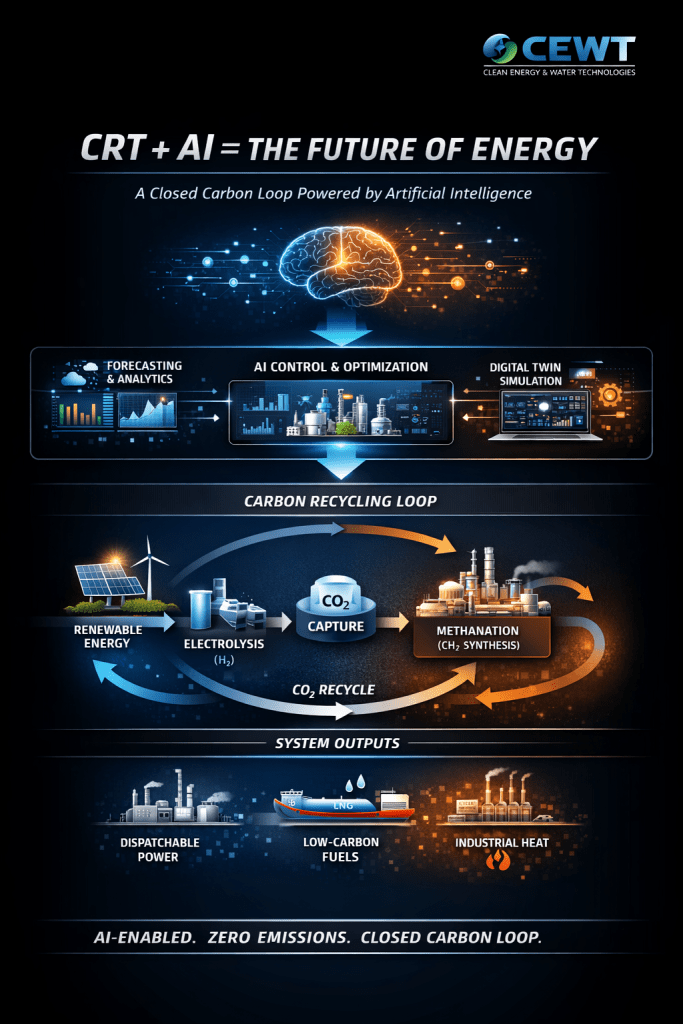
CEWT – AI-Enabled Carbon Recycling Technology (CRT) Architecture

A System Architecture for Zero-Emission Baseload Power and Closed Carbon Loop Fuels

1. Closed Carbon Loop (Physical System)

Renewable Energy → Electrolysis (H₂) → CO₂ Capture → Methanation (CH₄) → Power / Industrial Use → CO₂ → Capture → Loop

2. AI Control Layer

• Forecasting (weather, grid demand)

• Digital Twin (system simulation)

• Real-time optimisation and autonomous control

3. System Architecture Layers

Layer 1 – Physical Assets: GTCC, Electrolysers, Methanation, CO₂ Capture

Layer 2 – Data Acquisition: SCADA, sensors, grid signals

Layer 3 – Integration: Data platform, system-wide visibility

Layer 4 – AI Intelligence: Optimisation, predictive control

Layer 5 – Decision Layer: Dispatch, economic optimisation

4. Key AI Functions

• Real-time balancing of H₂, CO₂, and CH₄

• Predictive control for renewable variability

• Economic optimisation of energy flows

• Carbon accounting across the full system

5. CEWT Positioning

CRT is not just a chemical process. It is an AI-enabled energy system integrating carbon, hydrogen, and power into a closed-loop architecture.

Internal Concept Note: CRT as an Integrated Energy Platform

1. Core Concept

Carbon Recycling Technology (CRT) is not a single process or unit operation. It is an integrated energy platform designed to manage carbon and hydrogen flows within a closed-loop system.

CRT enables the transformation of CO₂ from a waste emission into a reusable feedstock, combined with renewable hydrogen to deliver energy and fuels.

2. Platform Capabilities

CRT can be configured to deliver multiple outputs:

• Zero-emission baseload power and heat (via closed carbon loop)

• Low/zero-carbon fuels for transport (marine, industrial, etc.)

• Aviation-grade liquid fuels (with appropriate downstream configuration)

This multi-output capability defines CRT as a flexible energy architecture rather than a fixed technology.

3. Engineering Basis

CRT integrates three controllable elements:

a) Carbon Management

– CO₂ capture and recycling

– Closed carbon loop (no continuous fossil input)

b) Hydrogen Integration

– Renewable hydrogen as primary energy input

– Defines system energy intensity and output flexibility

c) Process Pathway Flexibility

– Methane loop (power generation via gas turbines)

– Syngas loop (fuel synthesis pathway)

4. Aviation Fuel Configuration

Aviation fuel is not a default output of CRT. It requires specific configuration:

• Syngas conditioning (H₂/CO ≈ 2)

• Fischer–Tropsch synthesis

• Hydro processing/upgrading to jet fuel specifications (C8–C16 range)

This enables the production of drop-in aviation fuels compatible with existing infrastructure.

5. System Modes

CRT can operate in different modes depending on system design:

Power Mode:

– Maximises electricity generation

– Uses methane loop via gas turbines

Fuel Mode:

– Diverts carbon and hydrogen to liquid fuel synthesis

– Lower overall efficiency, higher complexity

Hybrid Mode:

– Simultaneous power and fuel production

– Requires optimisation based on demand and economics

6. Strategic Insight

The value of CRT lies in its shared upstream infrastructure:

• CO₂ capture

• Hydrogen supply

• Carbon-hydrogen integration

This allows flexible allocation of energy between electrons (power) and molecules (fuels).

CRT, therefore, functions as an integrated platform capable of supporting multiple sectors from a single system architecture.

7. Key Positioning

CRT is an integrated carbon–hydrogen platform capable of delivering:

• Baseload power

• Low-carbon fuels

• Aviation-grade fuels (with configuration)

The system’s strength lies in its ability to operate as a closed-loop carbon architecture, reducing dependence on fossil carbon while maintaining energy reliability and scalability.

End of Note
Why System Architectures Like CRT Take Time to Be Recognised

We often assume that if a technology works, it will be adopted quickly.

But history shows something different.

The real breakthroughs are rarely just technologies.

They are system architectures.

And systems take longer to be recognised.


In today’s Power-to-X landscape, most solutions are built around technology blocks:

→ Electrolysers

→ Reactors

→ Storage systems

Each is optimised individually.

Each is commercially packaged.

But the next phase of the energy transition is not about better components.

It is about how those components are integrated into a coherent system.


This is where approaches like Carbon Recycling Technology (CRT) differ.

CRT is not a single unit or process.

It is an energy architecture that integrates:

→ Renewable electricity

→ Hydrogen production

→ CO₂ utilisation

→ Methanation

→ Thermal recovery

…into a closed carbon loop.


And that’s exactly why it takes time.

Because:

  • Vendors are optimised for repeatable products, not system redesign
  • Markets are structured around components, not architectures
  • Finance prefers known configurations, not integrated systems

So when a new architecture emerges, it doesn’t fit existing boxes.


The result?

It is not rejected.

It is simply not immediately recognised.


But over time, something shifts.

As constraints become visible:

→ Intermittency

→ Storage limitations

→ Infrastructure gaps

→ System inefficiencies

…the need for integrated solutions becomes unavoidable.


And that’s when architectures move from:

👉 “interesting concept.”

to

👉 “necessary solution.”


The energy transition is entering that phase now.

The question is no longer:

“Which technology is better?”

It is:

“Which system actually works at scale?”


CRT is one such system.

Not because it introduces a new reaction.

But because it redefines how energy, carbon, and heat interact.


🔥 Final Thought

Technologies compete.

Architectures endure.


#EnergyTransition #PowerToX #Hydrogen #CarbonRecycling #SystemsThinking #Defossilisation

FA System Reframing

CEWT Insight Note

We often frame petrol, diesel, and LNG as ‘fossil fuels’.

But that framing hides the real issue.

The problem is not the fuel.

The problem is fossil carbon.

As long as we remain tied to fossil carbon, oil dependence will continue — even when alternatives to fossil fuels exist.

This is because the system is built on a linear carbon flow:

Extract → Use → Emit

That is the real addiction.

Energy can be replaced.

Carbon flow must be redesigned.

The shift we need:

From fossil fuel thinking → To carbon system thinking

Carbon is not the enemy.

Unmanaged carbon flow is.

The future is not fossil-free.

It is fossil-carbon neutral.

— Clean Energy and Water Technologies Pty Ltd (CEWT) fossil Carbon vs Fossil Fuel

CEWT Policy Brief
Carbon Recycling Technology (CRT)

A System-Level Pathway to Firm, Zero-Emission Energy

1. The Structural Gap in the Energy Transition

Australia’s energy transition is progressing rapidly in renewable generation. However, intermittent electricity alone cannot support 24/7 grid stability, continuous industrial heat, and dispatchable energy for hard-to-abate sectors.

2. CRT: A System Integration Solution

Carbon Recycling Technology (CRT) creates a closed-loop system where CO₂ is combined with renewable hydrogen to produce renewable methane (RNG), reused for energy, and continuously recycled.

3. Strategic Value to Australia

Enhances energy security, industrial competitiveness, grid stability, and emissions reduction through closed-loop carbon operation.

4. Institutional Fit

CRT integrates with existing infrastructure, is modular and scalable, and reduces asset risk rather than replacing systems.

5. Financing Challenge

Current financial frameworks evaluate isolated assets, creating a recognition gap for system-level innovations like CRT.

6. Role of Public Finance

ARENA and CEFC can bridge early-stage risk, support pilot validation, and enable private capital participation.

7. Proposed Next Step

Pilot-scale CRT demonstration integrated with GTCC infrastructure to validate performance and economics.

8. Key Message

CRT completes the energy transition by enabling a closed-loop carbon energy system.

9. Closing Statement: Australia can lead in defining a fully integrated zero-emission energy architecture

Closed-Loop Energy Systems:

Closed-Loop Energy Systems:
Thorium Cycle + Carbon Recycling Technology (CRT)

Overview
This document presents a unified systems perspective linking India’s thorium-based nuclear program with Carbon Recycling Technology (CRT). Both represent closed-loop architectures designed to achieve long-term sustainability, energy security, and environmental stability.


1. Thorium Closed Fuel Cycle
Thorium (Th-232) is converted into fissile Uranium-233 within a reactor system, enabling a self-sustaining nuclear fuel cycle. This reduces dependence on imported uranium and minimises long-lived nuclear waste.


2. Carbon Recycling Technology (CRT)
CRT captures CO₂ emissions and combines them with renewable hydrogen to produce renewable methane (RNG). The methane is used for power generation, releasing CO₂, which is recaptured, forming a closed carbon loop.


3. Integrated Closed-Loop Energy Architecture
Thorium systems close the nuclear fuel loop, while CRT closes the carbon loop. Together, they form a complementary architecture enabling firm power, energy storage, and decarbonised industrial energy.


Conceptual Diagram (Text Representation)

[Thorium Loop]
Th-232 → Reactor → U-233 → Energy → Recycle

[Carbon Loop]
CO₂ → +H₂ → CH₄ → Energy → CO₂ (captured again)

[Integrated System]
Firm Power (Nuclear) + Flexible Fuel (CRT) → Circular Energy Economy


CEWT Perspective
The future of energy lies not in isolated technologies, but in integrated, closed-loop systems that eliminate waste, maximise resource utilisation, and deliver continuous, reliable power without fossil inputs.

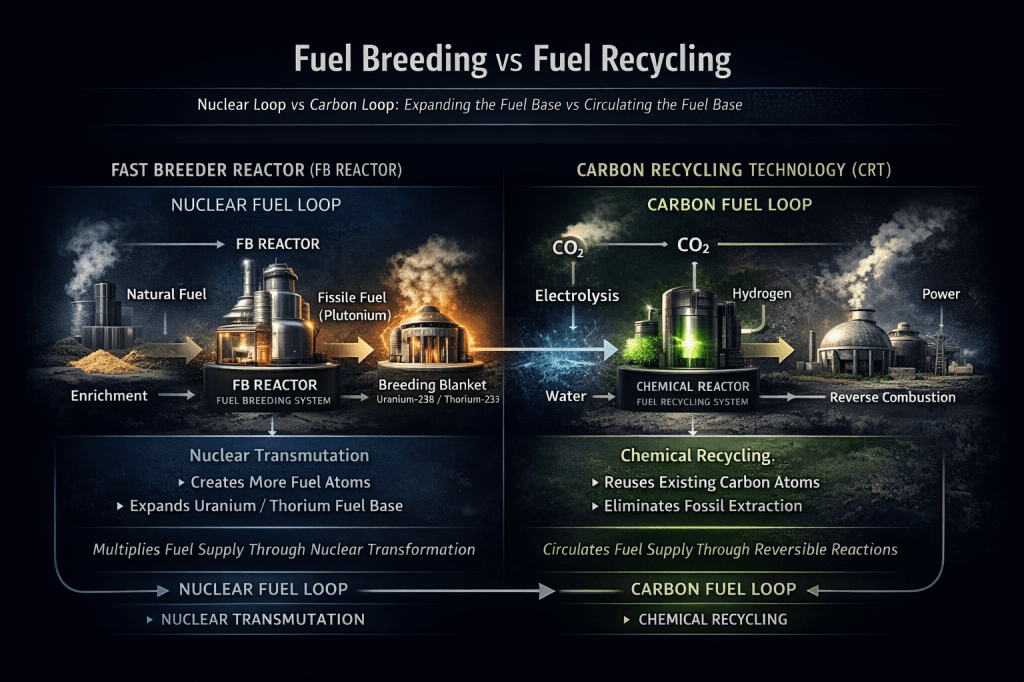
But it also highlights an interesting contrast in how we think about closed-loop systems.

A fast breeder reactor multiplies fuel through nuclear transformation.

Systems like CRT take a different path—they circulate fuel instead of consuming it, reusing the same carbon atoms in a continuous loop.

Both approaches point in the same direction:

👉 reducing dependence on continuous resource extraction

One expands the fuel base.

The other removes the need for new fuel altogether.

That shift—from extraction to internalised systems—is where the future of energy architecture is heading.

A simple comparison between CRT and FBR.

CEWT
Carbon Recycling Technology (CRT)
Investor & Strategic Brief


Delivering Closed-Loop Energy Systems for a Defossilised World

1. Executive Summary

The global energy system is undergoing a structural reset.
Geopolitical instability, volatile fuel markets, and climate constraints are exposing the limitations of the traditional open-loop energy model.

Carbon Recycling Technology (CRT), developed by Clean Energy and Water Technologies (CEWT), introduces a closed-loop energy architecture that continuously recycles carbon.

CRT enables dispatchable, zero-emission power while maintaining compatibility with existing infrastructure — solving energy security and decarbonisation simultaneously.


2. The Problem

• Fossil fuel dependency exposes nations to geopolitical risk 
• Renewable intermittency limits industrial application 
• Hydrogen faces storage, transport, and cost challenges 
• Existing infrastructure is hydrocarbon-based 

The current system is fragmented and unsustainable.


3. The CRT Solution

CRT creates a closed carbon loop:

CO₂ + Renewable H₂ → Synthetic Methane → Energy → CO₂ (recycled)

Key outcomes:
• Baseload renewable power 
• Continuous industrial heat 
• Energy-dense fuel storage 
• Full infrastructure compatibility


4. Strategic Advantages

• System-level integration (power + heat + fuel) 
• Energy sovereignty for nations 
• Reduced transition CAPEX (uses existing assets) 
• Scalable across industries (power, steel, chemicals)


5. Financial Snapshot (135 MW Project)

• Total CAPEX: ~A$1.624 Billion 
• IRR: ~11.7% 
• Payback: ~8 years 
• Debt:Equity: 65:35 
• Strong alignment with ARENA, CEFC, and Green Iron Fund


6. Why Now

• Energy markets destabilised by geopolitical conflict 
• Carbon pricing tightening globally 
• Industrial decarbonisation urgency is increasing 
• Hydrogen economy limitations are becoming evident 

This creates a clear entry point for CRT.


7. Conclusion

The transition ahead is not about replacing fuels — it is about redesigning the system.

CRT enables a shift from open-loop to closed-loop energy architecture, delivering both sustainability and energy independence.

This is foundational change, not incremental improvement.

FrCEWT | Investor Brief
Carbon Recycling Technology (CRT)

From Energy Crisis to Energy Sovereignty

EXECUTIVE SUMMARY

The global energy system is undergoing structural disruption driven by geopolitical instability and climate constraints.
This is not a temporary crisis — it is the breakdown of an outdated energy architecture.

For over a century, energy systems have operated as open loops:
Extract → Burn → Generate → Emit → Pollute

This model is no longer viable.

Carbon Recycling Technology (CRT), developed by Clean Energy and Water Technologies (CEWT), introduces a closed-loop energy architecture where carbon is continuously recycled rather than emitted.

CRT transforms captured CO₂ into renewable methane using green hydrogen, enabling dispatchable, zero-emission power generation while maintaining energy density and infrastructure compatibility.

This represents a paradigm shift from fuel substitution to system redesign.


THE OPPORTUNITY

• Global energy markets are facing volatility due to supply disruptions and geopolitical risk
• Industrial sectors require 24/7 power, heat, and molecular fuels
• Hydrogen alone faces storage, transport, and cost limitations
• Existing infrastructure is built around hydrocarbons

CRT addresses all four simultaneously.

It enables:
• Baseload renewable power
• Industrial heat continuity
• Molecular energy storage
• Compatibility with existing gas infrastructure


CORE TECHNOLOGY

CRT integrates:
• CO₂ capture
• Renewable hydrogen production
• Methanation (CO₂ + 4H₂ → CH₄ + 2H₂O)
• Gas turbine power generation

Carbon becomes a recyclable carrier.
Hydrogen becomes the energy input.
Methane becomes the storage medium.

The result is a perpetual carbon-energy loop.


INVESTMENT CASE

1. System-Level Innovation
CRT is not a single technology — it is an integrated energy architecture addressing power, heat, and fuel simultaneously.

2. Infrastructure Advantage
Leverages existing gas pipelines, storage, and turbines — reducing transition costs.

3. Energy Sovereignty
Enables nations to produce fuel domestically from CO₂ and renewable electricity.

4. Market Alignment
Aligned with global decarbonisation policies, carbon markets, and energy security priorities.

5. Scalability
Applicable across power generation, steel, chemicals, and desalination sectors.


STRATEGIC POSITIONING

CRT sits at the intersection of:
• Renewable energy
• Carbon management
• Synthetic fuels
• Industrial decarbonisation

It bridges the gap between intermittent renewables and continuous industrial demand.


WHY NOW

• Fossil fuel volatility is rising
• Hydrogen economics remain uncertain
• Carbon pricing is tightening globally
• Grid stability challenges are increasing

The current disruption is accelerating adoption of closed-loop systems.


CONCLUSION

The energy transition is not simply about replacing fuels.

It is about redesigning the system.

CRT enables that transition by closing the carbon loop — transforming a liability into a reusable asset.

This is not incremental improvement.

This is foundational change.


CONTACT
Clean Energy and Water Technologies Pty Ltd (CEWT)
Australia

om Energy Crisis to Energy Sovereignty