Skip navigation

Energy industry is at a crossroad. It must now find a new direction to address the climate issue while to continue to supply energy to the world. The options are very clear. It can find new ways and means to genuinely address some of the mistakes of the past by inventing new methods to address the problem irrespective of the cost involved because time is not in our favour. Alternatively, one can redirect the issue using new terminologies and jargons and temporarily buy some time till finding an alternative and lasting solution to the problem. The first option will take time and cost more, and the second option may not take time and cost less. It seems most of the companies are choosing the second alternative. But how?

Renewable energy is defined as “a source of energy that is available from the nature that can be constantly replenished”. This will guarantee the sustainability. But we are used to Carbon based fuels and technologies and therefore we also need a renewable Carbon that can substitute fossil fuels so that existing technologies for power and transportation can be used. Biomass is also derived from plants and animals like fossil fuels, but it is different in terms of time scale, and it can be replenished quickly unlike fossil fuels. It is basically made up of Carbon, Hydrogen and additionally oxygen, like fossil fuels such as coal, oil and gas but free from sulphur. Therefore, one can use the same technology such as combustion, gasification and pyrolysis etc and convert a biomass into energy, chemicals and fuels while claiming them as “renewables”. It will require oxy-combustion and gasification methods and unfortunately usage of pure Oxygen will be inevitable.Therefore, both Carbon as well as Hydrogen derived from biomass becomes “Green” and “renewable”. In addition “Green Hydrogen” using renewable energy sources such as solar and wind by water electrolysis will help decarbonisation by capturing and converting CO2 emissions into a Syngas. It requires a steep fall in the cost of renewable electricity to less than $20/Mwh and Carbon emission to be taxed at least @ $250/Mt to discourage fossil industry. Once we establish green and renewable Carbon and Hydrogen then it is only a matter of generating a syngas, combination of Hydrogen and Carbon monoxide with various ratios to synthesis various chemicals including bio crude oil that leads to refineries to produce petrol, diesel and aviation fuels. We will be back into the game but with different brand called “Green and renewable”; it is “an old wine in a new bottle” Everybody is happy and politicians can now heave a sigh of relief and feel comfortable. One can also use “blue hydrogen’ as a mix to green hydrogen and synthesis various downstream chemicals such as Ammonia, urea etc.

Thus they can use them to decarbonise the fossil economy. In either way there is still an issue of CARBON EMISSION that needs to be addressed. They may claim biofuel as Carbon neutral, but it will not stop the increasing concentration of GHG into the atmosphere or climate change. Therefore Carbon tax will be inevitable. Bioenergy and renewable energy may increase the sustainability but will not address the issue of global warming and climate change. Nature does not discriminate between ‘bio-carbon’ and ‘fossil carbon’. Only “Carbon Recycling Technology” can address the problem of global warming and climate change. In our process of CRT we neither use “bio-Carbon” or “fossil Carbon from coal, oil and gas but CO2 derived from DIC (dissolved inorganic Carbon) from seawater.That is why the Hydrocarbon derived in our process is called Carbon negative fuel. Moreover it recycles the CO2 emission resulting from such hydrocarbon within the sCO2 (super critical CO2) power system with Zero CO2 emission.The simplest method for transport will be to to collect CO2 emission from all petrol and diesel engines in a liquid form using a retrofittable device in the vehicle and convert them in a centralised facility to Syngas using renewable Hydrogen .The syngas can be converted into renewable crude using F-T reaction hat can be processed in a refinery for recycling into petrol, diesel and aviation fuel so that we can eliminate technologies such as large batteries and Fuel cells. By this way we can ensure the CO2 level in the atmosphere is stabilised and existing infrastructures are utilised. The availability of biomass for a radical change will be an issue especially in Asia where growing population requires more land for agriculture and deforestation is a common problem. It is absolutely clear that the same old fossil industry will promote Hydrogen in a much bigger scale so that oil and gas industry will re-brand itself as “Green and Renewable” and continue to grow along with their CO2 emissions unabated.
Energy generation and usage is considered not only as a mark of progress of a nation but also security of a nation. That is why countries go to extraordinary distance to achieve such a security and everything else becomes secondary in the path of their goal. That is why countries with high oil and gas reserves enjoy good relationship and privileges with powerful nations of the world. Countries who do not have their own oil and gas reserves and who completely rely on import of oil and gas have no choice but maintain a good relationship with oil rich countries despite their difference in ideologies and policies. But with warming globe and changing climate the dependence on fossil fuels is fast becoming unsustainable and countries look for alternatives. It is good news for the whole world especially for nations who depend completely on import of oil and gas because they can develop their own renewable energy sources to lower their emissions. But there is one major difference. Countries who depend on import of oil and gas required to develop only an infrastructure to store and distribute oil and gas, But with renewable energy they have to develop an infrastructure to produce the hardware necessary to use alternative energy sources such as solar, wind, geothermal  but also energy storage such as batteries. The warming globe and changing climate have become a grave threat to the plant earth and a threat to lives of entire future generations. It is the greatest challenge of the industrialized world. One can view this as threat or as an opportunity. But it is time to act irrespective of our views and we must act now.

It is an opportunity for scientists and engineers to view energy sources and their applications in a new perspective. It is an opportunity to understand how human activities affect our environment and how not to damage them but preserve them for our future generations while developing new alternatives. Humanity is just a part of a larger environment and any damage to planet earth is at our own peril. It is an ancient wisdom, but we neglected them. When an aboriginal of Australia said “we belong to earth and earth does not belong to us” we failed to listen to them. We(people) became bigger than They (environment).

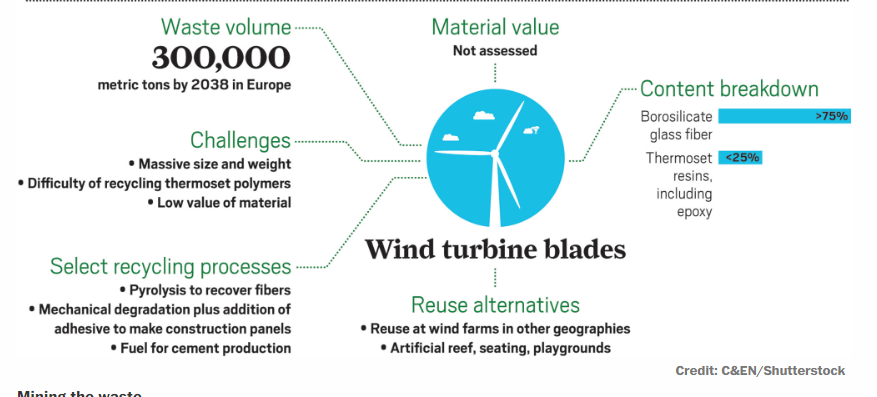
In pursuit of a new energy source one must be extremely careful in examining Nature and how she operates so that we do not make the same mistakes of the past. As we develop renewable energy as a potential energy source of the future, we should be aware of the life cycle of such a system and their impact on environment. Renewable energy requires hardware that uses exotic metals, catalysts, polymers, new Carbon sources and glasses. As we switch to Carbon free economy, we should make sure that there are no emissions in developing renewable energy sources and if necessary impose Carbon tax on such emissions and, to develop recycling technologies to recycle that hardware safely and environmentally friendly manner. It is critically important issue as we move forward. According to an article published in Chemical engineering News

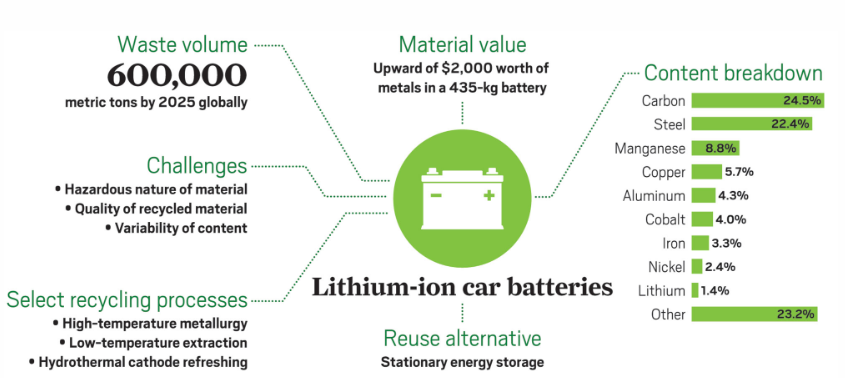
“The potential quantities of waste are enormous. By 2025, waste batteries removed from electric vehicles will total 95 Giga watt hours, according to an estimate by Bloomberg New Energy Finance. That pile will weigh roughly 600,000 metric tons.

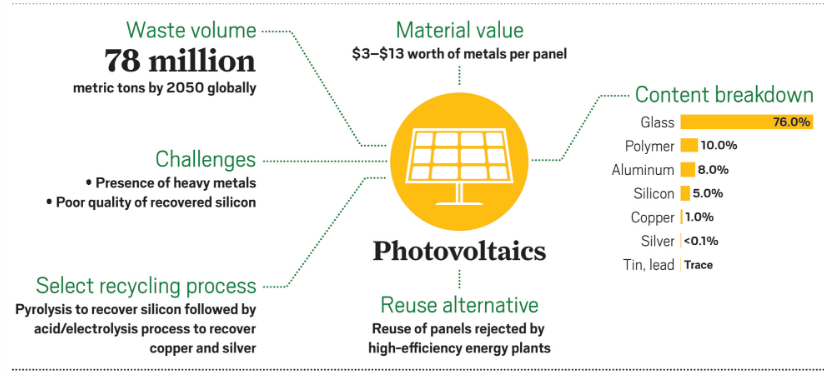
A similar amount of old solar panels will have accumulated by then, according to projections by the International Renewable Energy Agency. IRENA anticipates solar panel waste could reach 78 million metric tons by 2050. And Europe could see 300,000 metric tons per year of decommissioned wind turbine blades in the next two decades, says the trade association Wind Europe.

Each year, approximately 300,000 metric tons of lithium-ion battery waste is generated around the world, says Sheetanshu Upadhyay, an analyst with India’s Esticast Research & Consulting. Most of those batteries come from mobile devices, but that waste will soon be overshadowed by old electric car batteries. Sales of plug-in electric vehicles are expected to surpass 2.6 million in 2020, according to Navigation Research.”

The above data shows the amount of CO2 emission associated with implementation of renewable energy sources soon. There is a potential for large scale recycling industries on renewables, but it will come with a price and environmental issues. Right now, the main problem is the CO2 emission and the only way to tackle this problem is impose Carbon tax on emissions while encouraging industries with low emission technologies. It should be possible for UN to pass a unanimous resolution among the nations to address climate change by imposing Carbon tax uniformly across the nation. By such resolution UN can bring all those countries to the table who are currently reluctant to be a party to the Paris accord. Countries can use “Carbon rating” similar to “energy ratings” currently used for measuring energy efficiencies in appliances such as Heaters and air-conditioners. The lowest emitting technologies will get the highest Carbon rating while high emission technologies will get the lowest Carbon ratings. By using such a method country who are reluctant to act on climate change will be disadvantaged; they will not be able to compete in international market or export their goods to low emitting countries based on Carbon ratings.


Recycling PV solar panelsRecycling renewablesRecycling wind turbines

(Zero Emission Power and Steel)

Using Carbon Recycling Technology (CRT) as the Core System Architecture

1. Introduction


The global energy transition is entering a new phase. The challenge is no longer simply reducing emissions from individual sectors.
The challenge is now systemic: how to simultaneously decarbonise and defossilise power generation, steelmaking, transport, and marine fuels while maintaining industrial reliability, economic competitiveness, and energy security.

Clean Energy and Water Technologies Pty Ltd (CEWT) proposes the ZEPS® Platform — Zero Emission Power and Steel — built around Carbon Recycling Technology (CRT) as an integrated energy and industrial architecture.

ZEPS® is not merely a standalone technology solution. It is a system-level platform designed to create a circular carbon economy where renewable electricity, hydrogen, captured CO₂, industrial heat, and renewable fuels operate together as a unified industrial ecosystem.

2. Why ZEPS® Matters


Traditional decarbonisation approaches often treat sectors independently:
• Power generation
• Steelmaking
• Transport
• Shipping
• Industrial heat

However, these sectors are deeply interconnected through energy flows, thermal integration, fuel systems, and infrastructure dependencies.

The ZEPS® platform recognises that the future transition cannot be solved through isolated technologies alone. Instead, it requires an integrated system architecture capable of:
• Producing reliable zero-emission power
• Supplying industrial heat
• Producing renewable fuels
• Supporting steel production
• Enabling long-duration energy storage
• Supporting transport and marine decarbonisation
• Recycling carbon rather than continuously extracting fossil carbon

This is where CRT becomes the enabling core architecture.

3. CRT as the Core Architecture


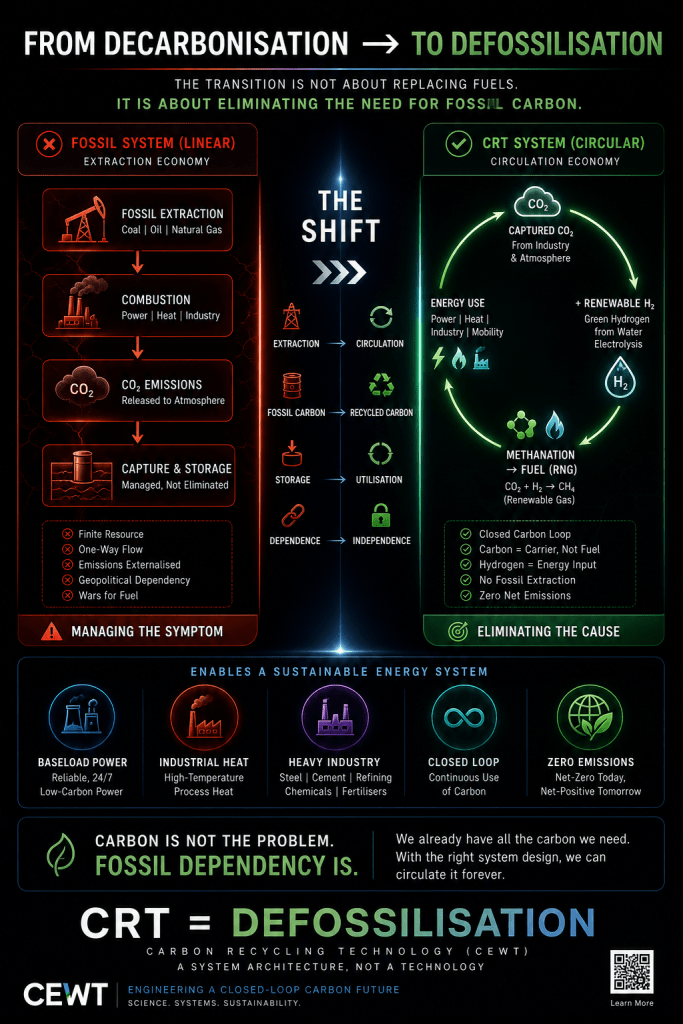
Carbon Recycling Technology (CRT) creates a closed carbon loop.

Renewable electricity is used to generate hydrogen. Captured CO₂ is combined with hydrogen through methanation to produce Renewable Natural Gas (RNG).
When RNG is used in power generation or industrial systems, CO₂ is produced again, captured again, and recycled continuously.

In this architecture:
• Hydrogen becomes the energy input
• Carbon becomes the recyclable carrier
• Renewable electricity becomes dispatchable industrial energy
• Fossil dependency is progressively eliminated

CRT therefore goes beyond “decarbonisation.”
It creates a pathway toward “defossilisation” — the removal of continuous dependence on fossil fuel extraction.

4. The ZEPS® Platform


The ZEPS® platform integrates multiple industrial sectors into one coordinated system:

A. Zero Emission Power
• Renewable electricity integrated with CRT
• Dispatchable baseload power generation
• Grid stability support
• Long-duration energy balancing
• Reduced dependence on imported fossil fuels

B. Zero Emission Steel
• Integration with DRI (Direct Reduced Iron) systems
• Hydrogen-rich reducing gases
• Renewable methane integration
• Industrial heat continuity
• Lower emissions steel production pathways

C. Transport Fuels
• Renewable methane for heavy transport
• Existing gas infrastructure compatibility
• Reduced transition friction for trucking and logistics sectors
• Lower lifecycle carbon intensity

D. Marine Fuel Applications
• Renewable methane as a scalable marine fuel
• Potential compatibility with LNG-based marine infrastructure
• Reduced maritime emissions
• Improved fuel security for shipping corridors

E. Industrial Heat
• Continuous high-temperature energy supply
• Thermal integration for industrial clusters
• Enhanced energy efficiency
• Reduced process instability

5. From Energy Transition to System Transition


One of the greatest challenges facing industrial decarbonisation is intermittency.

Heavy industries such as steel, refining, desalination, chemicals, and shipping require continuous energy availability.
Electricity-only approaches may struggle to provide:
• Long-duration storage
• High-temperature heat
• Fuel flexibility
• Seasonal energy balancing
• Industrial continuity

The ZEPS® platform addresses this challenge through renewable fuel circularity and carbon recycling.

This transforms renewable energy from intermittent electricity into reliable industrial infrastructure.

6. Decarbonisation vs Defossilisation


The term “decarbonisation” focuses primarily on reducing emissions.

The term “defossilisation” goes further.

Defossilisation means removing structural dependence on fossil carbon extraction itself.

This distinction is critical.

A system may reduce emissions temporarily while still remaining fundamentally dependent on fossil fuel extraction, fuel imports, geopolitical fuel risk, and volatile hydrocarbon pricing.

The ZEPS® platform aims to structurally replace this dependency by creating renewable circular fuel systems.

This is why CRT represents not merely an emissions technology — but an industrial architecture for long-term energy sovereignty and resilience.

7. Economic and Strategic Implications


The implications extend beyond emissions reduction.

The ZEPS® platform has the potential to support:
• Industrial competitiveness
• Domestic fuel security
• Grid resilience
• Strategic manufacturing
• Export competitiveness
• Circular carbon economies
• Long-term energy stability

Countries capable of integrating renewable power, industrial heat, steelmaking, and transport fuels into unified systems may become the industrial leaders of the next energy era.

8. Conclusion


The energy transition is increasingly revealing a deeper truth:

The future will not be shaped by isolated technologies alone.
It will be shaped by an integrated system architecture.

The ZEPS® Platform positions CEWT’s Carbon Recycling Technology (CRT) as the enabling core for a new industrial energy model — one capable of simultaneously supporting:
• zero-emission power,
• zero-emission steel,
• renewable transport fuels,
• marine fuel applications,
• and long-term industrial resilience.

This is not only a pathway to decarbonisation.

It is a pathway toward defossilisation.


Prepared by Clean Energy and Water Technologies Pty Ltd (CEWT)
2026

(Zero Emission Power and Steel)

Using Carbon Recycling Technology (CRT) as the Core System Architecture

1. Introduction


The global energy transition is entering a new phase. The challenge is no longer simply reducing emissions from individual sectors.
The challenge is now systemic: how to simultaneously decarbonise and defossilise power generation, steelmaking, transport, and marine fuels while maintaining industrial reliability, economic competitiveness, and energy security.

Clean Energy and Water Technologies Pty Ltd (CEWT) proposes the ZEPS® Platform — Zero Emission Power and Steel — built around Carbon Recycling Technology (CRT) as an integrated energy and industrial architecture.

ZEPS® is not merely a standalone technology solution. It is a system-level platform designed to create a circular carbon economy where renewable electricity, hydrogen, captured CO₂, industrial heat, and renewable fuels operate together as a unified industrial ecosystem.

2. Why ZEPS® Matters


Traditional decarbonisation approaches often treat sectors independently:
• Power generation
• Steelmaking
• Transport
• Shipping
• Industrial heat

However, these sectors are deeply interconnected through energy flows, thermal integration, fuel systems, and infrastructure dependencies.

The ZEPS® platform recognises that the future transition cannot be solved through isolated technologies alone. Instead, it requires an integrated system architecture capable of:
• Producing reliable zero-emission power
• Supplying industrial heat
• Producing renewable fuels
• Supporting steel production
• Enabling long-duration energy storage
• Supporting transport and marine decarbonisation
• Recycling carbon rather than continuously extracting fossil carbon

This is where CRT becomes the enabling core architecture.

3. CRT as the Core Architecture


Carbon Recycling Technology (CRT) creates a closed carbon loop.

Renewable electricity is used to generate hydrogen. Captured CO₂ is combined with hydrogen through methanation to produce Renewable Natural Gas (RNG).
When RNG is used in power generation or industrial systems, CO₂ is produced again, captured again, and recycled continuously.

In this architecture:
• Hydrogen becomes the energy input
• Carbon becomes the recyclable carrier
• Renewable electricity becomes dispatchable industrial energy
• Fossil dependency is progressively eliminated

CRT, therefore, goes beyond “decarbonisation.”
It creates a pathway toward “defossilisation” — the removal of continuous dependence on fossil fuel extraction.

4. The ZEPS® Platform


The ZEPS® platform integrates multiple industrial sectors into one coordinated system:

A. Zero Emission Power
• Renewable electricity integrated with CRT
• Dispatchable baseload power generation
• Grid stability support
• Long-duration energy balancing
• Reduced dependence on imported fossil fuels

B. Zero Emission Steel
• Integration with DRI (Direct Reduced Iron) systems
• Hydrogen-rich reducing gases
• Renewable methane integration
• Industrial heat continuity
• Lower emissions steel production pathways

C. Transport Fuels
• Renewable methane for heavy transport
• Existing gas infrastructure compatibility
• Reduced transition friction for trucking and logistics sectors
• Lower lifecycle carbon intensity

D. Marine Fuel Applications
• Renewable methane as a scalable marine fuel
• Potential compatibility with LNG-based marine infrastructure
• Reduced maritime emissions
• Improved fuel security for shipping corridors

E. Industrial Heat
• Continuous high-temperature energy supply
• Thermal integration for industrial clusters
• Enhanced energy efficiency
• Reduced process instability

5. From Energy Transition to System Transition


One of the greatest challenges facing industrial decarbonisation is intermittency.

Heavy industries such as steel, refining, desalination, chemicals, and shipping require continuous energy availability.
Electricity-only approaches may struggle to provide:
• Long-duration storage
• High-temperature heat
• Fuel flexibility
• Seasonal energy balancing
• Industrial continuity

The ZEPS® platform addresses this challenge through renewable fuel circularity and carbon recycling.

This transforms renewable energy from intermittent electricity into reliable industrial infrastructure.

6. Decarbonisation vs Defossilisation


The term “decarbonisation” focuses primarily on reducing emissions.

The term “defossilisation” goes further.

Defossilisation means removing structural dependence on fossil carbon extraction itself.

This distinction is critical.

A system may reduce emissions temporarily while still remaining fundamentally dependent on fossil fuel extraction, fuel imports, geopolitical fuel risk, and volatile hydrocarbon pricing.

The ZEPS® platform aims to structurally replace this dependency by creating renewable circular fuel systems.

This is why CRT represents not merely an emissions technology — but an industrial architecture for long-term energy sovereignty and resilience.

7. Economic and Strategic Implications


The implications extend beyond emissions reduction.

The ZEPS® platform has the potential to support:
• Industrial competitiveness
• Domestic fuel security
• Grid resilience
• Strategic manufacturing
• Export competitiveness
• Circular carbon economies
• Long-term energy stability

Countries capable of integrating renewable power, industrial heat, steelmaking, and transport fuels into unified systems may become the industrial leaders of the next energy era.

8. Conclusion


The energy transition is increasingly revealing a deeper truth:

The future will not be shaped by isolated technologies alone.
It will be shaped by an integrated system architecture.

The ZEPS® Platform positions CEWT’s Carbon Recycling Technology (CRT) as the enabling core for a new industrial energy model — one capable of simultaneously supporting:
• zero-emission power,
• zero-emission steel,
• renewable transport fuels,
• marine fuel applications,
• and long-term industrial resilience.

This is not only a pathway to decarbonisation.

It is a pathway toward defossilisation.


Prepared by Clean Energy and Water Technologies Pty Ltd (CEWT)
2026

One of the biggest misconceptions in the energy transition is that the challenge is simply generating more renewable electricity.

Increasingly, the real challenge is:

  • infrastructure integration
  • 24×7 reliability
  • cooling
  • resilience
  • lifecycle engineering
  • and industrial continuity.

This is becoming especially visible in the rapid growth of AI and hyperscale data centres.

Data centres do not operate on “average” power.
They operate on continuous infrastructure reliability.

That changes the engineering equation.

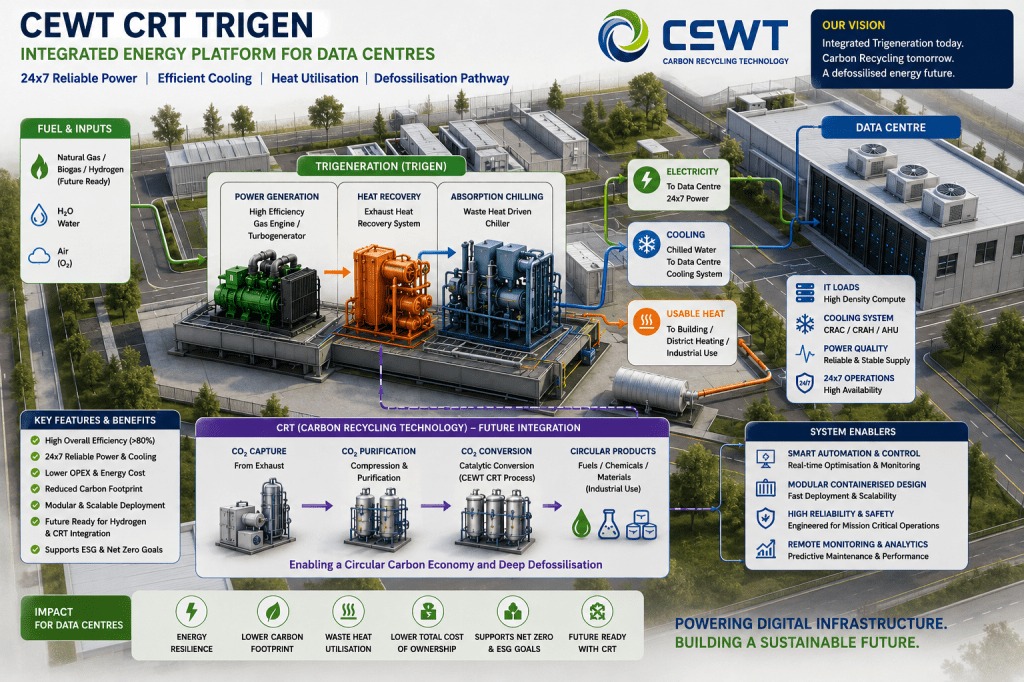
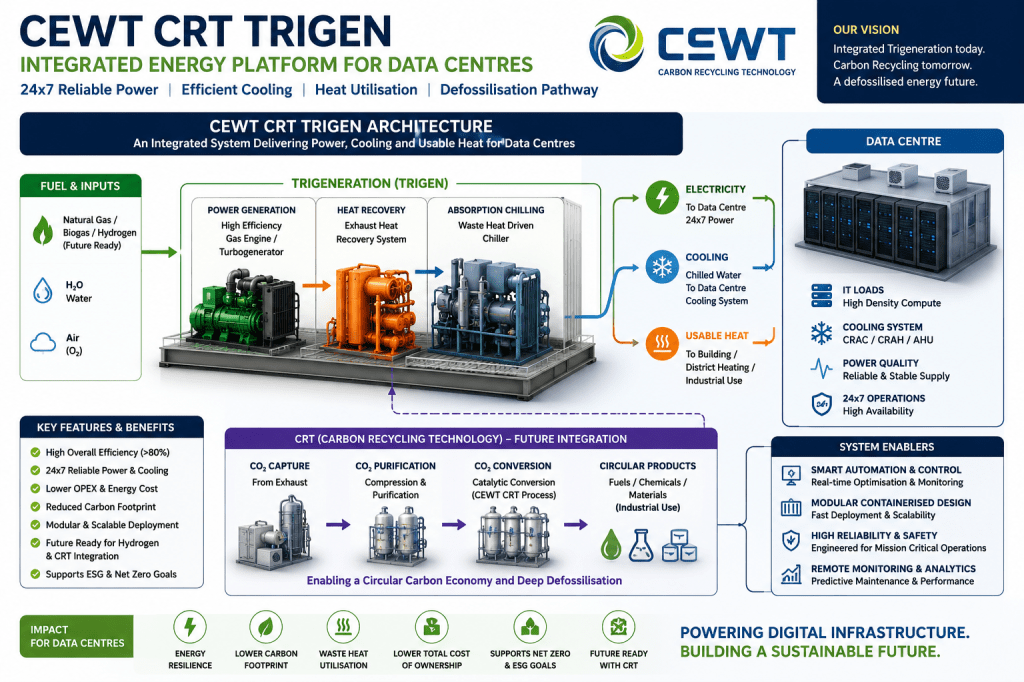
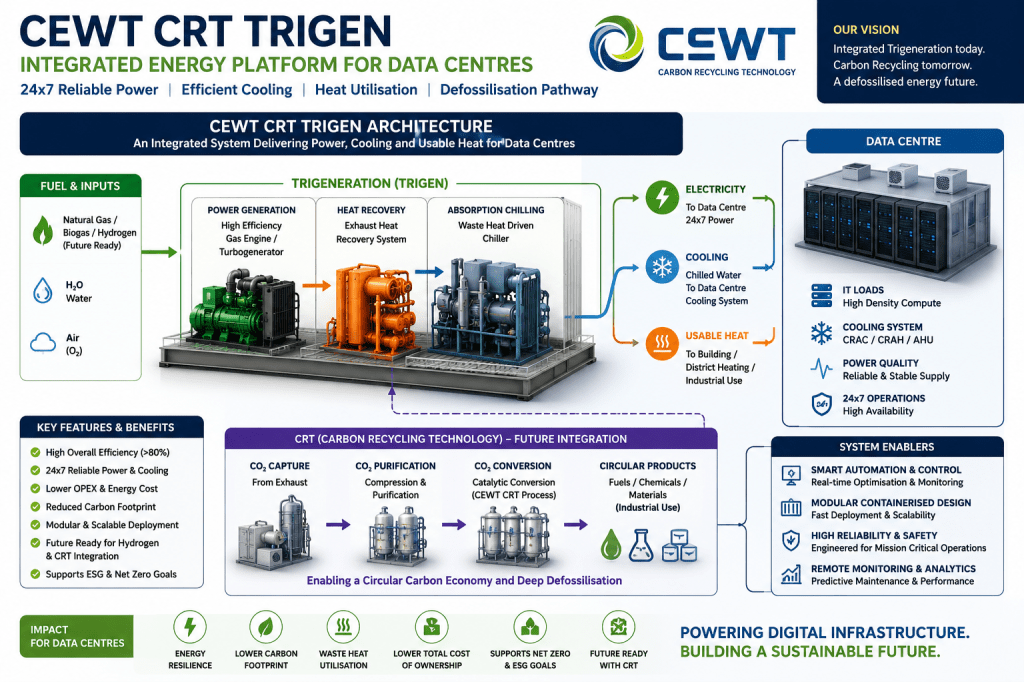
At CEWT, we have now completed the integrated engineering basis for the CEWT TriGen-CRT platform — a modular integrated energy architecture designed for:

  • continuous power generation
  • waste-heat recovery
  • absorption cooling
  • advanced automation
  • modular deployment
  • and future CRT-based defossilisation pathways.

The objective is not simply “lower emissions.”

The objective is:
24×7 industrial operation with a structured pathway toward defossilised infrastructure.

Importantly, the pilot platform is not intended merely as a demonstration unit.

It is intended as:
An operational proof-of-integration platform capable of supporting future commercial-scale deployment for data centres and industrial infrastructure.

The future of the transition may depend less on isolated technologies —
and more on how intelligently entire infrastructure systems are integrated.

The transition is not only electrical.

It is architectural.

DataCentres #EnergyInfrastructure #Trigeneration #Defossilisation #CRT #Cooling #AIInfrastructure #EnergyTransition #Infrastructure #CEWT

One of the biggest misconceptions in the energy transition is that the challenge is simply generating more renewable electricity.

Increasingly, the real challenge is:

  • infrastructure integration
  • 24×7 reliability
  • cooling
  • resilience
  • lifecycle engineering
  • and industrial continuity.

This is becoming especially visible in the rapid growth of AI and hyperscale data centres.

Data centres do not operate on “average” power.
They operate on continuous infrastructure reliability.

That changes the engineering equation.

At CEWT, we have now completed the integrated engineering basis for the CEWT TriGen-CRT platform — a modular integrated energy architecture designed for:

  • continuous power generation
  • waste-heat recovery
  • absorption cooling
  • advanced automation
  • modular deployment
  • and future CRT-based defossilisation pathways.

The objective is not simply “lower emissions.”

The objective is:
24×7 industrial operation with a structured pathway toward defossilised infrastructure.

Importantly, the pilot platform is not intended merely as a demonstration unit.

It is intended as:
An operational proof-of-integration platform capable of supporting future commercial-scale deployment for data centres and industrial infrastructure.

The future of the transition may depend less on isolated technologies —
and more on how intelligently entire infrastructure systems are integrated.

The transition is not only electrical.

It is architectural.

DataCentres #EnergyInfrastructure #Trigeneration #Defossilisation #CRT #Cooling #AIInfrastructure #EnergyTransition #Infrastructure #CEWTEWT TriGen-CRT platform — a modular integrated energy architecture designed for:

Clean Energy and Water Technologies Pty Ltd (CEWT) is now exploring opportunities to support data centres in Australia and overseas through integrated trigeneration systems.

By combining:
• Electricity generation
• Process heat recovery
• Absorption chilling for cooling

CEWT aims to help data centres improve overall energy efficiency while reducing emissions and dependence on conventional grid-only architectures.

Our broader vision is to integrate advanced carbon recycling and circular energy pathways into future industrial and digital infrastructure.

As the industry evolves, system architecture and energy continuity will become increasingly important.

We welcome discussions with:
• Data centre developers
• Industrial parks
• Energy infrastructure partners
• Investors and strategic collaborators

#DataCentres #Trigeneration #EnergyTransition #Cooling #DigitalInfrastructure #IndustrialDecarbonisation #CircularEconomy #CRT #CEWT #Australia

From Net Zero to Defossilisation: Rethinking the Energy Transition

For decades, the global energy transition has been framed around a single objective: Net Zero.

It is a powerful goal. It has mobilised governments, industries, and capital at unprecedented scale. Yet, as we move deeper into implementation, a critical question is emerging:

👉 Are we solving the problem—or managing its symptoms?

## The Limitation of Net Zero

Net Zero, by definition, allows for continued emissions—provided they are balanced by offsets or removals.

In practice, this has led to:

– Continued dependence on fossil fuels 

– Increasing reliance on carbon credits and offsets 

– Complex accounting frameworks that often obscure physical realities 

While these mechanisms may reduce reported emissions, they do not fundamentally change the structure of our energy systems.

We are still operating within a linear model:

> Extract → Burn → Emit → Offset

## A Shift in Perspective: From Accounting to Systems

The energy transition is not just a challenge of replacing fuels. It is a challenge of redesigning systems.

If we step back, the core issue becomes clear:

> Carbon is not inherently the problem. 

> The problem is how we use—and lose—it.

In natural systems, carbon is continuously cycled. In industrial systems, it is extracted, used once, and discarded.

## Introducing Defossilisation

Defossilisation goes beyond Net Zero.

It is not about balancing emissions. 

It is about eliminating dependence on fossil inputs altogether.

The objective shifts from:

– Reducing emissions 

to 

– Redesigning systems so emissions no longer exist as waste

## Carbon as a Carrier, Not a Liability

At the heart of defossilisation is a simple but powerful idea:

> Carbon can function as a reusable energy carrier.

Instead of releasing CO₂ into the atmosphere, it can be:

– captured 

– combined with renewable hydrogen 

– converted into fuel 

– and reused within the system 

This creates a closed-loop energy cycle, where carbon continuously circulates rather than accumulates.

## The Role of Carbon Recycling Technology (CRT)

Carbon Recycling Technology (CRT) is designed around this principle.

Rather than treating CO₂ as an endpoint, CRT:

– captures CO₂ from industrial processes 

– converts it into renewable methane (RNG) 

– reintroduces it as fuel for power and heat 

The result is a self-reinforcing loop:

> CO₂ → Fuel → Energy → CO₂ → Fuel

In this model:

– Carbon is retained within the system 

– Fossil fuel input is progressively eliminated 

– Energy reliability is maintained 

## Why This Matters for Heavy Industry

Sectors such as:

– steel 

– cement 

– refining 

cannot rely solely on intermittent renewables or direct electrification.

They require:

– continuous energy 

– high-temperature heat 

– stable fuel supply 

Defossilisation through carbon recycling offers a pathway that:

– integrates with existing infrastructure 

– avoids full system replacement 

– maintains industrial continuity 

## Beyond Technology: A New Framework for Value

Moving toward defossilisation also requires a shift in how we measure progress.

Traditional metrics such as GDP or even emissions intensity do not capture:

– system resilience 

– energy security 

– long-term sustainability 

The next phase of the transition must focus on:

– system performance 

– circularity 

– resource efficiency

## From Transition to Transformation

The energy transition is often described as a process of substitution—replacing one fuel with another.

Defossilisation represents something deeper:

> A transition from linear consumption to circular systems.

It is not about choosing between:

– hydrogen or batteries 

– renewables or fuels 

It is about integrating them into coherent, closed-loop systems.

## Conclusion

Net Zero has been an essential starting point.

But as we confront the realities of implementation, it is becoming clear that balancing emissions is not enough.

The long-term solution lies in redesigning how energy systems function—so that:

– Carbon is no longer wasted 

– fossil inputs are no longer required 

– and industrial systems can operate sustainably without compromise 

> Defossilisation is not just an environmental goal. 

It is a systems transformation.

And technologies that enable carbon to circulate—rather than accumulate—may well define the next chapter of the global energy transition.

Ahilan Raman 

Managing Director 

Clean Energy and Water Technologies Pty Ltd (CEWT)

“Carbon is not the problem. Linear thinking is.”