Skip navigation

Category Archives: Clean energy

Clean Energy and Water Technologies Pty Ltd (CEWT)

ABN 61 691 320 028 | ACN 691 320 028

Technology Note

Why Carbon Recycling Technology (CRT) Is Structurally Superior for Green Iron Production

Date: March 2026

Prepared for: Government agencies, investors, industrial partners


Overview

Carbon Recycling Technology (CRT) enables zero-emission iron production by combining hydrogen-rich syngas reduction with a closed carbon loop.

Unlike hydrogen-only pathways that require large new infrastructure and massive electrolysis capacity, CRT preserves the proven gas-based reduction chemistry used in Direct Reduced Iron (DRI) systems while eliminating net carbon emissions.

This approach allows the transition to green iron production using existing industrial infrastructure with significantly lower energy and hydrogen requirements.


1. Uses Proven Gas-Based Iron Reduction Chemistry

CRT reduces iron ore using hydrogen-rich syngas (CO + H₂) generated through steam reforming.

This is the same fundamental chemistry used in natural-gas-based DRI processes such as those deployed globally by Midrex.

Advantages

  • Proven shaft-furnace technology
  • Established reduction kinetics
  • Mature industrial operating experience
  • Reduced technical risk

CRT therefore builds on existing metallurgical practice rather than introducing an entirely new process.


2. Achieves Zero Emissions Through Carbon Recycling

In conventional natural-gas DRI:

Natural Gas → Reduction → CO₂ released to atmosphere

In CRT:

Natural Gas / RNG → Reduction → CO₂ captured → recycled → Renewable Natural Gas (RNG)

The carbon atom, therefore, circulates continuously within the system, acting as a recyclable carrier rather than being emitted.

This closed molecular loop allows CRT to achieve net-zero emissions without eliminating carbon from the process chemistry.


3. Dramatically Lower Hydrogen Requirement

Hydrogen-only ironmaking requires hydrogen to supply both:

  • the reducing gas, and
  • the energy source for the process

This results in very large electrolysis capacity requirements.

CRT instead uses hydrogen-rich syngas, with only a small renewable hydrogen trim required to maintain the carbon recycling loop.

Benefits

  • significantly smaller electrolysers
  • lower renewable electricity demand
  • reduced hydrogen storage requirements
  • improved economic feasibility

4. Compatible With Existing Industrial Infrastructure

Hydrogen-only steelmaking requires major changes to industrial systems, including:

  • new hydrogen production infrastructure
  • new fuel supply networks
  • modified furnaces and process systems

CRT maintains compatibility with existing infrastructure, including:

  • gas reforming systems
  • DRI shaft furnaces
  • gas handling and distribution networks
  • high-temperature industrial heat systems

This allows decarbonisation to proceed faster and at lower capital cost.


Structural Advantage of CRT

Traditional decarbonisation approaches attempt to remove carbon from industrial energy systems.

CRT instead recycles carbon as a molecular energy carrier, while renewable hydrogen provides the incremental energy required to maintain the loop.

This architecture preserves the thermodynamic advantages of carbon-based fuels while eliminating net emissions.


Conclusion

Carbon Recycling Technology provides a practical pathway for green iron production by combining:

  • proven gas-based reduction chemistry
  • closed-loop carbon recycling
  • minimal hydrogen requirements
  • compatibility with existing infrastructure

This system architecture enables heavy industry to transition toward zero-emission production while maintaining operational reliability and economic viability.
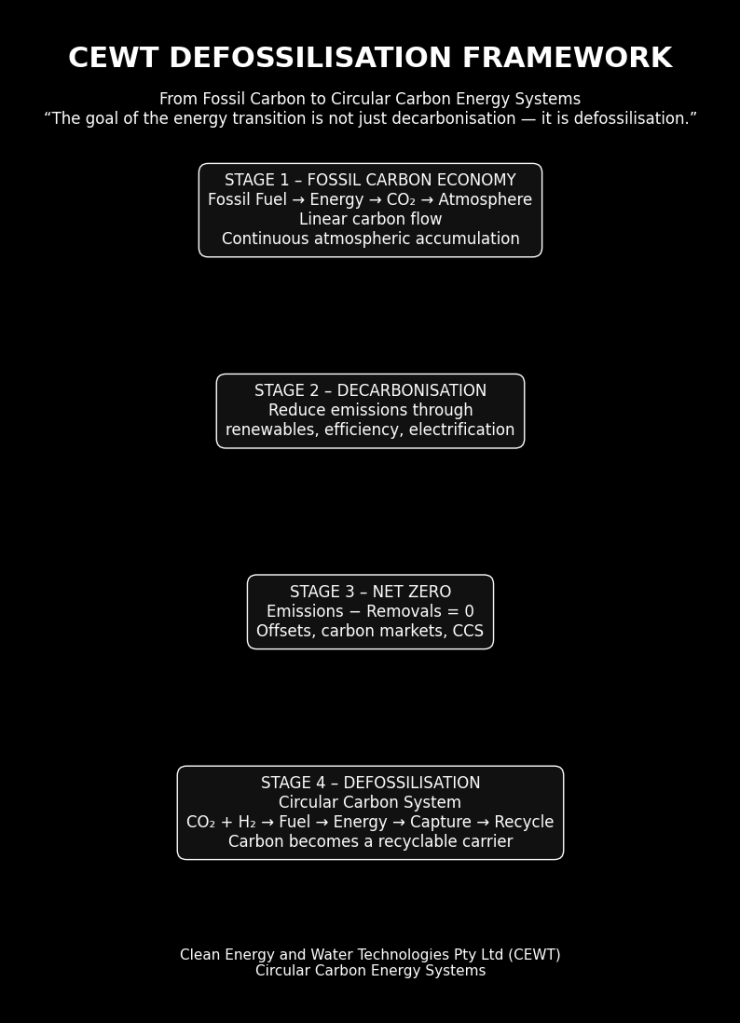
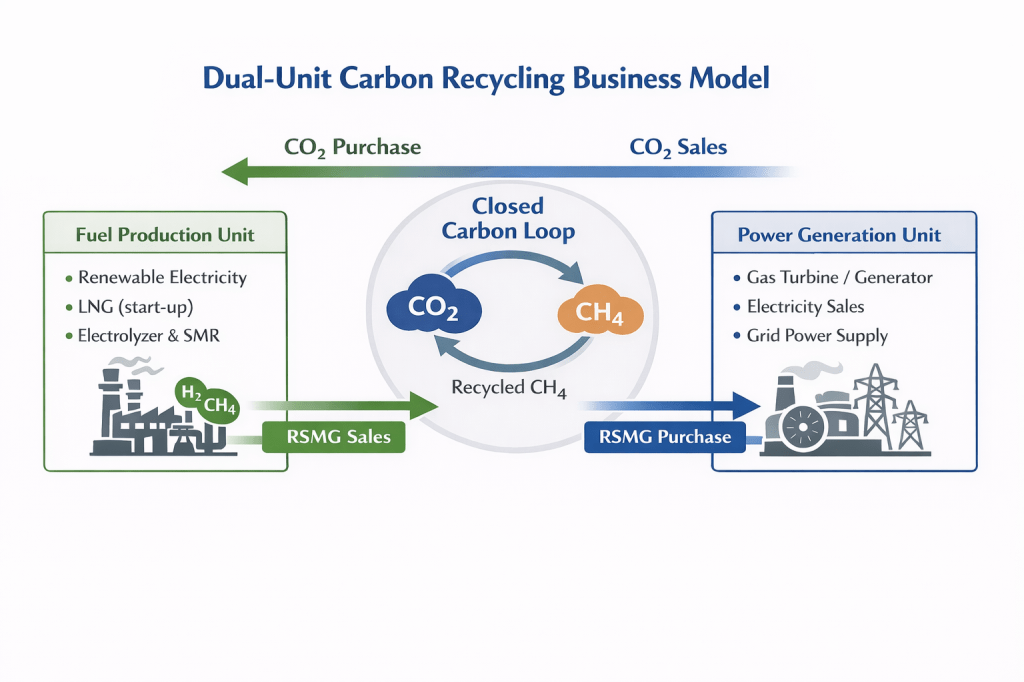
Net Zero Balances Carbon. Carbon Circulation Eliminates the Problem.

Suggested LinkedIn headline

Net Zero balances carbon.

Carbon Circulation prevents the problem in the first place.


LinkedIn Post Text

For more than a decade, climate policy has focused on Net Zero.

The idea is straightforward:

Emit CO₂ → Remove CO₂ → Balance the equation.

This framework has mobilised governments, corporations and investors around the world. But fundamentally, Net Zero is an accounting approach. It assumes emissions will occur and must later be offset, captured, or removed.

A different approach is possible.

Instead of balancing emissions after they occur, we can design energy systems where carbon never becomes waste in the first place.

This is the principle behind Carbon Recycling Technology (CRT).

In CRT systems, captured CO₂ is combined with renewable hydrogen to produce renewable methane.

When methane is used for power generation or industrial energy, the resulting CO₂ is captured and recycled back into the system.

Carbon atoms, therefore, circulate continuously within the energy system.

Carbon becomes a recyclable carrier of energy, while renewable hydrogen provides the energy input that drives the cycle.

This shifts the conversation from:

Carbon accounting → Carbon system design

Instead of managing emissions after they occur, circular carbon systems prevent them at the source.

The next phase of the energy transition may therefore not simply be about achieving Net Zero.

It may be about building circular carbon energy systems.


Clean Energy and Water Technologies Pty Ltd (CEWT)

Advancing circular carbon energy systems for a resilient and sustainable future.


#CircularCarbon

#CarbonRecycling

#EnergyTransition

#Decarbonisation

#CleanEnergy

#NetZero

#EnergySystems

#IndustrialDecarbonisation

Carbon Recycling Technology

Recently I filed a preliminary patent application on ‘decarbonisation’.
It is a holistic process that uses only seawater and sun to generate a base load power with zero emission using the principle of ‘circular economy’. Somebody asked me to explain this technology in a lay man’s language. It is similar to an example what I explained as follows:
Let me explain in a lay mans’s language. Imagine you fill your car with 50 lit  petrol and go on a trip. The petrol is a Hydrocarbon (chemical term).Suppose I fit a small equipment on the exhaust pipe of your car which will collect the exhaust gases in a liquid form and collect it. When you finish your trip you can remove that equipment which collected your exhaust in a liquid form and hand over to a small processing unit on the road side. The processing unit will convert that exhaust  liquid into Petrol once agin. You can fill your car with this new petrol and also fit your car with new exhaust collector and return back to your destination. It means there is a zero emission from your car. You need not convert your car into electric or do any modification at all. You don’t have to fill your car with new petrol. It is called CRT (carbon recycling technology). It means you don’t need any petrol at all except for the initial filling. Even that can be eliminated by extracting Carbon from sea water and synthesising a Carbon negative Petrol. No pollution at all because of zero emissions. It simply uses the same Carbon atom again and again by substituting the ‘fossil hydrogen’ with’ renewable hydrogen’ with absolutely no emissions. It fulfils all the requirement of a ‘circular economy’ and a Carbon -free atmosphere. What is unique about this technology is it derives Carbon from seawater (where CO2 has already been absorbed from industrial emissions) and converting into Carbon negative synthetic fuel (unlike Carbon neutral synthetic fuels which are made from CO2 emissions that encourages continuous usage of fossil fuels) with cleaner properties. An Oxy combustion will make it a unique fuel of the future. Our current focus is to generate a base load power(24 x7) without any energy storage at all. It is the only technology in the world that generates a base load power (24 x 7) and synthetic fuels such as aviation fuel, marine fuel, petrol, diesel and CNG using only Sun/wind and Seawater.

Is this your new site? Log in to activate admin features and dismiss this message
Log In