Skip navigation

This is not an oil crisis.

It’s something deeper — and far more structural.

It’s an energy system failure.


For decades, energy systems were built on a simple assumption:

Demand is predictable. Supply is controllable.

That world no longer exists.


Today, three forces are colliding:

AI is turning electricity into continuous demand

🌬️ Renewables are inherently intermittent

🔋 Storage is still short-duration

Individually, each works.

Together, they create instability.


We are now facing a mismatch that the system was never designed for:

  • Demand is becoming time-dependent and continuous
  • Supply is becoming variable and weather-driven

And we are trying to bridge that gap with incremental fixes.

More renewables.

More batteries.

More transmission.


But here’s the uncomfortable truth:

You cannot solve a structural problem with incremental solutions.


This is why the conversation around energy is starting to shift — quietly, but fundamentally.

From technology → to system architecture


At Clean Energy and Water Technologies (CEWT), we’ve been working on this problem from a different angle.

Not just how to generate clean energy.

But how to reshape energy so it behaves like the system needs it to.


Because the real challenge is not producing energy.

It is aligning energy with time.


This is where Carbon Recycling Technology (CRT) comes in.

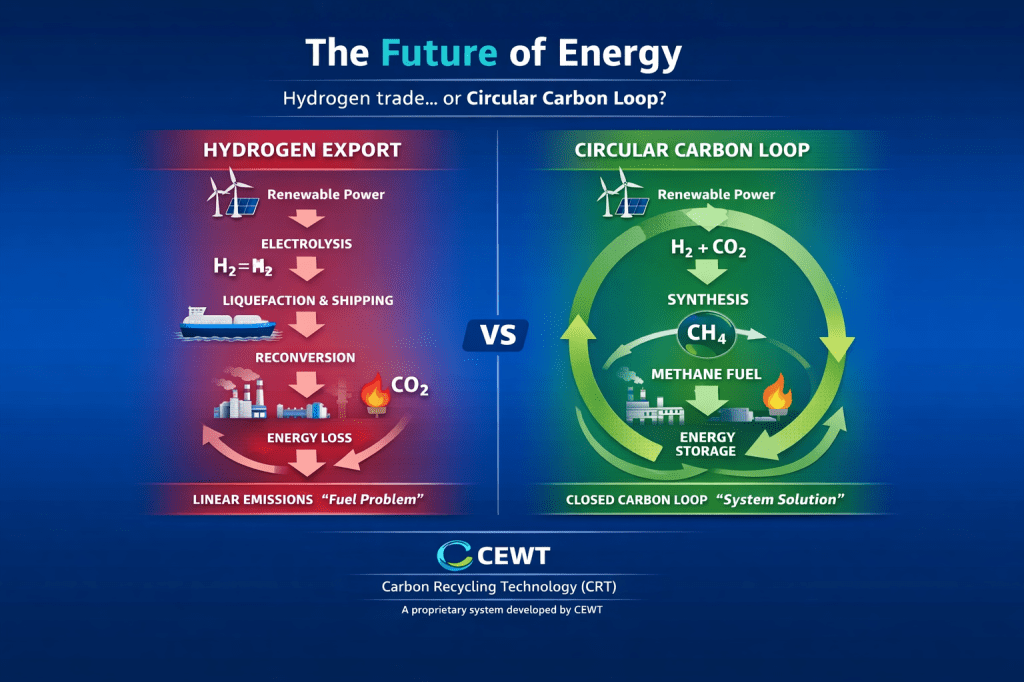
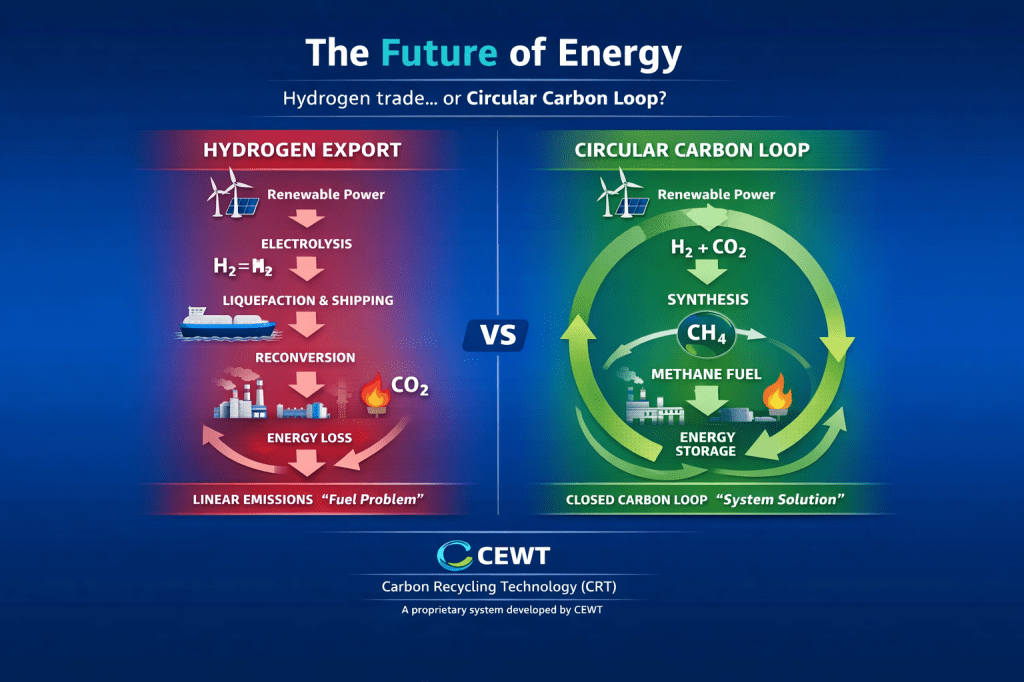
  • Renewable electricity is converted into hydrogen
  • Hydrogen combines with captured CO₂
  • The result is renewable methane (RNG) — a storable, dispatchable energy carrier

And when used, the CO₂ is captured and recycled again.


Carbon is no longer a liability.

It becomes a carrier.


This changes the equation:

Instead of forcing demand to follow supply,

Supply is reshaped to follow demand.


And that is the missing layer in today’s energy transition.


We are not just transitioning energy.

We are redesigning the system that carries it.


AI, industry, and global electrification are accelerating this reality.

The question is no longer whether change is needed.

It is whether we continue to optimise the old system —

or build the one that actually works.


There is no shortcut.

Closing the carbon loop is the only real path to defossilisation.


#EnergyTransition #AI #EnergySystems #Hydrogen #Decarbonisation #CRT #CEWT
Clean Energy and Water Technologies Pty Ltd (CEWT)

Energy Systems Insight Note
AI Load vs Grid Reality — A System Architecture Perspective

1. The Emerging Mismatch

Artificial Intelligence (AI), particularly at inference scale, introduces a new category of electricity demand.

While AI models are often evaluated based on efficiency per computation, the electrical grid experiences demand differently.

The grid sees:
• Continuous load accumulation over time 
• Cumulative demand from distributed inference 
• Persistent, baseload-like pressure 

Model efficiency is instantaneous — grid stress is time-integrated.

2. Why This Matters

As AI adoption accelerates, inference workloads behave like:
• Always-on services 
• Globally distributed compute 
• Latency-sensitive operations 

AI is no longer a discrete load. It becomes a continuous system force shaping demand.

3. Limits of Current Approaches

Current responses include:
• Time-of-use pricing 
• Real-time markets 
• Location-based signals 
• Limited workload shifting 

But these are incremental. The structural imbalance remains:

Renewables → intermittent 
Batteries → short-duration 
AI demand → continuous 

Pricing alone cannot solve this.

4. The System Architecture Shift

The next phase requires integrated system design.

CEWT’s Carbon Recycling Technology (CRT):
• Converts renewable electricity into renewable gas 
• Stores energy in molecular form 
• Dispatches energy when required 

This enables long-duration storage and demand-aligned supply.

5. Reframing the Problem

Instead of aligning demand to supply:

We must reshape supply to follow demand.

This is essential for AI-scale energy systems and industrial decarbonisation.

6. The Strategic Fork

Path 1: Incremental expansion 
• More renewables, storage, transmission 

Path 2: Architectural integration 
• Electrons + molecules 
• Long-duration storage 
• Demand-responsive systems

7. Conclusion

AI is not just a load — it is a system-shaping force.

It will either stress existing infrastructure or drive a transition toward integrated energy systems.

The outcome depends on whether we optimise incrementally or redesign fundamentally.


CEWT — Advancing Carbon Recycling Technology for integrated, dispatchable, zero-emission energy systems.

🌐 CEWT Foundation Series

CRT: ESG as an Engineered System

Most ESG today is treated as a reporting framework—

metrics, disclosures, and compliance.

But what if ESG was not something you report…

👉 But something you build into the system itself?

At CEWT, this is the foundation of Carbon Recycling Technology (CRT).


🔷 CRT is not just a technology.

👉 It is an ESG playbook—engineered into reality.


🟢 E — Environmental

Closed carbon loop

No new fossil input

Carbon is recycled, not emitted

🔵 S — Social

Energy security

Industrial continuity

Reliable, dispatchable power for real economies

⚙️ G — Governance

System-level transparency

Measurable inputs and outputs

No reliance on offsets—only physical accountability


👉 This is the shift:

From ESG as disclosure

To ESG as design

From targets and reporting

To systems that inherently deliver outcomes


🌱 CRT transforms ESG from a framework into an operating system.

Not theoretical.

Not aspirational.

But engineered, verifiable, and scalable.


#CEWT #CRT #ESG #Defossilisation #EnergyTransition #SystemThinking #NetZero #CleanEnergy

1. The Context

Billions have already been invested in hydrogen. Only now are we asking whether the fundamentals actually work.
The challenge is not just economic or technological. It is rooted in thermodynamics.

2. The Scientific Foundation

Hydrogen is not a primary energy source. It is a high-Gibbs-free-energy molecule.
This means energy must be supplied to produce it (via electrolysis), and losses are inevitable when converting it back into usable energy.
These losses are not due to immature technology—fundamental thermodynamic limits govern them.

3. The Core Mistake

The industry has made a category error by treating hydrogen as:
• A fuel
• A traded commodity
• An export vector

However, physics supports hydrogen primarily as:
• A reactive intermediate
• A system-integrated molecule

When used outside this role, inefficiencies become unavoidable.

4. Why Carriers Do Not Solve the Problem

Hydrogen carriers such as ammonia, LOHCs, and e-fuels introduce additional conversion steps.
Each step adds entropy, energy loss, and capital cost.

This does not solve hydrogen’s limitations—it compounds them.

5. The System Perspective

The challenge is not hydrogen itself, but where it is placed within the energy system.
When used as a traded fuel, it struggles.
When used within a closed, integrated system, its performance improves significantly.

6. Conclusion

Hydrogen is not a dead end. But it is misapplied in current energy strategies.

The real breakthrough will not come from better hydrogen technologies alone.
It will come from better system design—placing hydrogen where thermodynamics actually supports it.

We do not have a hydrogen problem.
We have a system design problem misunderstood as a fuel problem.

After a month’s pause, this series returns at a time when the intersection of energy security and water scarcity has never been more critical.


Green hydrogen is often presented as a solved pathway:
scale it, subsidize it, deploy it.


But engineering reality tells a different story.

Hydrogen is not just another fuel.
It is the smallest molecule in the universe, with properties that challenge materials, infrastructure, economics, and even system design itself.


Six Realities Often Overlooked

• The trillion-dollar subsidy gap required for global scale

• Materials challenges, including embrittlement in pipelines and storage systems

• Energy penalties across conversion, compression, and transport

• The water–energy nexus, often ignored in deployment strategies

• Infrastructure mismatch with existing hydrocarbon-based systems

• The atomic reality that makes hydrogen both powerful — and problematic


Beyond the Narrative

The goal is not to dismiss hydrogen. It is to place it within its true engineering and economic context.

Because the energy transition is not driven by headlines — it is governed by systems, constraints, and thermodynamics.

Are we designing energy systems around electrons alone — or are we overlooking the critical role of molecules?


CEWT Perspective

At Clean Energy and Water Technologies (CEWT), we believe the future is not about choosing between electrons and molecules.

It is about designing systems where both coexist — in balance, in continuity, and in alignment with physical reality.


Series Note

This is Article 2 of a 12-part monthly series exploring the realities behind energy transition technologies — beyond headlines and hype.

Is this your new site? Log in to activate admin features and dismiss this message
Log In