Skip navigation

xraymike79's avatarCollapse of Industrial Civilization

An astute reader has directed me to a couple of brilliant, just-released videos done by David Wasdell (produced by Envisionation) which bring into focus the rapid changes that are occurring in the Arctic and what the horrific implications are for the rest of the planet. I have watched both videos and posted an abbreviated version of them below. The original transcript of the two videos is here. We can see that even the worse case scenarios plotted by mainstream climate models have grossly underestimated what is happening in the Arctic. As Mr. Wasdell states, “The Arctic… is the fastest moving response to global warming and climate change anywhere on the planet.”

One of the reasons for the Arctic’s rapid temperature increase is that it is not being shielded by industrial pollutants that once came from the Northern Hemisphere. The aerosol effect is now coming primarily from the burning of poor…

View original post 2,046 more words

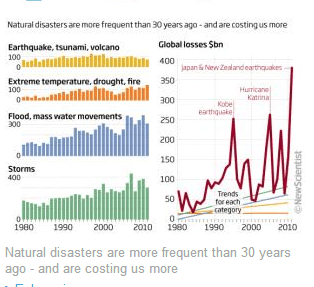
The climate is changing with increasing global warming caused by man-made Carbon emission. The economic impact of global warming can no longer be ignored by Governments around the world because it is impacting their budget bottom lines. Weather is becoming unpredictable. Even if Meteorological department predicts a disaster 24 hrs in advance, there is nothing Governments can do to prevent human and economic losses within a short span of time but evacuate people to safety leaving behind all their properties. Governments are forced to allocate funds for disaster management every year caused by severe draughts, unprecedented snow falls, and coastal erosion by rising sea levels, flash flooding, inundation and power black outs. We often hear people saying,” we were completely taken by surprise by this event and we have never seen anything like this in the last 50 years” after every naturals disasters explaining the nature and scale of disasters. Nature is forcing Governments to allocate more funds for disaster managements and such allocations have reached unprecedented levels. The cost of natural disasters around the world in 2011 was estimated at $ 400 billion and in 2012 it was estimated at $160 billion. The only way to fund these disasters is to tax Carbon pollution which causes global warming. Countries should take long-term decisions that will save their current and future generations to come.  They should understand how Carbon is emitted and what the best way to curb such emissions is. It is a global issue and its requires a collective solution.  There is no use of pricing Carbon when economic recession can jeopardize the pricing mechanism? Global warming is a moral and social issue and not just an economic issue.

Developed countries have emitted bulk of the Carbon since industrial revolution while developing countries such as India and China were emitting less carbon in spite of their vast population due to their lowest per capita consumption. But that trend has now changed with rapid industrialization and economic growth of India and China and other developing economies. Australia is still a leading emitter of Carbon in the world in spite of their low population because of their high energy consumption, availability of cheap and high quality Coal and increasing mining, industrial and agricultural activities. That is why Australia is one of the first few countries who introduced Carbon tax while rest of the countries is still debating about it. Now it is clear that Carbon emission is directly proportional to industrial, economic and population growth of a country and it can be easily quantified based on the growth rate of each country. It is time countries agree to cut their Carbon emissions to sustainable levels with a realistic Carbon pricing mechanism and sign a world-wide treaty through UN.

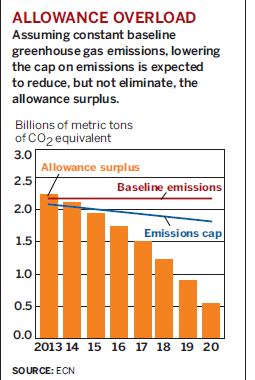
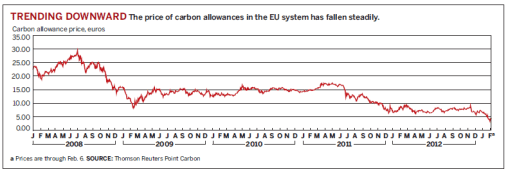
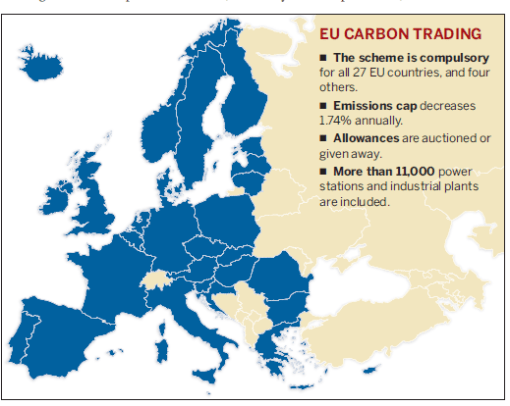
“THE EUROPEAN UNION carbon emissions trading scheme—the biggest in the world and the heart of Europe’s climate- change program—is in dire straits. The scheme’s carbon price has collapsed. The primary reason: The economic recession has suppressed manufacturing, thereby reducing emissions and creating a huge over- supply of carbon emissions allowances. Carbon trading is a market approach to reducing greenhouse gas emissions in which each facility involved is given an emissions cap for the year, and each year that cap is reduced. A firm must record and report its facilities’ emissions and must obtain allowances for its total emissions. An allowance permits a facility to emit 1 metric ton of carbon dioxide or its carbon equal; some allowances are given for free by the government, others can be bought at auction or from other firms. If a facility exceeds its cap, the company operating it has options: It can cut emissions, buy allowances from other companies, or get allowance offsets by reducing emissions at another pollution source. The cost of an allowance is referred to as the car-bon price and is driven by market conditions such as supply and demand. If the low-carbon price continues, the region’s ability to meet long-term reduction targets for greenhouse gas emissions will be severely hampered because the trading scheme will fail to provide money for clean-tech programs and incentive for manfacturers to adopt cleaner technologies. The trading scheme is a key component of the EU’s climate-change strategy because about 40% of all greenhouse gases emit-ted in the region fall under EU’s control. The mandatory scheme applies to 11,000 industrial installations, including power plants and major chemical facilities, across all 27 member states, as well as in Croatia, Iceland, Liechtenstein, and Norway. The aviation sector has been included in the scheme, but its active participation has been deferred to allow for an international agreement on aviation emissions, which is expected to be concluded in the fall. The goal of the European Commission, the EU’s administrative body and the architect of the emissions trading scheme, is to reduce all greenhouse gas emissions by 20% from 1990 levels by 2020. To contribute toward this goal, the trading scheme has targeted a 21% cut in the emissions of participating sectors by 2020 from a 2005 baseline. In recent weeks, however, the EU carbon price dropped to a new low of $5.20 for each metric ton allowance of CO2, down from a high of $23 in 2011. This is despite an annual reduction of the EU emissions cap of 1.74% through 2020 and the introduction on Jan. 1 of a new phase of the scheme requiring companies to purchase allowances. AT ITS CURRENT carbon price, the EU emission scheme’s role in encouraging chemical firms to ditch fossil fuels and adopt greener technologies “is meaningless,” says André Veneman, director of sustainability at AkzoNobel. Many of the industry’s investments in low-carbon technologies that are marginally financially viable also will likely be delayed, he says. Without a strong carbon price, the underlying push to clean-tech in the EU will come only from the price of oil, Veneman adds. Veneman and other experts say that a carbon price of between $68 and $135 is required if industry as a whole is to be forced to shift onto a new low-carbon footing. Yvo de Boer, special global adviser for climate change and sustainability for KPMG—an audit, tax, and advisory firm—and form EUROPEAN SCHEME IS IN FREE FALL Record-low CARBON PRICE threatens to derail transition away from fossil fuels and ability to meet climate-change targets.” Source: EUROPEAN SCHEME IS IN FREE FALL Record-low CARBON PRICE threatens to derail transition away from fossil fuels and ability to meet climate-change targets ALEX SCOTT, C&EN LONDO

The burden of Carbon tax should be borne by both power generators as well as consumers. Even if the Carbon tax is imposed on emitters it will eventually be passed on to consumers. Either way the cost of energy will increase steeply or there is no way to avoid such escalation if we want to keep up our power consumption levels or our current life style. In other words people will have to pay penalty for polluting the air either by generating or consuming power that causes Carbon pollution. All developed countries that have polluted the atmosphere with Carbon emission should be taxed retrospectively from the time of industrial revolution so that emerging countries need not bear the full cost of global warming. Such a fund should be used for developing renewable and clean energy technologies or to purchase Carbon allowances. Current mechanism of Carbon pricing does not penalize countries who caused the global warming in the first place for hundreds of years but penalizes only countries who now accelerate the rate of Carbon emission. Such an approach is a gross injustice on the emerging economies and not at all pragmatic. Most of the developed countries are currently facing economic recession resulting in plummeted Carbon price. This will only encourage existing Carbon emitters to emit Carbon cheaply and penalize Renewable energy and clean energy technologies with higher tariffs and drive them to extinction. In spite of Carbon level in the atmosphere exceeding 400 ppm according to the latest report, the world is helpless to cut the Carbon emission anytime sooner making our planet vulnerable to catastrophic natural disasters. Countries that are reluctant to pay Carbon tax will pay for Natural disasters which may be many times costlier than Carbon tax. Countries like US, European Union, Japan, Australia the largest power consumers and countries like Saudi Arabia, Russia, Venezuela, Iran, Iraq, Libya the largest oil producers should bear the cost of Carbon pollution that caused the globe to warm sine industrial revolution. Such a fund should be used in developing innovative Renewable energy and clean energy technologies of the future. More than anything else the rich and powerful countries should declare global warming as a moral issue of the twenty-first century and take some bold and hard economic decisions to save the planet earth..Allowance overloadCarbon pricing downward trendcost of Natural disatersEU carbon trading


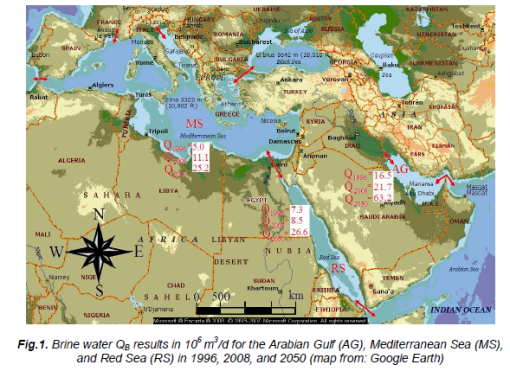
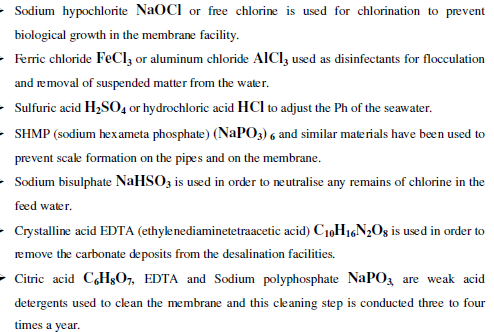
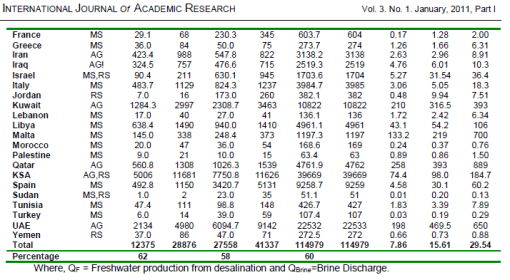
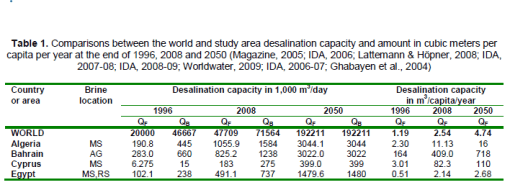
Brine dischage in Gulfchemical usage in desalinationDesal capacityDesalination capacity in the worldsalinity levels in Gulf regionwater cycle

Water and energy are two critical issues that will decide the future of humanity on the planet earth. They determine the security of a nation and that is why there is an increasing competition among nations to achieve self-sufficiency in fresh water and clean energy. But these issues are global issues and we need collective global solutions. In a globalised world the carbon emission of one nation or the effluent discharged into the sea from a desalination plant changes the climate of the planet and affects the entire humanity. It is not just a problem of one nation but a problem of the world. The rich and powerful nations should not pollute the earth, air and sea indiscriminately, hoping to achieve self-sufficiency for themselves at the cost of other nations.  It is very short-sighted policy. Such policies are doomed to fail over a time. Next generation will pay the price for such policies. Industrialised countries and oil rich countries should spend their resources on research and development than on weapons and invent new and creative solutions to address some of the global problems such as energy and water. With increasing population and industrialisation the demand for energy and water is increasing exponentially. But the resources are finite. It is essential that we conserve them, use them efficiently and recycle them wherever possible so that humanity can survive with dignity and in peace. It is possible only by innovation that follows ‘Nature’s path.

The earth’s climate is changing rapidly with unpredictable consequences .Many of us are witnessing  for the first time in our lives unusual weather patterns such as  draughts, flash flooding,  unprecedented   snow falls, bush fires, disease and deaths. Although we consider them as natural phenomena there is an increasing intensity and frequency that tells us a different story. They are human induced and we human beings cause these unprecedented events. When scientists point out human beings cause the globe to warm there were scepticism. We never believed we were capable of changing the entire weather system of the globe.

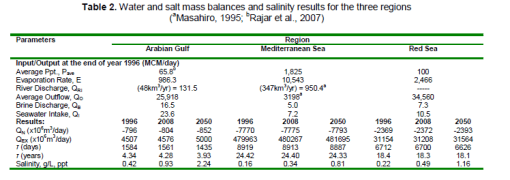
We underestimate our actions. By simply discharging effluent from our desalination plants into the sea, can we change the salinity of the ocean or by burning coal can we change the climate of the world? The answer is “Yes” according to science. Small and incremental pollution we cause to our air and water in everyday life have dramatic effects because we disturb the equilibrium of the Nature. In order to restore the equilibrium, Nature is forced to act by changing the climate whether we like it or not.

Nature always maintains“equilibrium” that maintains perfect balance and harmony in the world. If any slight changes are made in the equilibrium by human beings then Nature will make sure such changes are countered by a corresponding change that will restore the equilibrium. This is a natural phenomenon. The changes we cause may be small or incremental but the cumulative effect of such changes spanning hundreds of years will affect the equilibrium dramatically.

We depend on fossil fuels for our energy needs. These fossils were buried by Nature millions of years ago. But we dig deep into the earth, bring them to surface and use them to generate power, run our cars and heat our homes. Our appetite for fossil fuels increased exponentially as our population grew. We emitted Carbon into the atmosphere from burning fossil fuels for hundreds of years without many consequences. But the emissions have reached a limit that causes a shift in Nature’s equilibrium and Nature will certainly act to counter this shift and the consequences are changes in our weather system that we are now witnessing. The only way to curtail further Carbon emission into the atmosphere is to capture the current Carbon emissions and convert them into a fuel so that we can recycle them for further power generations without adding fresh fossil fuel into the system while meeting our energy demands.

We can convert Carbon emissions into a synthetic natural gas (SNG) by using Hydrogen derived from water. That is why I always believe ‘Water and energy are two sides of the same coin’. But cost of Hydrogen generation from water will be high and that is the price we will have to pay to compensate the changing climate. Sooner we do better will be the outcome for the world.

In other word the cost of energy will certainly go up whether we price the Carbon by way of trading or impose Carbon tax or pay incentives for renewable energy or spend several billions of dollars for an innovative technology. There is no short cut. This is the reality of the situation. It will be very difficult for politicians to sell this concept to the public especially during election times but they will have no choice.

Similarly serious shortage for fresh water in many parts of the world will force nations to desalinate seawater to meet their growing demand. Saudi Arabia one of the largest producers of desalinated water in the world is still planning for the highest capacity of 600,000m3/day. This plant will discharge almost 600,000 m3/day of effluent back into the sea with more than double the salinity of seawater. Over a time the salinity of seawater in the Gulf region has increased to almost 40% higher than it was a decade ago. What it means is their recovery of fresh water by desalination will decrease or their energy requirement will further increase. Any increase in salinity will further increase the fossil fuel consumption (which they have in plenty) will increase the Carbon emission. It is a vicious cycle and the entire world will have to pay the price for such consequences. Small island nations in pacific will bear the brunt of such consequences by inundation of seawater or they will simply disappear into the vast ocean. Recent study by NASA has clearly demonstrated the relationship between the increasing salinity of seawater and the climate change.

According to Amber Jenkins Global Climate Change Jet Propulsion Laboratory:

“We know that average sea levels have risen over the past century, and that global warming is to blame. But what is climate change doing to the saltness, or salinity, of our oceans? This is an important question because big shifts in salinity could be a warning that more severe droughts and floods are on their way, or even that global warming is speeding up...

Now, new research coming out of the United Kingdom (U.K.) suggests that the amount of salt in seawater is varying in direct response to man-made climate change.  Working with colleagues to sift through data collected over the past 50 years, Peter Stott, head of climate monitoring and attribution at the Met Office in Exeter, England, studied whether or not human-induced climate change could be responsible for rises in salinity that have been recorded in the subtropical regions of the Atlantic Ocean, areas at latitudes immediately north and south of Earth’s tropics. By comparing the data to climate models that correct for naturally occurring salinity variations in the ocean, Stott has found that man-made global warming — over and above any possible natural sources of global warming, such as carbon dioxide given off by volcanoes or increases in the heat output of the sun — may be responsible for making parts of the North Atlantic Ocean more salty.

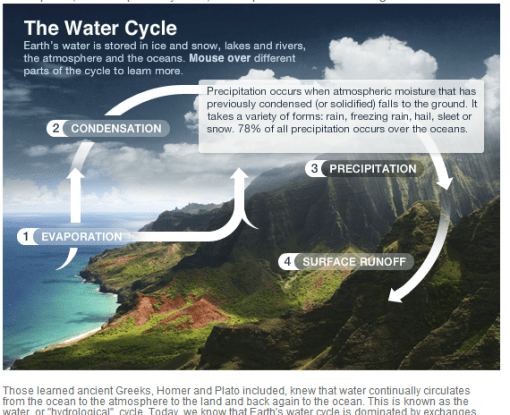
Salinity levels are important for two reasons. First, along with temperature, they directly affect seawater density (salty water is denser than freshwater) and therefore the circulation of ocean currents from the tropics to the poles. These currents control how heat is carried within the oceans and ultimately regulate the world’s climate. Second, sea surface salinity is intimately linked to Earth’s overall water cycle and to how much freshwater leaves and enters the oceans through evaporation and precipitation. Measuring salinity is one way to probe the water cycle in greater detail.”

It is absolutely clear that the way we generate power from fossil fuels and the water we generate from desalination of seawater  cannot be continued as business as usual but requires an innovation. New technologies to generate power without emitting Carbon into the atmosphere and generating fresh water from seawater without dumping the highly saline effluent back into the sea will decide the future of our planet. Discharge of concentrated brine into sea will wipe out the entire fish population in the region. The consequences are dire. Oil rich countries should spend their riches on Research and Developments to find innovative ways of desalinating seawater instead of investing massively on decades old technologies and changing the chemistry of the ocean and the climate forever.


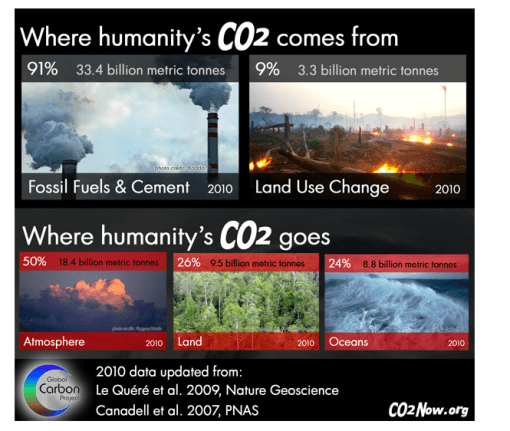
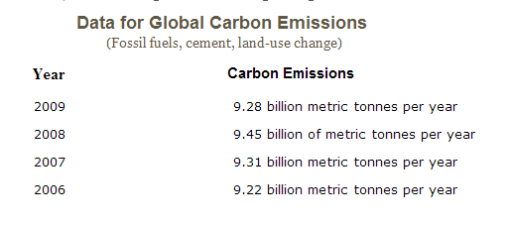
The Carbon emission in the atmosphere is steadily increasing.  The latest statistics indicates that it has reached a staggering 35.6 billion tons/yr, a 2.6% increase over the previous year, thanks to the growth of China. It is becoming clear that there is a relationship between the Carbon emission, global warming and erratic weather patterns around the world. According to ‘The Guardian’,

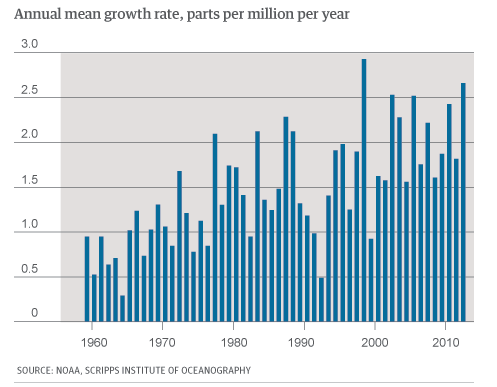
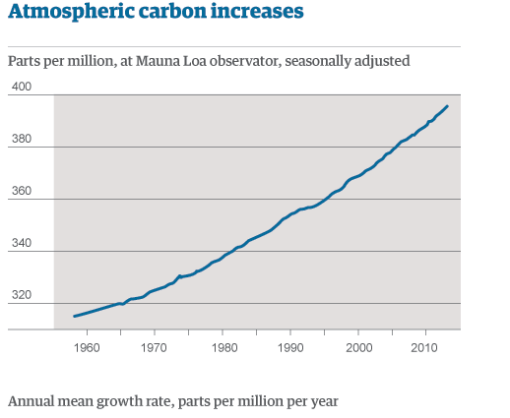
“The chances of the world holding temperature rise to 2C – the level of global warming considered “safe” by scientists – appear to be fading fast with US scientists reporting the second-greatest annual rise in CO2emissions in 2012. Carbon dioxide levels measured at Mauna Loa observatory in Hawaii jumped by 2.67 parts per million (ppm) in 2012 to 395ppm, said Pieter Tans, who leads the greenhouse gas measurement team for the US National Oceanic and Atmospheric Administration (NOAA). The record was an increase of 2.93ppm in 1998.

The jump comes as a study published in Science on Thursday looking at global surface temperatures for the past 1,500 years warned that “recent warming is unprecedented”, prompting UN climate chief, Christiana Figures, to say that “staggering global temps show urgent need to act. Rapid climate change must be countered with accelerated action.” Tans told the Associated Press the major factor was an increase in fossil fuel use. “It’s just a testament to human influence being dominant”, he said. “The prospects of keeping climate change below that [two-degree goal] are fading away.

Preliminary data for February 2013 show CO2 levels last month standing at their highest ever recorded at Manua Loa, a remote volcano in the Pacific. Last month they reached a record 396.80ppm with a jump of 3.26ppm parts per million between February 2012 and 2013. Carbon dioxide levels fluctuate seasonally, with the highest levels usually observed in April. Last year the highest level at Mauna Loa was measured at 396.18ppm. What is disturbing scientists is the acceleration of CO2concentrations in the atmosphere, which are occurring in spite of attempts by governments to restrain fossil fuel emissions. According to the observatory, the average annual rate of increase for the past 10 years has been 2.07ppm – more than double the increase in the 1960s. The average increase in CO2 levels between 1959 to the present was 1.49ppm per year.

The Mauna Loa measurements coincide with a new peer-reviewed study of the pledges made by countries to reduce CO2 emissions. The Dutch government’s scientific advisers show that rich countries will have to reduce emissions by 50% percent below 1990 levels by 2020 if there is to be even a medium chance of limiting warming to 2C, thus preventing some of climate  change‘s worst impacts.”The challenge we already knew was great is even more difficult”, said Kelly Levin, a researcher with the World Resources Institute in Washington. “But even with an increased level of reductions necessary, it shows that a 2° goal is still attainable – if we act ambitiously and immediately.” Extreme weather, which is predicted by climate scientists to occur more frequently as the atmosphere warms and CO2 levels rise, has already been seen widely in 2013. China and India have experienced their coldest winter in decades and Australia has seen a four-month long heat wave with 123 weather records broken during what scientists are calling it ‘angry summer’. “We are in [getting] into new climatic territory. And when you get records being broken at that scale, you can start to see a shifting from one climate system to another. So the climate has in one sense actually changed and we are now entering a new series of climatic conditions that we just haven’t seen before”, said Tim Flannery, head of the Australian government’s climate change commission, this week. Earlier this week the Met Office warned that the “extreme” patterns of flood and drought experienced by Britain in 2012 were likely to become more frequent. One in every five days in 2012 saw flooding but one in four days were in drought”.

The biggest question now is how to put this Carbon genie back into the bottle? renewable energy may be an answer to curtail future Carbon emissions but what about the existing coal-fired power plants that constitutes 60% of the existing power generation in the world? There is no easy solution. But the “Law of conservation of mass” gives us a clue.The Carbon we dig from the earth in the form of coal, combusted into the atmosphere as Carbon dioxide may be captured and recycled back into the system in the form of a fuel.By this way, we may not need fresh coal to be mined.To achive this feat,we need Hydrogen from a renewable source.The renewable Hydrogen can be combined with Carbon dioxide captured from the coal-fired power plants to generate synthetic natural gas (SNG).The SNG generated by this method can be used for future power generation, substituting Coal and future carbon emission can be recycled in the form of SNG. This approach will open up a range of possibilities and potentially cut the carbon emission to zero.Annual CO2 growthAtmospheic Carbon increaseCO2 emissionsGlobal Carbon emissionHydrosol cycleHydrosol thremocycle

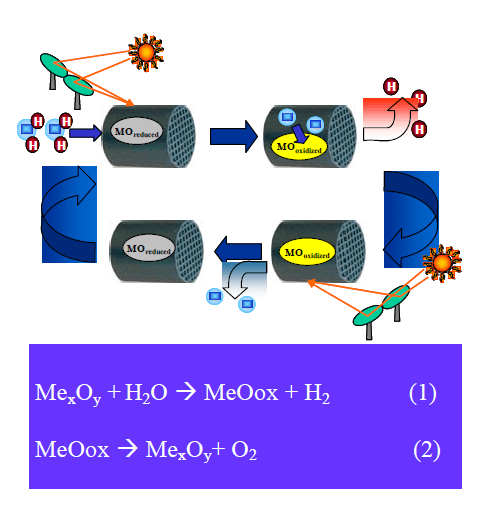
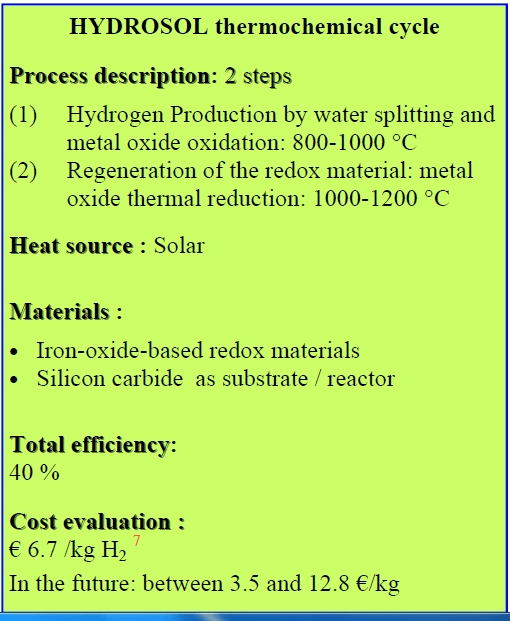
Many companies round the world including DOE (Department of energy,Govt of USA) are trying to develop an economically viable method to generate Hydrogen with an estimated cost of poduction at  $ 2.50 /kg of Hydrogen. One potential method is to generate Hydrogen by splitting water using a thermo-chemical process using concentrated solar therml energy developed by European Union called “Hydrosol cycle”. The method by which Hydrogen is generated should be free from any Carbon emision. To clean up  1 Kg Carbon dioxide one will require at least 0.2kg Hydrogen. For example, a 100Mw coal fired power plant emitting about 2256 Mt CO2/day will require about 451 Mt of Hydrogen/day, costing about $1,127,500 per day.It will cost roughly $500/Mt of C02 to  put the ‘ Carbon genie’  back into the bottle! One can imagein the cost of cleaning up  35.6 billion tons of Carbon dioxide  from the atmosphere.Only a Carbon free Hydrogen derived from water can save the world from a potential catastrophe.

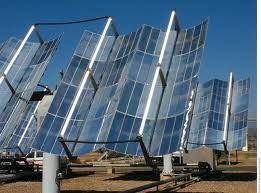
solar tower with heliostatsolar troughStirling dishSolar power plant in Queensland (annexure 1)It is a fact that solar energy is emerging as a key source of future energy as the climate change debate is raging all over the world. The solar radiation can meet world’s energy need completely in a benign way and offer a clear alternative to fossil fuels. However the solar technology is still in a growing state with new technologies and solutions emerging. Though PV solar is a proven technology the levelised cost from such plants is still much higher than fossil fuel powered plants. This is because the initial investment of a PV solar plant is much higher compared to fossil fuel based power plants. For example the cost of a gas based power plant can be set up at less than $1000/Kw while the cost of PV solar is still around $ 7000 and above. However solar thermal is emerging as an alternative to PV solar. The basic difference between these two technologies is  PV solar converts light energy of the sun directly into electricity and stores in a battery for future usage; solar thermal plants use  reflectors (collectors)  to focus the solar light to heat a thermic fluid or molten salt to a high temperature. The high temperature thermic fluid or molten salt is used to generate steam to run a steam turbine using Rankine cycle or heat a compressed air to run a gas turbine using Brayton cycle to generate electricity. Solar towers using heliostat and mirrors are predicted to offer  the lowest cost of solar energy in the near future as the cost of Heliostats are reduced and molten salts with highest eutectic points are developed. The high eutectic point molten salts are likely to transform a range of industries for high temperature applications. When solar thermal plants with molten salt storage can approach temperature of 800C, many fossil fuel applications can be substituted with solar energy. For example, it is expected by using solar thermal energy 24×7 in Sulfur-Iodine cycle, Hydrogen can be generated on a large commercial-scale at a cost @2.90/Kg.Research and developments are focused to achieve the above and it may soon become a commercial reality in the near future.

“The innovative aspect of CSP (concentrated solar power) is that it captures and concentrates the sun’s energy to provide the heat required to generate electricity, and not using fossil fuels or nuclear reactions. Another attribute of CSP plants is that they can be equipped with a heat storage system to generate electricity even when the sky is cloudy or after sunset. This significantly increases the CSP capacity factor compared with solar photovoltaics and, more importantly, enables the production of dispatchable electricity, which can facilitate both grid integration and economic competitiveness. CSP technologies therefore benefit from advances in solar concentrator and thermal storage technologies, while other components of the CSP plants are based on rather mature technologies and cannot expect to see rapid cost reductions. CSP technologies are not currently widely deployed. A total of 354 MW of capacity was installed between 1985 and 1991 in California and has been operating commercially since then. After a hiatus in interest between 1990 and 2000, interest in CSP has been growing over the past ten years. A number of new plants have been brought on line since 2006 (Muller- Steinhagen, 2011) as a result of declining investment costs and LCOE, as well as new support policies. Spain is now the largest producer of CSP electricity and there are several very large CSP plants planned or under construction in the United States and North Africa. CSP plants can be broken down into two groups, based on whether the solar collectors concentrate the sun rays along a focal line or on a single focal point (with much higher concentration factors). Line-focusing systems include parabolic trough and linear Fresnel plants and have single-axis tracking systems. Point-focusing systems include solar dish systems and solar tower plants and include two-axis tracking systems to concentrate the power of the sun.

Parabolic trough collector technology:

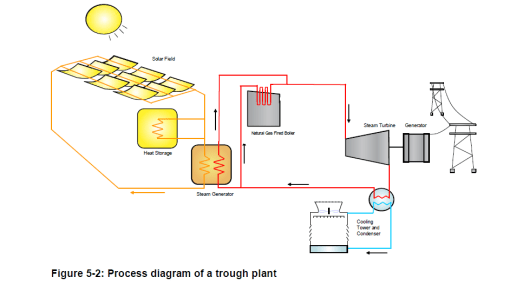
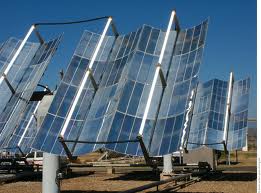
The parabolic trough collectors (PTC) consist of solar collectors (mirrors), heat receivers and support structures. The parabolic-shaped mirrors are constructed by forming a sheet of reflective material into a parabolic shape that concentrates incoming sunlight onto a central receiver tube at the focal line of the collector. The arrays of mirrors can be 100 meters (m) long or more, with the curved aperture of 5 m to 6 m. A single-axis tracking mechanism is used to orient both solar collectors and heat receivers toward the sun (A.T. Kearney and ESTELA, 2010). PTC are usually aligned North-South and track the sun as it moves from East to West to maximize the collection of energy. The receiver comprises the absorber tube (usually metal) inside an evacuated glass envelope. The absorber tube is generally a coated stainless steel tube, with a spectrally selective coating that absorbs the solar (short wave) irradiation well, but emits very little infrared (long wave) radiation. This helps to reduce heat loss. Evacuated glass tubes are used because they help to reduce heat losses.

A heat transfer fluid (HTF) is circulated through the absorber tubes to collect the solar energy and transfer it to the steam generator or to the heat storage system, if any. Most existing parabolic troughs use synthetic oils as the heat transfer fluid, which are stable up to 400°C. New plants under demonstration use molten salt at 540°C either for heat transfer and/or as the thermal storage medium. High temperature molten salt may considerably improve the thermal storage performance. At the end of 2010, around 1 220 MW of installed CSP capacity used the parabolic trough technology and accounted for virtually all of today’s installed

CSP capacity. As a result, parabolic troughs are the CSP technology with the most commercial operating experience (Turchi, et al., 2010).

Linear Fresnel collector technology:

 Linear Fresnel collectors (LFCs) are similar to parabolic trough collectors, but use a series of long flat, or slightly curved, mirrors placed at different angles to concentrate the sunlight on either side of a fixed receiver (located several meters above the primary mirror field). Each line of mirrors is equipped with a single-axis tracking system and is optimized individually to ensure that sunlight is always concentrated on the fixed receiver. The receiver consists of a long, selectively coated absorber tube.

Unlike parabolic trough collectors, the focal line of Fresnel collectors is distorted by astigmatism. This requires a mirror above the tube (a secondary reflector) to refocus the rays missing the tube, or several parallel tubes forming a multi-tube receiver that is wide enough to capture most of the focused sunlight without a secondary reflector. The main advantages of linear Fresnel CSP systems compared to parabolic trough systems are that:

LFCs can use cheaper flat glass mirrors, which are a standard mass-produced commodity;LFCs require less steel and concrete, as the metal support structure is lighter. This also makes the assembly process easier.

»»The wind loads on LFCs are smaller, resulting in better structural stability, reduced optical losses and less mirror-glass breakage; and.

»»The mirror surface per receiver is higher in LFCs than in PTCs, which is important, given that the receiver is the most expensive component in both PTC and in LFCs.

These advantages need to be balanced against the fact that the optical efficiency of LFC solar fields (referring to direct solar irradiation on the cumulated mirror aperture) is lower than that of PTC solar fields due to the geometric properties of LFCs. The problem is that the receiver is fixed and in the morning and afternoon cosine losses are high compared to PTC. Despite these drawbacks, the relative simplicity of the LFC system means that it may be cheaper to manufacture and install than PTC CSP plants. However, it remains to be seen if costs per kWh are lower. Additionally, given that LFCs are generally proposed to use direct steam generation, adding thermal energy storage is likely to be more expensive.

Solar to Electricity technology:

Solar tower technologies use a ground-based field of mirrors to focus direct solar irradiation onto a receiver mounted high on a central tower where the light is captured and converted into heat. The heat drives a thermodynamic cycle, in most cases a water-steam cycle, to generate electric power. The solar field consists of many of computer-controlled mirrors, called heliostats that track the sun individually in two axes. These mirrors reflect the sunlight onto the central receiver where a fluid is heated up. Solar towers can achieve higher temperatures than parabolic trough and linear Fresnel systems; because more sunlight can be concentrated on a single receiver and the heat losses at that point can be minimized. Current solar towers use water/steam, air or molten salt to transport the heat to the heat-exchanger/steam turbine system. Depending on the receiver design and the working fluid, the upper working temperatures can range from 250°C to perhaps as high 1 000°C for future plants, although temperatures of around 600°C will be the norm with current molten salt designs. The typical size of today’s solar power plants ranges from 10 MW to 50 MW (Emerging Energy Research, 2010). The solar field size required increases with annual electricity generation desired, which leads to a greater distance between the receiver and the outer mirrors of the solar field. This results in increasing optical losses due to atmospheric absorption, unavoidable angular mirror deviation due to imperfections in the mirrors and slight errors in mirror tracking.

Solar towers can use synthetic oils or molten salt as the heat transfer fluid and the storage medium for the thermal energy storage. Synthetic oils limit the operating temperature to around 390°C, limiting the efficiency of the steam cycle. Molten salt raises the potential operating temperature to between 550 and 650°C, enough to allow higher efficiency supercritical steam cycles although the higher investment costs for these steam turbines may be a constraint. An alternative is direct steam generation (DSG), which eliminates the need and cost of heat transfer fluids, but this is at an early stage of development and storage concepts for use with DSG still need to be demonstrated and perfected.

Solar towers have a number of potential advantages, which mean that they could soon become the preferred CSP technology. The main advantages are that:

»»The higher temperatures can potentially allow greater efficiency of the steam cycle and reduce water consumption for cooling the condenser;

»»The higher temperature also makes the use of thermal energy storage more attractive in order to achieve schedulable power generation; and

»»Higher temperatures will also allow greater temperature differentials in the storage system, reducing costs or allowing greater storage for the same cost.

The key advantage is the opportunity to use thermal energy storage to raise capacity factors and allow a flexible generation strategy to maximize the value of the electricity generated, as well as to achieve higher efficiency levels. Given this advantage and others, if costs can be reduced and operating experience gained, solar towers could potentially achieve significant market share in the future, despite PTC systems having dominated the market to date. Solar tower technology is still under demonstration, with 50 MW scale plant in operation, but could in the long-run provide cheaper electricity than trough and dish systems (CSP Today, 2008). However, the lack of commercial experience means that this is by no means certain and deploying solar towers today includes significant technical and financial risks.

Sterling dish technology:

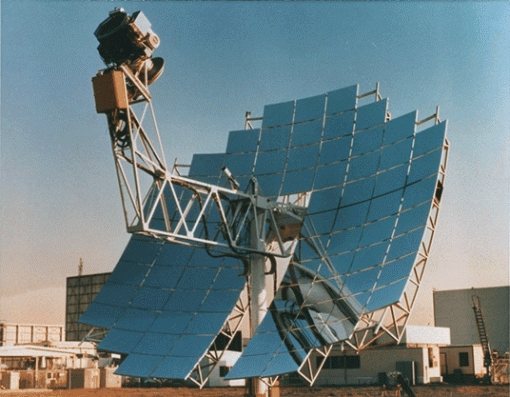
The Stirling dish system consists of a parabolic dish shaped concentrator (like a satellite dish) that reflects direct solar irradiation onto a receiver at the focal point of the dish. The receiver may be a Stirling engine (dish/ engine systems) or a micro-turbine. Stirling dish systems require the sun to be tracked in two axes, but the high energy concentration onto a single point can yield very high temperatures. Stirling dish systems are yet to be deployed at any scale. Most research is now focused on using a Stirling engine in combination with a generator unit, located at the focal point of the dish, to transform the thermal power to electricity. There are currently two types of Stirling engines: Kinematic and free piston. Kinematic engines work with hydrogen as a working fluid and have higher efficiencies than free piston engines. Free piston engines work with helium and do not produce friction during operation, which enables a reduction in required maintenance. The main advantages of Stirling dish CSP technologies are that:

»»The location of the generator – typically, in the receiver of each dish – helps reduce heat losses and means that the individual dish-generating capacity is small, extremely modular (typical sizes range from 5 to 50 kW) and are suitable for distributed generation;

»»Stirling dish technologies are capable of achieving the highest efficiency of all type of CSP systems

»»Stirling dishes use dry cooling and do not need large cooling systems or cooling towers, allowing CSP to provide electricity in water-constrained regions; and

»»Stirling dishes, given their small foot print and the fact they are self-contained, can be placed on slopes or uneven terrain, unlike PTC, LFC and solar towers. These advantages mean that Stirling dish technologies could meet an economically valuable niche in many regions, even though the levelised cost of electricity is likely to be higher than other CSP technologies. Apart from costs, another challenge is that dish systems cannot easily use storage. Stirling dish systems are still at the demonstration stage and the cost of mass-produced systems remains unclear. With their high degree of scalability and small size, stirling dish systems will be an alternative to solar photovoltaics in arid regions.”

(Source : IRENA 2012)


solar absorption chillersAir conditioning makes up bulk of the power usage, especially in tropical countries where the sun is shining almost throughout the year and the humidity levels are high. It makes a perfect sense to use solar heat to cool homes, business and factories. Many air-conditioning systems are commercially available using simple roof top PV solar panels to generate electric power to run an electric window air-conditioners. This system uses commercially available solar panels and window air-conditioners and uses solar power to generate electricity to run the compressor and the blower in the air-con unit. This system requires large storage battery to store adequate electricity to run your air-conditioners for specified period. Otherwise it requires a large area of solar panels to meet the demand. The efficiency of such systems can be improved using DC operated compressors and fans. However, renewable energy such as solar is still expensive to run air-conditioners because of high initial investment cost, though it may be economical in the long run as the cost of solar panels and accessories slowly come down over a time. Moreover such systems are limited to small air condition capacities.

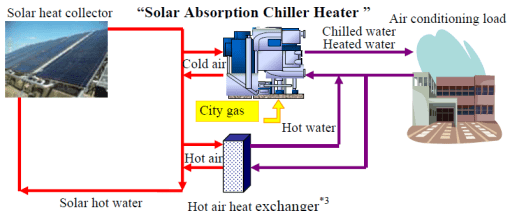
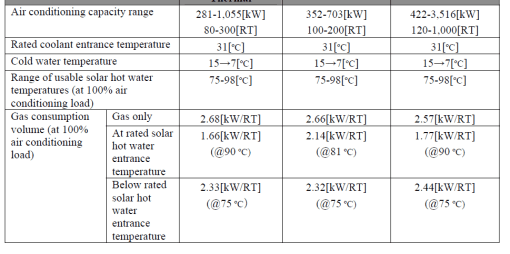
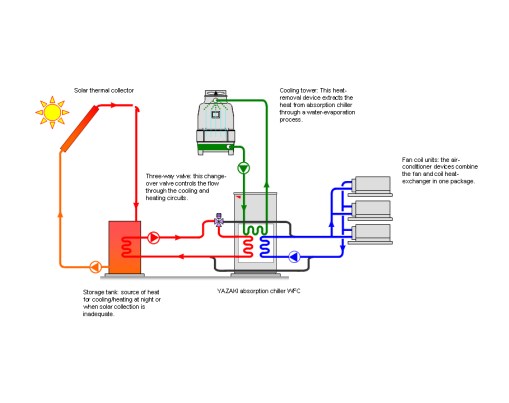
solar chillers-typical apacitiessolar absorption chillerFor large air-conditioning requirements such as business and factories, we need a system that uses solar heat directly to air-condition the premises with higher efficiency and thermal storage capabilities. Designing such a system is not very difficult because most of the components necessary to install such systems are readily available. One can install an air-conditioning system based on 100% solar thermal heat with molten salt thermal storage. Alternatively, a hybrid system can be installed based on solar heat without a thermal storage but using   city gas supply. Many countries use gas for heating during winter seasons but do not use gas during summer. These countries can use a hybrid (solar-gas) system to air-condition their premises and avoid peak electric usage during summer seasons thereby avoiding electrical black-outs. The advantage with such system is they can also be used for heating the premises during winter season. With changing climate due to global warming many warm countries like India also experiences cold temperatures during winter season. For example New Delhi in India has experienced a sharp drop in temperature up to 15-20c during winter from earlier winters.

Solar cooling systems to date have used waste heat gas absorption chiller heaters, which utilize the waste heat from cogeneration systems (CGS) for the cold water. However, these chiller heaters with their established technologies are devices designed for the effective use stable CGS high-temperature waste heat, so they cannot accommodate the preferential use of solar heat when solar hot water temperatures suddenly change from large variations in the heat collector temperatures due to changes in the weather. The new solar absorption chiller heaters are now specially designed for the effective use of low-temperature solar heat to address this problem and improve the energy conservation effect from solar cooling system. Hot water at less than 90C can be used for such systems and typical chillers with their rated specification are shown in the figures.solar trough

The efficiency of the system can be vastly improved by using parabolic solar concentrators, up to 27 times higher than ordinary flat plate solar collectors resulting in conversion efficiency up to 85% in heating and cooling. By selecting a natural refrigerant such as R717 we can save the environment from ozone depletion. Such systems offer flexibility to use exhaust heat, natural gas along with solar thermal storage up to 220C (phase transition temperature).The system offers an attractive return on investment, electricity savings and Carbon pollution reduction. The system can be designed from 5TR up to 200TR refrigeration capacity for 100% solar and up to 1000TR for a solar-gas hybrid systems. The solar thermal system with molten salt storage is versatile in its application because the same system can be designed for heating or cooling or on-site power generation for continuous applications.

.

Plastics have become an integral part of our lives. Plastic  constitutes about 12% of Municipal solid wastes generated in USA,a sharp increase from just 1% in 1960 to the current level. Increasing usage of plastics have created  environmental issues such as increased energy and water usage, emission of greenhouse gases and finally waste disposal and health issues. Many countries are now trying to cut the waste disposal problems by reducing usage, recovering  fuels from plastics and recycling.However  a large quantity of plastics are still returned to landfills  creating long-term health problems.

“According to EPA :

  • 31 million tons of plastic waste were generated in 2010, representing 12.4 percent of total MSW.
  • In 2010, the United States generated almost 14 million tons of plastics as containers and packaging, almost 11 million tons as durable goods, such as appliances, and almost 7 million tons as non-durable goods, such as plates and cups.
  • Only 8 percent of the total plastic waste generated in 2010 was recovered for recycling.
  • In 2010, the category of plastics which includes bags, sacks, and wraps was recycled at almost 12 percent.
  • Plastics also are found in automobiles, but recycling of these materials is counted separately from the MSW recycling rate.

How Plastics Are Made

Plastics can be divided in to two major categories: thermosets and thermoplastics. A thermoset solidifies or “sets” irreversibly when heated. They are useful for their durability and strength, and are used primarily in automobiles and construction applications. Other uses are adhesives, inks, and coatings.

A thermoplastic softens when exposed to heat and returns to original condition at room temperature. Thermoplastics can easily be shaped and molded into products such as milk jugs, floor coverings, credit cards, and carpet fibers.

According to the American Chemistry Council, about 1,800 US businesses handle or reclaim post-consumer plastics. Plastics from MSW are usually collected from curbside recycling bins or drop-off sites. Then, they go to a material recovery facility, where the materials are sorted into broad categories (plastics, paper, glass, etc.). The resulting mixed plastics are sorted by plastic type, baled, and sent to a reclaiming facility. At the facility, any trash or dirt is sorted out, then the plastic is washed and ground into small flakes. A flotation tank then further separates contaminants, based on their different densities. Flakes are then dried, melted, filtered, and formed into pellets. The pellets are shipped to product manufacturing plants, where they are made into new plastic products.

Resin Identification Code

The resin identification coding system for plastic, represented by the numbers on the bottom of plastic containers, was introduced by SPI, the plastics industry trade association, in 1988. Municipal recycling programs traditionally target packaging containers, and the SPI coding system offered a way to identify the resin content of bottles and containers commonly found in the residential waste stream. Plastic household containers are usually marked with a number that indicates the type of plastic. Consumers can then use this information to determine whether certain plastic types are collected for recycling in their area. Contrary to common belief, just because a plastic product has the resin number in a triangle, which looks very similar to the recycling symbol, it does not mean it is collected for recycling.

SPI Resin Identification Code

1

2

3

4

5

6

7

Type of Resin Content

PET

HDPE

Vinyl

LDPE

PP

PS

OTHER

Markets for Recovered Plastics

Markets for some recycled plastic resins, such as PET and HDPE, are stable and even expanding in the United States. Currently, the US has the capacity to be recycling plastics at a greater rate. The capacity to process post-consumer plastics and the market demand for recovered plastic resin exceeds the amount of post-consumer plastics recovered from the waste stream. The primary market for recycled PET bottles continues to be fiber for carpet and textiles, while the primary market for recycled HDPE is bottles, according to the American Chemistry Council.

Looking forward, new end uses for recycled PET bottles might include coating for corrugated paper and other natural fibers to make waterproof products like shipping containers. PET can even be recycled into clothing, such as fleece jackets. Recovered HDPE can be manufactured into recycled-content landscape and garden products, such as lawn chairs and garden edging.

Source Reduction

Source reduction is the process of reducing the amount of waste that is generated. The plastics industry has successfully been able to reduce the amount of material needed to make packaging for consumer products. Plastic packaging is generally more lightweight than its alternatives, such as glass, paper, or metal. Lighter weight materials require less fuel to transport and result in less material in the waste stream.”

Source : EPA.


Bio-LNG (01)Bio-LNG (02) Bio-LNG (03) Bio-LNG (04) Bio-LNG (05) Bio-LNG (07) Bio-LNG(06) Bio-LNG (08) Bio-LNG (09) Bio-LNG (10) Bio-LNG (11)

A new concept known as “hydraulic fracturing “ to enhance the recovery of land fill gas from new and existing land fill sites have been tested jointly by a Dutch and  Canadian companies. They claim it is now possible to recover such gas economically and liquefy them into Bio-LNG to be used as a fuel for vehicles and to generate power.

Most biofuels around the world are now made from energy crops like wheat, maize, palm oil, rapeseed oil etc and only  a minor part is  made from waste. But such a practice in not sustainable in the long run considering the anticipated food shortage due to climate changes.   The EU wants to ban biofuels that use too much agricultural land and encourage production of biofuels that do not use food material but waste materials. Therefore there is a need to collect methane gas that is emitted by land fill sites more efficiently and economically and to compete with fossil fuels.

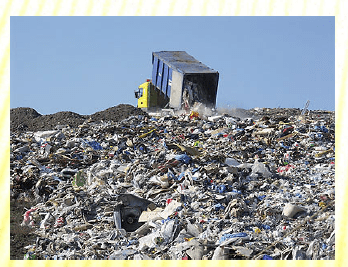
There are about 150,000 landfills in Europe with about 3–5 trillion cubic meters of waste (Haskoning 2011). All landfills emit landfill gas; the contribution of methane emissions from landfills is estimated to be between 30 and 70 million tons each year. Landfills contributed an estimated 450 to 650 billion cubic feet of methane per year (in 2000) in the USA. One can either flare landfill gas or make electricity with landfill gas. But it is prudent to produce the cleanest and cheapest liquid biofuel namely “Bio-LNG”.

Landfill gas generation: how do these bugs do their work?

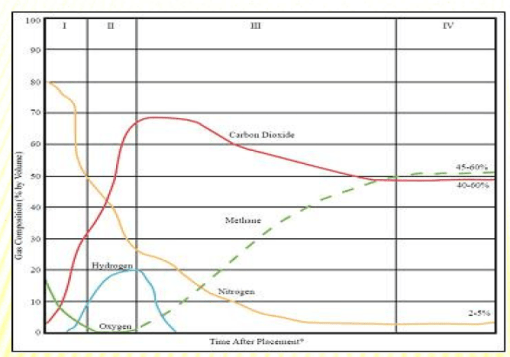
Researchers had a hard time figuring out why landfills do not start out as a friendly environment for the organisms that produce methane. Now new research from North Carolina State University points to one species of microbe that is paving the way for other methane producers. The starting bug has been found. That opens the door to engineer better landfills with better production management. One can imagine a landfill with real economic prospects other than getting the trash out of sight. The NCSU researchers found that an anaerobic bacterium called Methanosarcina barkeri appears to be the key microbe. The following steps are involved in the formation of landfill gas is shown in the diagram

Phase 1: oxygen disappears, and nitrogen

Phase 2: hydrogen is produced and CO2 production increases rapidly.

Phase 3: methane production rises and CO2 production decreases.

Phase 4: methane production can rise till 60%.

Phases 1-3 typically last for 5-7 years.

Phase 4 can continue for decades, rate of decline depending on content.

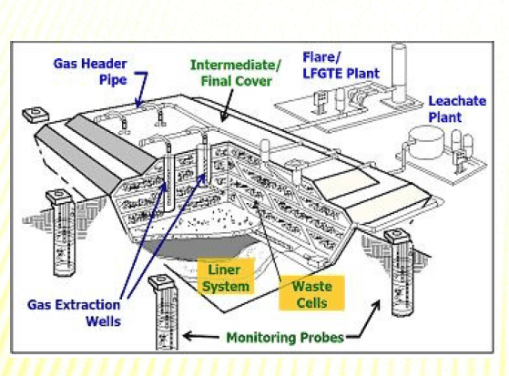
Installation of landfill gas collection system

A quantity of wells is drilled; the wells are (inter) connected with a pipeline system. Gas is guided from the wells to a facility, where it is flared or burnt to generate electricity. A biogas engine exhibits 30-40% efficiency. Landfills often lack access to the grid and there is usually no use for the heat.

The alternative: make bio-LNG instead and transport the bio-LNG for use in heavy-duty vehicles and ships or applications where you can use all electricity and heat.

Bio-LNG: what is it?

Bio-LNG is liquid bio-methane (also: LBM). It is made from biogas. Biogas is produced by anaerobic digestion. All organic waste can rot and can produce biogas, the bacteria does the work. Therefore biogas is the cheapest and cleanest biofuel  that can be generated without competing  with food or land use. For the first time there is a biofuel, bio-LNG, a better quality fuel than fossil fuel.

The bio-LNG production process

Landfill gas is produced by anaerobic fermentation in the landfill. The aim is to produce a constant flow of biogas with high methane content. The biogas must be upgraded, i.e. removal of H2S, CO2 and trace elements;

In landfills also siloxanes, nitrogen and Cl/F gases. The bio-methane must be purified (maximum 25/50ppm CO2, no water) to prepare for liquefaction. The cold box liquefies pure biomethane to bio-LNG

Small scale bio-LNG production using smarter methods.

•Use upgrading modules that do not cost much energy.

•Membranes which can upgrade to 98-99.5 % methane are suitable.

•Use a method for advanced upgrading that is low on energy demand.

•Use a fluid / solid that is allowed to be dumped at the site.

•Use cold boxes that are easy to install and low on power demand.

•Use LNG tank trucks as storage and distribution units.

•See if co-produced CO2 can be sold and used in greenhouses or elsewhere.

•Look carefully at the history and present status of the landfill.

What was holding back more projects?

Most flows of landfill gas are small (hundreds of Nm3/hour), so economy of scale is generally not favorable. Technology in upgrading and liquefaction has evolved, but the investments for small flows during decades cannot be paid back.

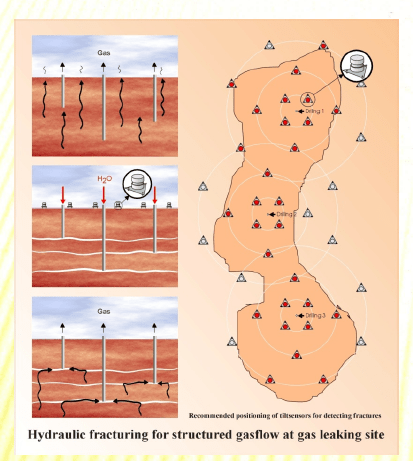
Now there is a solution: enhanced gas recovery by hydraulic fracturing. Holland Innovation Team and Fracrite Environmental Ltd. (Canada) has developed a method to increase gas extraction from landfill 3-5 times.

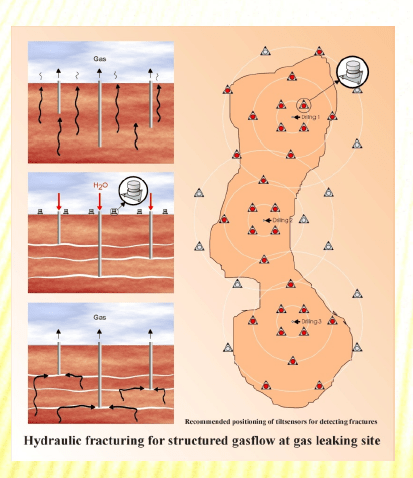
Hydraulic fracturing increases landfill gas yield and therefore economy of scale for bio-LNG production

The method consists of a set of drilling from which at certain dept the landfill is hydraulically broken. This means a set of circular horizontal fractures are created from the well at preferred depths. Sand or other materials are injected into the fractures. Gas gathers from below in the created interlayer and flows into the drilled well. In this way a “guiding” circuit for landfill gas is created. With a 3-5 fold quantity of gas, economy of scale for bio-LNG production will be reached rapidly. Considering the multitude of landfills worldwide this hydraulic fracturing method in combination with containerized upgrading and liquefaction units offers huge potential. The method is cost effective, especially at virgin landfills, but also at landfill with decreasing amounts of landfill gas.

Landfill gas fracturing pilot (2009).

• Landfill operational from 1961-2005

• 3 gas turbines, only 1 or 2 in operation at any time due to low gas extraction rates

• Only 12 of 60 landfill gas extraction wells still producing methane

• Objective of pilot was to assess whether fracturing would enhance methane extraction rates

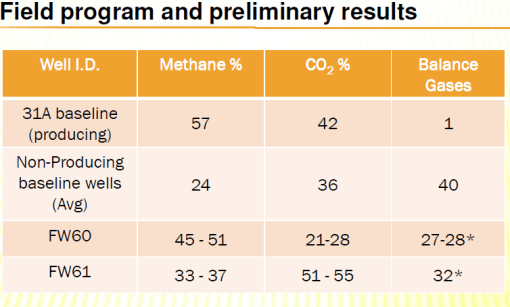
Field program and preliminary result

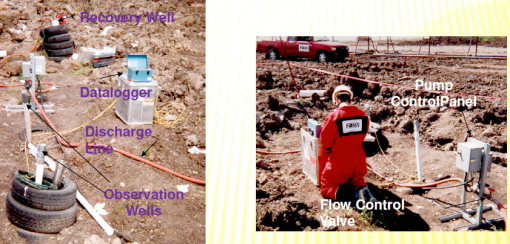
Two new wells drilled into municipal wastes and fractured (FW60, FW61). Sand Fractures at 6, 8, 10, 12 m depth in wastes with a fracture radius of 6 m. Balance gases believed to be due to oxygenation effects during leachate and

Groundwater pumping.

Note: this is entirely different from deep fracking in case of shale gas!

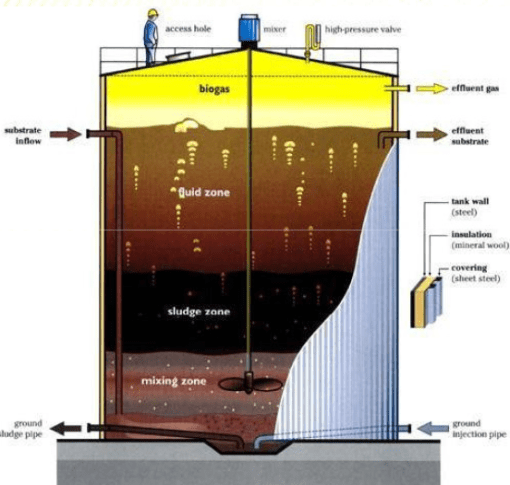
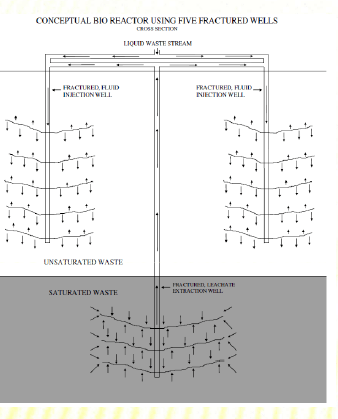
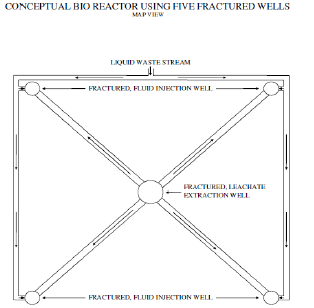
Conceptual Bioreactor Design

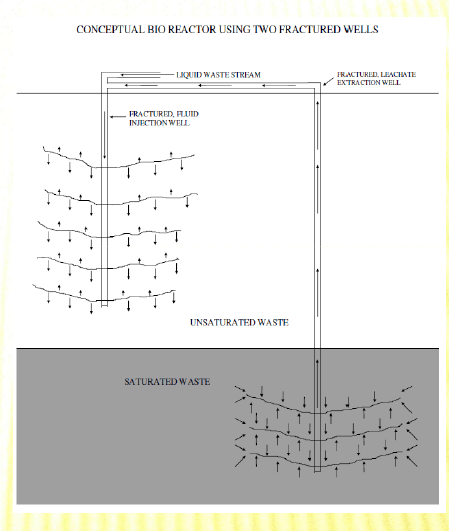
 The conceptual design is shown in the figures.There are anaerobic conditions below the groundwater table, but permeability decreases because of compaction of the waste. Permeability increases after fracking and so does the quantity of landfill gas and leachate.

Using the leachate by injecting this above the groundwater table will introduce anaerobic conditions in an area where up till then oxygen prevailed and so prevented landfill gas formation

It can also be done in such a systematic way, that all leachate which is extracted, will be disposed off in the shallow surrounding wells above the groundwater table.

One well below the groundwater table is fracked, the leachate is injected at the corners of a square around the deeper well. Sewage sludge and bacteria can be added to increase yield further

Improving the business case further

A 3-5 fold increased biogas flow will improve the business case due to increasing

Economy of scale. The method will also improve landfill quality and prepare the landfill for other uses.

When the landfill gas stream dries up after 5 years or so, the next landfill can be served by relocating the containerized modules (cold boxes and upgrading modules). The company is upgrading with a new method developed in-house, and improving landfill gas yield by fracking with smart materials. EC recommendations to count land fill gas quadrupled for renewable fuels target and the superior footprint of bio-LNG production from landfills are beneficial for immediate start-ups

Conclusions and recommendations

Landfills emit landfill gas. Landfill gas is a good source for production of bio-LNG. Upgrading and liquefaction techniques are developing fast and decreasing in price. Hydraulic fracturing can improve landfill gas yield such that economy of scale is reached sooner. Hydraulic fracturing can also introduce anaerobic conditions by injecting leachate, sewage sludge and bacteria above the groundwater table. The concept is optimized to extract most of the landfill gas in a period of five years and upgrade and liquefy this to bio-LNG in containerized modules.

Holland Innovation Team and Fracrite aim at a production price of less than €0.40 per kilo (€400/ton) of bio-LNG, which is now equivalent to LNG fossil prices in Europe and considerably lower than LNG prices in Asia, with a payback time of only a few years.

(Source:Holland Innovation Team)


Seawater desalination is a technology that provides drinking water for millions of people around the world. With increasing industrialization and water usage and lack of recycling or reuse, the demand for fresh water is increasing at the fastest rate. Industries such as power plants use bulk of water for cooling purpose and chemical industries use water for their processing. Agriculture is also a major user of water and   countries like India exploit ground water for this purpose. To supplement fresh water, Governments and industries in many parts of the world are now turning to desalinated seawater as a potential source of fresh water. However, desalination of seawater to generate fresh water is an expensive option, due to its large energy usage. However, due to frequent failure of monsoon rains and uncertainties and changing weather pattern due to global warming, seawater desalination is becoming a potential source of fresh water, despite its cost and environmental issues.

Seawater desalination technology has not undergone any major changes during the past three decades. Reverse osmosis is currently the most sought after technology for desalination due to increasing efficiencies of the membranes and energy-saving devices. In spite of all these improvements the biggest problem with desalination technologies is still the rate of recovery of fresh water. The best recovery in SWRO plants is about 50% of the input water. Higher recoveries create other problems such as scaling, higher energy requirements and O&M issues and many suppliers would like to restrict the recoveries to 35%, especially when they have to guarantee the life of membranes and the plant.

Seawater is nothing but fresh water with large quantities of dissolved salts. The concentration of total dissolved salts in seawater is about 35,000mgs/lit. Chemical industries such as Caustic soda and Soda ash plants use salt as the basic raw material. Salt is the backbone of chemical industries and number of downstream chemicals are manufactured from salt. Seawater is the major source of salt and most of these chemical industries make their own salt using solar evaporation of seawater using traditional methods with salt pans. Large area of land is required for this purpose and solar evaporation is a slow process and it takes months together to convert seawater into salt. It is also labor intensive under harsh conditions.

The author of this article has developed an innovative technology to generate fresh water as well as salt brine suitable for Caustic soda and Soda ash production. By using this novel process, one is able to recover almost 70% fresh water against only 40% fresh water recovered using conventional SWRO process, and also recover about 7- 9% saturated brine simultaneously. Chemical industries currently producing salt using solar evaporation are unable to meet their demand or expand their production due to lack of salt. The price of salt is steadily increasing due to supply demand gap and also due to uncertainties in weather pattern due to global warming. This result in increased cost of production and many small and medium producers of these chemicals are unable to compete with large industries. Moreover, countries like Australia who have vast arid land can produce large quantities of salt   with mechanized process  competitively; Australia is currently exporting salt to countries like Japan, while countries like India and China are unable to compete in the international market with their age-old salt pans using  manual labor. In solar evaporation the water is simply evaporated.

Currently these chemical industries use the solar salt which has a number of impurities, and it requires an elaborate purification process. Moreover the salt can be used as a raw material only in the form of saturated brine without any impurities. Any impurity is detrimental to the Electrolytic process where the salt brine is converted into Caustic soda and Soda ash. Chemical industries use deionized water to dissolve solar salt to make saturated brine and then purify them using number of chemicals before it can be used as a raw material for the production of Caustic soda or Soda ash. The cost of such purified brine is many times costlier than the raw salt. This in turn increase the cost of chemicals produced.

In this new process, seawater is pumped into the system where it is separated into 70% fresh water meeting WHO specifications for drinking purpose, and 7-10% saturated pure brine suitable for production of caustic soda and Soda ash. These chemical industries also use large quantities of process water for various purposes and they can use the above 70% water in their process. Only 15-20% of unutilized seawater is discharged back into the sea in this process, compared to 65% toxic discharge from convention desalination plants. This new technology is efficient and environmentally friendly and generates value added brine as a by-product. It is a win situation for the industries and the environment. The technology has been recently patented and is available for licensing on a non-exclusive or exclusive basis. The advantage of this technology is any Caustic soda or Soda ash plant located near the seashore can produce their salt brine directly from seawater without stock piling solar salt for months together or transporting over a long distance or importing from overseas.

Government and industries can join together to set up such plants where Governments can buy water for distribution and industries can use salt brine as raw material for their chemical production. Setting up a desalination plants only for supplying drinking water to the public is not a smart way to cut the cost of drinking water. For example, the Victorian Government in Australia has set up a large desalination plant to supply drinking water. This plant was set up by a foreign company on BOOT (build, own and operate basis) and water is sold to the Government on ‘take or pay’ basis. Currently the water storage level at catchment area is nearly 80% of its capacity and the Government is unlikely to use desalinated water for some years to come. However, the Government is legally bound by a contract to buy water or pay the contracted value, even if Government does not need water. Such contracts can be avoided in the future by Governments by joining with industries who require salt brine 24×7  throughout the year, thus mitigating the risk involved by  expensive legal contracts.


Energy storage systemsFlow batteryReversible fuelcell

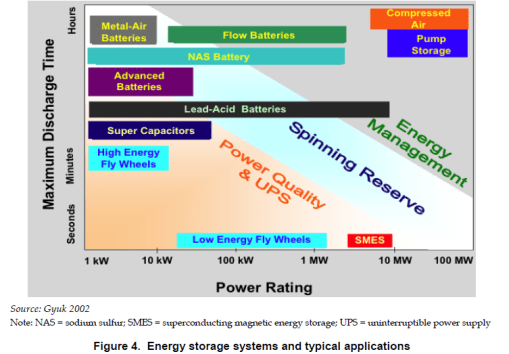
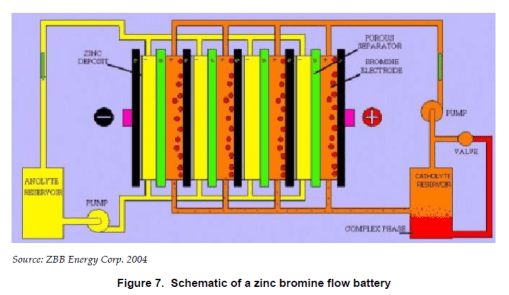
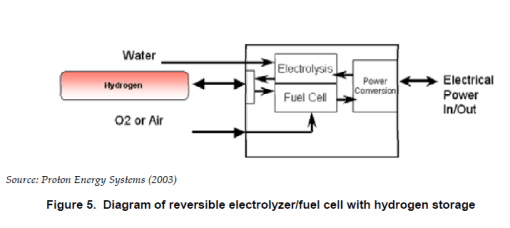
The share of renewable energy is steadily increasing around the world. But storing such intermittent energy source and utilizing it when needed has been a challenge. In fact energy storage makes up a significant part of the cost in any renewable energy technology. Many storage technologies are now available in the commercial market, but choosing a right type of technology has always been a difficult choice. In this article we will consider four types of storage technologies. The California Energy Commission conducted economic and environmental analyses of four energy storage options for a wind energy project: (1) lead acid batteries, (2) zinc bromine (flow) batteries, (3) a hydrogen electrolyzer and fuel cell storage system, and (4) a Hydrogen storage option where the hydrogen was used for fueling hydrogen powered vehicle. Their conclusions were:

”Analysis with NREL’s (National Renewable Energy laboratory)  HOMER model showed that, in most cases, energy storage systems were not well used until higher levels of wind penetration were modeled (i.e., 18% penetration in Southern California in 2020). In our scenarios, hydrogen storage became more cost-effective than battery storage at higher levels of wind power production, and using the hydrogen to refuel vehicles was more economically attractive than converting the hydrogen to electricity. The overall value proposition for energy storage used in conjunction with intermittent renewable power sources depends on multiple factors. Our initial qualitative assessment found the various energy storage systems to be environmentally benign, except for emissions from the manufacture of some battery materials.

However, energy storage entails varying economic costs and environmental impacts depending on the specific location and type of generation involved, the energy storage technology used, and the other potential benefits that energy storage systems can provide (e.g., helping to optimize

Transmission and distribution systems, local power quality support, potential provision of spinning reserves and grid frequency regulation, etc.)”.

Key Assumptions


Key assumptions guiding this analysis include the following:

Wind power will expand in California under the statewide RPS program to a level of

approximately 10% of total energy provided in 2010 and 20% by 2020, with most of

this expansion in Southern California.

• Costs of flow battery systems are assumed to decline somewhat through 2020 and

costs of hydrogen technologies (electrolyzers, fuel cell systems, and storage systems)

are assumed to decline significantly through 2020.

• In the case where hydrogen is produced, stored, and then reconverted to electricity

using fuel cell systems, we assume that the hydrogen can be safely stored in

modified wind turbine towers at relatively low pressure at lower costs than more

conventional and higher-pressure storage.

• In the case where hydrogen is produced and sold into transportation markets, we

assume that there is demand for hydrogen for vehicles in 2010 and 2020, and that the

Hydrogen is produced at the refueling station using the electricity produced from

wind farms (in other words, we assume that transmission capacity is available for

this when needed)?

Key Project Findings


Key findings from the HOMER model projections and analysis include the following:

Energy storage systems deployed in the context of greater wind power development

were not particularly well utilized (based on the availability of “excess” off-peak

electricity from wind power), especially in the 2010 time frame (which assumed 10%

wind penetration statewide), but were better utilized–up to 1,600 hours of operation per

year in some cases–with the greater (20%) wind penetration levels assumed for 2020.

• The levelized costs of electricity from these energy storage systems ranged from a low of

$0.41 per kWh—or near the marginal cost of generation during peak demand times—to

many dollars per kWh (in cases where the storage was not well utilized). This suggests

that in order for these systems to be economically attractive, it may be necessary to

optimize their output to coincide with peak demand periods, and to identify additional

value streams from their use (e.g., transmission and distribution system optimization,

provision of power quality and grid ancillary services, etc.)

• At low levels of wind penetration (1%–2%), the electrolyzer/fuel cell system was either

inoperable or uneconomical (i.e., either no electricity was supplied by the energy storage

system or the electricity provided carried a high cost per MWh).

• In the 2010 scenarios, the flow battery system delivered the lowest cost per energy

stored and delivered.

• At higher levels of wind penetration, the hydrogen storage systems became more

economical such that with the wind penetration levels in 2020 (18% from Southern

California), the hydrogen systems delivered the least costly energy storage.

• Projected decreases in capital costs and maintenance requirements along with a more

durable fuel cell allowed the electrolyzer/fuel cell to gain a significant cost advantage

over the battery systems in 2020.

• Sizing the electrolyzer/fuel cell system to match the flow battery system’s relatively

high instantaneous power output was found to increase the competitiveness of this

system in low energy storage scenarios (2010 and Northern California in 2020), but in

scenarios with higher levels of energy storage (Southern California in 2020), the

Electrolyzer/fuel cell system sized to match the flow battery output became less

competitive.

• In our scenarios, the hydrogen production case was more economical than the

Electrolyzer/fuel cell case with the same amount of electricity consumed (i.e., hydrogen

production delivered greater revenue from hydrogen sales than the electrolyzer/fuel

cell avoided the cost of electricity, once the process efficiencies are considered).

• Furthermore, the hydrogen production system with a higher-capacity power converter

and electrolyzer (sized to match the flow battery converter) was more cost-effective than

the lower-capacity system that was sized to match the output of the solid-state battery.

This is due to economies of scale found to produce lower-cost hydrogen in all cases.

• In general, the energy storage systems themselves are fairly benign from an

environmental perspective, with the exception of emissions from the manufacture of

certain components (such as nickel, lead, cadmium, and vanadium for batteries). This is

particularly true outside of the U.S., where battery plant emissions are less tightly

controlled and potential contamination from improper disposal of these and other

materials are more likely. The overall value proposition for energy storage systems used in conjunction with intermittent renewable energy systems depends on diverse factors.

• The interaction of generation and storage system characteristics and grid and energy

resource conditions at a particular location.

• The potential use of energy storage for multiple purposes in addition to improving the

dependability of intermittent renewable (e.g., peak/off-peak power price arbitrage,

helping to optimize the transmission and distribution infrastructure, load-leveling the

grid in general, helping to mitigate power quality issues, etc.)

• The degree of future progress in improving forecasting techniques and reducing

prediction errors for intermittent renewable energy systems

• Electricity market design and rules for compensating renewable energy systems for their

output

Conclusions


“This study was intended to compare the characteristics of several technologies for providing

Energy storage for utility grids—in a general sense and also specifically for battery and

Hydrogen storage systems—in the context of greater wind power development in California.

While more detailed site-specific studies will be required to draw firm conclusions, we believe

those energy storage systems have relatively limited application potential at present but may

become of greater interest over the next several years, particularly for California and other areas

that is experiencing significant growth in wind power and other intermittent renewable.

Based on this study and others in the technical literature, we see a larger potential need for

energy storage system services in the 2015–2020 time frames, when growth in renewable produced electricity is expected to reach levels of 20%–30% of electrical energy supplied.

Depending on the success in improved wind forecasting techniques and electricity market

designs, the role for energy storage in the modern electricity grids of the future may be

significant. We suggest further and more comprehensive assessments of multiple energy

storage technologies for comparison purposes, and additional site- and technology-specific

project assessments to gain a better sense of the actual value propositions for these technologies

in the California energy system.


This project has helped to meet program objectives and to benefit California in the

Following ways:

Providing environmentally sound electricity. Energy storage systems have the

Potential to make environmentally attractive renewable energy systems more

competitive by improving their performance and mitigating some of the technical issues

associated with renewable energy/utility grid integration. This project has identified the

potential costs associated with the use of various energy storage technologies as a step

toward understanding the overall value proposition for energy storage as a means to

help enable further development of wind power (and potentially other intermittent

renewable resources as well).

Providing reliable electricity. The integration of energy storage with renewable energy

sources can help to maintain grid stability and adequate reserve margins, thereby

contributing to the overall reliability of the electricity grid. This study identified the

potential costs of integrating various types of energy storage with wind power, against

which the value of greater reliability can be assessed along with other potential benefits.

Providing affordable electricity. Upward pressure on natural gas prices, partly as a

function of increased demand, has significantly contributed to higher electricity prices in

California and other states. Diversification of electricity supplies with relatively low-cost

sources, such as wind power, can provide a hedge against further natural gas price

increases. Higher penetration of these other (non-natural-gas-based) electricity sources,

Potentially enabled by the use of energy storage, can reduce the risks of future electricity.”

(Source: California Energy Commission prepared by University of Berkeley).