Skip navigation

Category Archives: Clean energy


All existing power generation technologies including nuclear power plants uses heat generation as a starting point. The heat is used to generate steam which acts as a motive force to run an alternator to produces electricity. We combust fossil fuels such as coal oil and gas to generate above heat which also emits greenhouse gases such as oxides of Carbon and Nitrogen. As I have disused in my earlier article, we did not develop a technology to generate heat without combusting a fossil fuel earlier. This was due to cheap and easy availability of fossil fuel. The potential danger of emitting greenhouse gases into the atmosphere was not realized until recently when scientists pointed out the consequences of carbon build up in the atmosphere. The growth of population and industries around the world pushed the demand for fossil fuels over a period which enhanced the Carbon build up in the atmosphere.

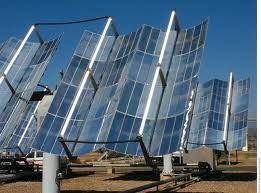
But now Concentrated Solar Power (CSP) systems have been developed to capture the heat of the sun more efficiently and the potential temperature of solar thermal can reach up to 550. This dramatic improvement is the efficiency of solar thermal has opened up new avenues of power generation as well as other applications. “CSP is being widely commercialized and the CSP market has seen about 740 MW of generating capacity added between 2007 and the end of 2010. More than half of this (about 478 MW) was installed during 2010, bringing the global total to 1095 MW. Spain added 400 MW in 2010, taking the global lead with a total of 632 MW, while the US ended the year with 509 MW after adding 78 MW, including two fossil–CSP hybrid plants”. (Ref: Wikipedia)

“CSP growth is expected to continue at a fast pace. As of April 2011, another 946 MW of capacity was under construction in Spain with total new capacity of 1,789 MW expected to be in operation by the end of 2013. A further 1.5 GW of parabolic-trough and power-tower plants were under construction in the US, and contracts signed for at least another 6.2 GW. Interest is also notable in North Africa and the Middle East, as well as India and China. The global market has been dominated by parabolic-trough plants, which account for 90 percent of CSP plants.As of 9 September 2009, the cost of building a CSP station was typically about US$2.50 to $4 per  watt, the fuel (the sun’s radiation) is free. Thus a 250 MW CSP station would have cost $600–1000 million to build. That works out to $0.12 to $0.18/kwt. New CSP stations may be economically competitive with fossil fuels. Nathaniel Bullard,” a solar analyst at Bloomberg

New Energy Finance, has calculated that the cost of electricity at the Ivanpah Solar Power Facility, a project under construction in Southern California, will be lower than that from  photovoltaic power and about the same as that from natural gas  However, in November 2011, Google announced that they would not invest further in CSP projects due to the rapid price decline of photovoltaics. Google spent $168 million on Bright Source IRENA has published on June 2012 a series of studies titled: “Renewable Energy Cost Analysis”. The CSP study shows the cost of both building and operation of CSP plants. Costs are expected to decrease, but there are insufficient installations to clearly establish the learning curve. As of March 2012, there was 1.9 GW of CSP installed, with 1.8 GW of that being parabolic trough” Ref: Wikipedia.

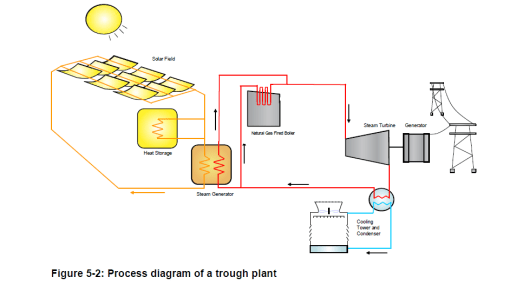
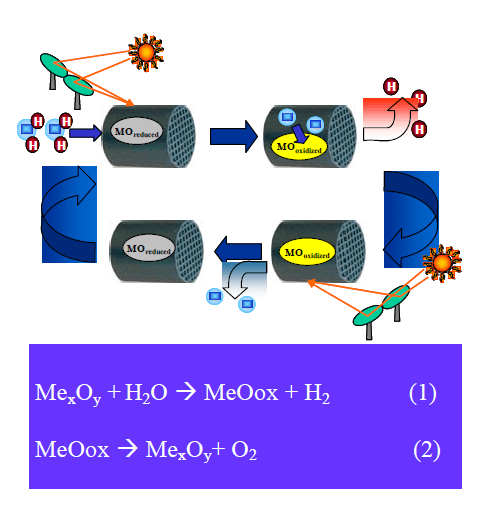
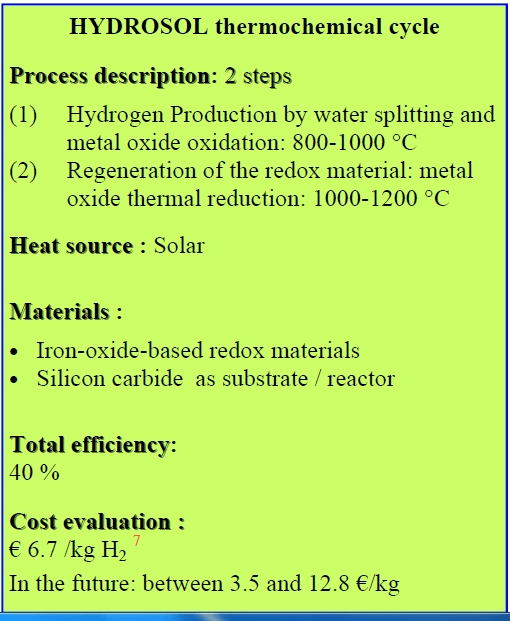
One Canadian company has demonstrated to generate Hydrogen from water using a catalytic thermolysis using sun’s high temepertaure.The same company has also demonstrated generating base load power using conventional steam turbine by  CSP using parabolic troughs. They store sun’s thermal energy using a proprietary thermic fluid and use them during night times to generate continuous power. The company offers to set up CSP plants of various capacities from 15Mw up to 500Mw.


Renewable Hydrogen offers the most potential energy source of the future for the following reasons. Hydrogen has the highest heat value compared to rest of the fossil fuels such as Diesel, petrol or butane. It does not emit any greenhouse gases on combustion. It can readily be generated from water using your roof mounted solar panels. The electrical efficiency of fuel cell using Hydrogen as a fuel is more than 55% compared to 35% with diesel or petrol engine. It is an ideal fuel that can be used for CHP applications. By properly designing a system for a home, one can generate power as well as use the waste heat to heat or air-condition your home. It offers complete independence from the grid and offers complete insulation from fluctuating oil and gas prices. By installing a renewable Hydrogen facility at your home, you can not only generate Electricity for your home but also fuel your Hydrogen car. The system can be easily automated so that it can take care of your complete power need as well as your fuel requirement for your Hydrogen car. Unlike Electric cars, you can fill two cylinders of a Hydrogen car which will give a mileage of 200miles.You can also charge your electric car with Fuel cell DC power.

Renewable Hydrogen can address all the problems we are currently facing with fossil fuel using centralized power generation and distribution. It will not generate any noise or create any pollution to the environment. It does not need large amount of water. With increasing efficiency of solar panels coming into the market the cost of renewable Hydrogen power will become competitive to grid power. Unlike photovoltaic power, the excess solar power is stored in the form of Hydrogen and there is no need for deep cycle batteries and its maintenance and disposal. It is a one step solution for all the energy problems each one of us is facing. The only drawback with any renewable energy source is its intermittent nature and it can be easily addressed by building enough storage capacity for Hydrogen. Storing large amount of energy is easy compared to battery storage.

The attached ‘You Tube’ video footage show how Solar Hydrogen can be used to power your home and fuel your Hydrogen car. Individual homes and business can be specifically designed based on their power and fuel requirements.

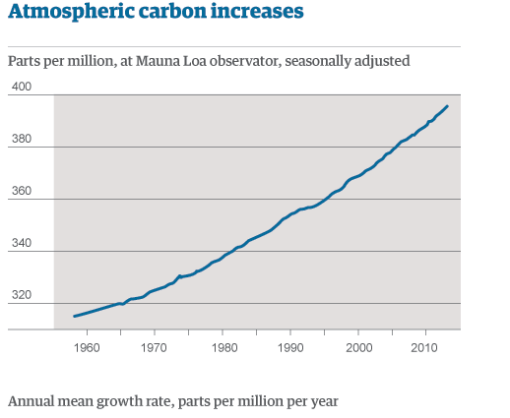
There is a raging debate going on around the world especially in US about the global warming and its causes, among scientists and the public alike. When IPCC released its findings on the connection between greenhouse gas emission and the global warming and its disastrous consequences, there was an overwhelming disbelief and skepticism in many people. In fact many scientists are skeptical even now   about these findings and many of them published their own theories and models to prove their skepticism with elaborate ‘scientific explanations’.   I am not going into details whether greenhouse gas emission induced by human beings causes the globe to warm or not, but certainly we have emitted billions of  tons of Carbon in the form of Carbon dioxide into the atmosphere since industrial revolution. Bulk of these emissions is from power plants fueled by Coal, oil and gas. Why power plants emit so much Carbon into the atmosphere and why Governments around the world allow it in the first place?  When the emission of Oxide of Nitrogen and Sulfur are restricted by EPA why they did not restrict Oxides of carbon? The reason is very simple. They did not have a technology to generate heat without combustion and they did not have a technology to generate power without heat. It was the dawn of industrial revolution and steam engines were introduced using coal as a fuel. The discovery of steam engines was so great and nobody was disturbed by the black smoke it emitted. They knew very well that the efficiency of a steam engine was low as shown by Carnot cycle, yet steam engine was a new discovery and Governments were willing to condone Carbon emission. Governments were happy with steam engine because it could transport millions of people and goods in bulk across the country and Carbon emission was not at all an issue. Moreover carbon emission did not cause any problem like emission of oxides of Sulfur because it was odorless, colorless and it was emitted above the ground level away from human beings. However the effect of Carbon is insidious. Similarly, power generation technology was developed by converting thermal energy into electrical energy with a maximum efficiency of 33%.This means only 33% of the thermal energy released by combustion of coal is converted into electricity. When the resulting electricity is transmitted across thousands of kilometers by high tension grids, further 5-10% power is lost in the transmission. When the high tension power is stepped down through sub stations to lower voltage such as 100/200/400V further 5% power is lost. The net power received by a consumer is only 28% of the heat value of the fuel in the form of electricity. The balance 67% of heat along with Greenhouse gases from the combustion of coal is simply vented out into the atmosphere. It is the most inefficient method to generate power. Any environmental pollution is the direct result of inefficiency of the technology. Governments and EPA around the world ignore this fact .Thank to President Obama who finally introduced the pollution control bill for power plants after 212 years of industrial revolution.  Still this bill did not go far enough to control Carbon emission in its current form. Instead of arguing whether globe is warming due to emission of Carbon by human beings or not, Scientists should focus on improving the science and technology of power generation. For example, the electrical efficiency of a Fuel cell is more than 55% compared to conventional power generation and emits reduced or no carbon. Recent research by MIT shows that such conversion of heat into electricity can be achieved up to 90% compared to current levels of 35%.Had we developed such a technology earlier, probably we will not be discussing about GHG and global warming now. MIT research group is now focusing on developing new type of PV and according to their press release: “Thermal to electric energy conversion with thermophotovoltaics relies on radiation emitted by a hot body, which limits the power per unit area to that of a blackbody. Micro gap thermophotovoltaics take advantage of evanescent waves to obtain higher throughput, with the power per unit area limited by the internal blackbody, which is n2 higher. We propose that even higher power per unit area can be achieved by taking advantage of thermal fluctuations in the near-surface electric fields. For this, we require a converter that couples to dipoles on the hot side, transferring excitation to promote carriers on the cold side which can be used to drive an electrical load. We analyze the simplest implementation of the scheme, in which excitation transfer occurs between matched quantum dots. Next, we examine thermal to electric conversion with a glossy dielectric (aluminum oxide) hot-side surface layer. We show that the throughput power per unit active area can exceed the n2 blackbody limit with this kind of converter. With the use of small quantum dots, the scheme becomes very efficient theoretically, but will require advances in technology to fabricate.” Ref:J.Appl.Phys. 106,094315c(2009); http://dx.doi.org/10.1063/1.3257402 Quantum-coupled single-electron thermal to electric conversion scheme”. Power generation and distribution using renewable energy sources and using Hydrogen as an alternative fuel is now emerging. Distributed energy systems may replace centralized power plants in the future due to frequent grid failures as we have seen recently in India. Most of the ‘black outs’ are caused  by grid failures due to cyclones, tornadoes and other weather related issues, and localized distribution system with combined heat and power offers a better alternative. For those who are skeptical about global warming caused by man-made greenhouse gases the question still remains, “What happened to billions of tons of Caron dioxide emitted into  the atmosphere by power plants and transportation  since industrial revolution?”.          

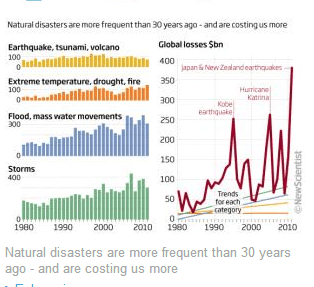
We have used Hydrocarbon as the source of fuel for our power generation and transportation since industrial revolution. It has resulted in increasing level of man-made Carbon into the atmosphere; and according to the scientists, the level of carbon has reached an unsustainable level and any further emission into the atmosphere will bring catastrophic consequences by way of climate change. We have already saw many natural disasters in a short of span of time. Though there is no direct link established between carbon level in the atmosphere and the global warming, there is certainly enough evidence towards increase in the frequency of natural disasters and increase in the global and ocean temeperatures.We have also seen that Hydrogen is a potential candidate as a source of future energy that can effectively substitute hydrocarbons such as Naphtha or Gasoline. However, hydrogen generation from water using electrolysis is energy intensive and the source of such energy can come only from a renewable source such as solar and wind. Another issue with electrolysis of water for Hydrogen generation is the quality of water used. The quality of water used for electrolysis is high, meeting ASTM Type I Deionized Water preferred, < 0.1 micro Siemen/cm (> 10 megOhm-cm).

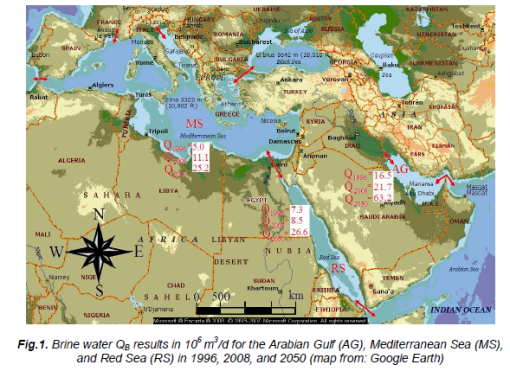
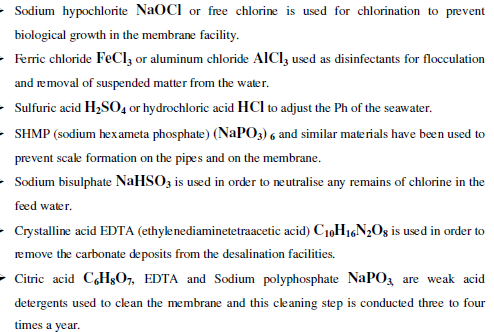
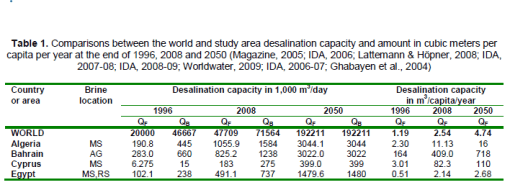
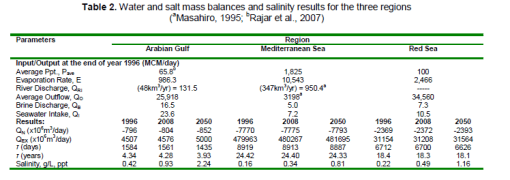
A unique desalination technology has been developed by an Australian company to generate on site Hydrogen directly from seawater. In conventional seawater desalination technology using reverse osmosis process only 30-40% of fresh water is recovered as potable water with TDS less than 500 ppm as per WHO standard. The balance highly saline concentrate with TDS above 65,000 ppm is discharged back into the sea which is detrimental to the ocean’s marine life. More and more sweater desalination plants are set up all over the world to mitigate drinking water shortage. This conventional desalination is not only highly inefficient but also causes enormous damage to the marine environment.

The technology developed by the above company will be able to recover almost 75% of fresh water from seawater and also able to convert the concentrate into Caustic soda lye with Hydrogen and Chlorine as by-products by electrolysis. The discharge into the sea is drastically reduced to less than 20% with no toxic chemicals. This technology has a potential to revolutionize the salt and caustic soda industries in the future. Caustic soda is a key raw material for a number of chemical industries including PVC.Conventionally, Caustic soda plants all over the world depends on solar salt for their production of Caustic soda.Hydrogne and Chlorine are by-products.Chlrine is used for the production of PVC (poly vinyl chloride) and Hydrogen is used as a fuel.

In the newly developed technology, the seawater is not only purified from other contaminants such as Calcium, Magnesium and Sulfate ions present in the seawater but also concentrate the seawater almost to a saturation point so that it can be readily used to generate Hydrogen on site. The process is very efficient and commercially attractive because it can recover four valuable products namely, drinking water, Caustic soda lye, Chlorine and Hydrogen. The generated Hydrogen can be used directly in a Fuel cell to generate power to run the electrolysis. This process is very ideal for Caustic soda plants that are now located on seashore. This process can solve drinking water problems around the world because potable water becomes an industrial product. The concentrated seawater can also be converted in a salt by crystallization for food and pharmaceutical applications. There is a growing gap between supply and demand of salt production and most of the chemical industries are depending upon the salt from solar pans.

Another potential advantage with this technology is to use wind power to desalinate the water. Both wind power and Hydrogen will form a clean energy mix. It is a win situation for both water industry and the environment as well as for the salt and chemical industries. In conventional salt production, thousands of hectares of land are used to produce few hundred tons of low quality salt with a year-long production schedule. There is a mis match between the demand for salt by large Caustic soda plants and supply from primitive methods of solar production by solar evaporation contaminating cultivable lands.

The above case is an example of how clean energy technologies can change water, salt and chemical industries and also generate clean power economically, competing with centralized power plants fuelled with hydrocarbons. Innovative technologies can solve problems of water shortage, greenhouse gases, global warming, and environmental pollution not only economically but also environmental friendly way. Industries involved in seawater desalination, salt production, chemical industries such as Caustic soda, Soda ash and PVC interested to learn more on this new technology can write directly to this blog address for further information.

Fuel cell technology is emerging as a base-load power generation technology as well as back-up power for intermittent renewable energy such as solar and wind, substituting conventional storage batteries. However, Fuelcell requires a Fuel in the form of Hydrogen of high purity. The advantage of Fuel cell is, its high electrical efficiency compared to conventional fossil fuel power generation technology, using Carnot cycle. Fuel cell is an electro-chemical device like a battery and generates power using electro-chemical redox reaction silently with no gaseous emission, unlike engines and turbines with combustion, rotary movements and gaseous emissions. The fuel Hydrogen can be generated using a renewable energy sources such as solar and wind as described in my previous articles, “Solar Hydrogen for cleaner future” dated 4 July 2012, and “Renewable Hydrogen for remote power supply “dated 28 June 2012.

Alternatively, Hydrogen can also be generated using biomass through Biogas. Biogas is an important source of renewable energy in the carbon constrained economy of today’s world. The biogas can be generated from waste water and agro-waste by anaerobic digestion using enzymes. Biomass such as wood waste can also be gasified to get syngas, a mixture of Hydrogen and Carbon dioxide. In anaerobic digestion, the main product will be methane gas accompanied by carbon dioxide and nitrogen while the main product in gasification will be Hydrogen, carbon monoxide and carbon dioxide and oxides of Nitrogen. Whatever may be the composition of the resulting gas mixture, our focus will be to separate methane or Hydrogen from the above mixture. In anaerobic digestion, the resulting Methane gas has to be steam reformed to get Hydrogen gas suitable for Fuel cell application. In gasification, the resulting Syngas has to be separated into pure Hydrogen and Carbon dioxide so that pure Hydrogen can be used as a fuel in Fuel cell applications. As I have outlined in many of my previous articles, Hydrogen was the only fuel we have used all these years and we are still using it  in the form of Hydrocarbons and it will continue to be the fuel in the future also. The only difference is future Hydrogen will be free from carbon.

We have to discuss two issues to mitigate Carbon emission, and it can be done by 1.Elimination of Carbon from the fuel source. 2. Generation of Renewable and Carbon free clean energy directly from solar and wind. One option  to cut Carbon from the fuel source is to use Biomass as the raw material to generate Hydrogen so that fresh Carbon will not be added  into the atmosphere by emissions .The second option is to generate pure Hydrogen from water by electrolysis using renewable energy such as wind and solar. Environmentally friendly waste-to-energy projects are becoming popular all over the world. But now most of these waste-to-energy projects generate either Biogas (Methane) by anaerobic digestion or Syngas (Hydrogen and Carbon dioxide) by gasification. Both these gases need further purification before they can be used as a fuel for power generation. The Methane content in the Biogas (about 60% methane and 40% Carbon dioxide with other impurities) needs to be enriched to 90% Methane and free from other impurities. The composition of a typical Biogas is shown in table1.

The resulting purified methane gas will be reformed using steam reformation in presence of a catalyst to get syngas; finally Hydrogen should be separated from resulting syngas so that it can be used directly into the Fuelcell.The common Fuel cell used for this application is invariably Phosphoric acid fuel cell.

PAFC uses 100% Phosphoric acid in Silicon carbide matrix as an electrolyte. PAFC is a self-contained unit completely enclosed in a cabin consisting of a gas reformer, Fuellcell power generator, Power conditioning unit and other auxiliaries. The PAFC is of modular construction with capacities ranging from 100Kw up to 500Kw as a single unit. It can be installed outdoor in the open and it can be readily connected to a piped Biogas. It can also be connected to existing piped natural gas or LPG bullet as a stand-by fuel. Any waste-to energy project can be integrated with Fuel cell power generation with CHP application to get greatest economic and environmental benefits. Hydrogen derived from biomass will be an important source of fuel in the future of clean energy; and Fuel cell will become an alternative power generation technology for both stationary power generation and transportation such as Fuel cell car or Hybrid cars.

PAFC is a compact, self-contained power generation unit that is used even for base load power. The electrical efficiency of PAFC  is about 42% .It is suitable for CHP applications so that the total energy efficiency can reach up to 85%.It is ideal for supplying continuous power 24×7 and also to use waste heat for space heating or space air-conditioning with an absorption chiller in CHP applications. The ideal candidates for PAFC power generation using CHP will be hospitals, super markets, Data centers, Universities or any continuous process industry.PAFC is now used as a backup power for large-scale renewable energy project with an access to piped natural gas. A schematic flow diagram of a fuel cell power generation is shown in Fig 3 using biogas at Yamagata sewage treatment plant in Japan. Biomass  based  Fuecell  power generation has a great potential all over the world irrespective of location and size of the country.

PV solar is expanding as a potential renewable energy source for each house, and the cost of solar panels are slowly coming down as the volume of production increases. However, the intermittent nature of solar energy is still an issue, especially for off grid and remote locations. Now solar energy is stored using lead acid batteries for such applications and inverters become part of the system. The capacity of the battery bank is designed to meet the electrical demand and to absorb the fluctuation of the energy generated by solar panels and it varies from place to place. This method stores the electrical energy generated by PV solar in the form of DC current and delivers it in the form of AC current. Though this method is the simplest one for remote locations, storing solar power in the form of Hydrogen is more economical and environmentally friendly in the long run.

Solar energy can directly be used to generate Hydrogen using solid polymer electrolyzers and stored in cyclinders.The stored Hydrogen can then be used to fuel a stationary Fuel cell to generate power on site. One can design a system by integrating various components in such a way; the Hydrogen generated by solar energy is used to generate power on site as and when required. By this method one can generate required power throughout the day 24×7 irrespective of the availability of sun. The system integration involves various components supplied by various manufacturers with various specifications and the success of a system depends on the careful design using data acquired over a time on a specific location.

Many winds to Hydrogen projects also have been tested in locations around the world.NREL (National renewable energy laboratory, USA) has conducted number of tests by integrating various components such as PV solar and wind turbines with Electrolyzers (both PEM electroylzers and alkaline electrolyzers) and Hydrogen IC engines for remote power generation as well as for fuelling vehicles with Hydrogen. Though the cost of this system is still expensive, such integration offers enormous potential as a clean energy source for remote locations without any grid power. When one takes into account the fluctuating oil prices, cost of global warming, cost of power transmissions and losses during long distance power transmission from fossil fuel power plants, Renewable Hydrogen offers the best and sustainable alternative to fossil fuels. Such a system offers complete independence, energy security, reliability and fixed power tariff.

System integration of renewable energy sources for Hydrogen production and on site power generation using Fuel cell or Hydrogen engine is the key to a successful deployment of solar and wind energy for rural electrification and to remote islands. Such system will offer greater return on investment even to supply power to the grid based on power purchase agreements with Government and private companies. Renewable Hydrogen is the only practical solution for clean power of the future and sooner we embrace this integrated solution better for a cleaner future. Government and private companies investing on oil and gas explorations can focus their attention in developing renewable Hydrogen based solutions so that the cost of Hydrogen can become competitive to fossil fuel. Once the cost of Hydrogen reaches parity with cost of fossil fuel then, it will set the beginning of a green revolution in clean energy.

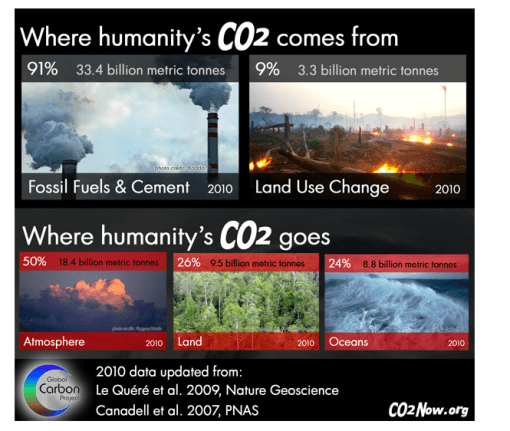
The unabated emission of Carbon dioxide by burning fossil fuels by human beings is altering the chemistry of our oceans at an unprecedented rate in the last 65 million years. When excess Carbon dioxide is absorbed by seawater it forms Carbonic acid, which is weak and unstable and increase the Hydrogen ion concentration in seawater. It decreases the pH value. The seawater is alkaline and the mean ocean surface pH  was measured at 8.2 in 1750.This acidity has  increased by 30% in recent times due to absorption of vast amount of man-made carbon dioxide since pre-industrial time. The amount estimated are about 500 Giga tones or 25% emitted into the atmosphere. According to UN report: “If we continue at this rate the ocean pH will decline by a further 0.3 by the end of this century, an unprecedented 150% increase in ocean acidity. This rate of change has not been experienced for around 65 million years, since the dinosaurs became extinct. Such a major change in basic ocean chemistry is likely to have real implications for ocean life in the future, especially organisms that need calcium carbonate to build shells or skeletons. Not all organisms will react at the same rate or in the same way to decreasing carbonate ion concentration. There are three naturally occurring forms of calcium carbonate used by marine organisms to build shells, plates or skeletons: calcite, aragonite and high magnesium calcite. For example, microscopic plants called coccolithophores surround themselves with protective calcite plates; aragonite is used by periods to build their shells and corals use it to make their skeletons that help to form reefs; while some echinoderms – starfish, sea urchins, brittle stars – utilize magnesium calcite to form their exoskeletons. Magnesium calcite is more soluble and sensitive to ocean acidification than aragonite; with calcite being the least soluble of the three. A lowering of pH and reduction of carbonate ions will make it more difficult for organisms to sustain their calcified shells, and in under saturated conditions, waters become corrosive to these minerals.

Additionally, most multicellular marine organisms have evolved a regulatory system to keep up the hydrogen ion balance of their internal fluids and spend energy doing this so an increase in hydrogen ions in seawater means that they will have to divert more energy away from important processes such as growth and reproduction to do this. However, studies of mussels, crab and sea urchin species have shown they have only a partial or no, compensation mechanism potentially making them more vulnerable than those organisms that possess a compensation mechanism”.(Ref:UNEP)

The contribution of marine food in the form of Protein to food security is substantial. Fish supplies about 15% of animal protein for about 3 billion people worldwide. Further one billion people depend on fisheries for their primary source of Protein. Steadily increasing population is pushing the demand for protein even further, while the fish stock is dwindling in many parts of the world due to over fishing and environmental degradation.

“Productivity ‘hotspots’ such as upwelling regions where cold water is rich in both nutrients and CO2, coastal seas, fronts, estuaries and sub-polar regions often supply the main protein source for coastal communities. However, many of these areas are also projected to be very vulnerable to ocean acidification this century.” (Source: UNEP)

Global warming has a much wider ramification than originally thought. It is not just warming the globe but threatens the food security and our own survival as human beings.

Wind energy is one of the fastest growing renewable energy sources in the world and in 2011 the global market grew by 6% with 40.5 GW new powers brought online, according to Global Wind Report. However storage of intermittent renewable energy is a critical contributing factor in renewable energy development. A study was conducted by University of California for California Energy Commission on the economic and environmental impact of for energy storage technologies and the ways to improve the energy efficiency of wind energy. When there is a strong wind there is no demand for power, and when there is a high demand for power there is no wind. This anomalous supply demand gap demands a reliable way of storing wind power during high wind velocity periods.

They examined for energy storage technologies namely 1.lead acid batteries, 2. Zinc Bromine flow batteries, 3.Hydrogen electrolyzer and Fuel cell storage system and 4.Hydrogen option to fuel Hydrogen cars with Hydrogen. By using NREL (national Renewable Energy laboratory) computer simulation model HOMER  for high wind penetration of 18% in California, they concluded that Hydrogen storage is the most cost-effective than other battery storage technologies and using Hydrogen to fuel Hydrogen cars is economically attractive  than converting Hydrogen into Electricity. The environmental impact of using Hydrogen is benign compared to batteries with their emissions.

“The key findings of this experiments are as follows: Energy storage systems deployed in the context of greater wind power development were not particularly well used (based on the availability of “excess” off-peak electricity from wind power), especially in the 2010 time frame (which assumed 10% wind penetration statewide), but were better utilized–up to 1,600 hours of operation per year in some cases–with the greater (20%) wind penetration levels assumed for 2020.

The levelized costs of electricity from these energy storage systems ranged from a low of $0.41 per kWh—or near the marginal cost of generation during peak demand times—to many dollars per kWh (in cases where the storage was not well utilized). This suggests that in order for these systems to be economically attractive, it may be necessary to optimize their output to coincide with peak demand periods, and to identify additional, value streams from their use (e.g., transmission and distribution system optimization, provision of power quality and grid ancillary services, etc.).

At low levels of wind penetration (1%–2%), the electrolyzer/fuel cell system was either inoperable or uneconomical (i.e., either no electricity was supplied by the energy storage system or the electricity provided carried a high cost per MWh).

In the 2010 scenarios, the flow battery system delivered the lowest cost per energy stored and delivered.  At higher levels of wind penetration, the hydrogen storage systems became more economical such that with the wind penetration levels in 2020 (18% from Southern California), the hydrogen systems delivered the least costly energy storage.

Projected decreases in capital costs and maintenance requirements along with a more durable fuel cell allowed the electrolyzer/fuel cell to gain a significant cost advantage over the battery systems in 2020.

Sizing the electrolyzer/fuel cell system to match the flow battery system’s relatively high instantaneous power output was found to increase the competitiveness of this system in low energy storage scenarios (2010 and Northern California in 2020), but in scenarios with higher levels of energy storage (Southern California in 2020), the electrolyzer/fuel cell system sized to match the flow battery output became less competitive.

The hydrogen production case was more economical than the electrolyzer/fuel cell case with the same amount of electricity consumed (i.e., hydrogen production delivered greater revenue from hydrogen sales than the electrolyzer/fuel cell avoided the cost of electricity, once the process efficiencies are considered).

Furthermore, the hydrogen production system with a higher-capacity power converter and electrolyzer (sized to match the flow battery converter) was more cost-effective than the lower-capacity system that was sized to match the output of the solid-state battery. This is due to economies of scale found to produce lower-cost hydrogen in all cases.

In general, the energy storage systems themselves are fairly benign from an environmental perspective, with the exception of emissions from the manufacture of certain components (such as nickel, lead, cadmium, and vanadium for batteries). This is particularly true outside of the U.S., where battery plant emissions are less tightly controlled and potential contamination from improper disposal of these and other materials is more likely. The overall value proposition for energy storage systems used in conjunction with intermittent renewable energy systems depends on diverse factors:

The interaction of generation and storage system characteristics and grid and energy resource conditions at a particular site The potential use of energy storage for multiple purposes in addition to improving the dependability of intermittent renewable (e.g., peak/off-peak power price arbitrage, helping to optimize the transmission and distribution infrastructure, load-leveling the grid in general, helping to mitigate power quality issues, etc.)

The degree of future progress in improving forecasting techniques and reducing prediction errors for intermittent.  Electricity market design and rules for compensating renewable energy systems for their output”. Hydrogen storage and Hydrogen cars hold the key for future renewable energy industries and Governments and industries should focus on these two key segments.

Chemistry has revolutionized human life and it has affected each and every one of us in some way or other for the past several decades. We were happily using these chemicals in our everyday life without really understanding their side effects.Individuls and companies who invented and commercialized chemical products were keen to offer end products to consumers often without explaining the side effects of such chemicals.They themselves were not fully aware of long-term consequences of such chemicals. Classical examples are Chlorine and its derivatives.

Chlorine is a common chemical that is used even today in many countries to disinfect drinking water in water treatment plants. Their usage is sill continued though they found that Haloethanes, which are formed by the action of Chlorine on decayed organic leaves in water storage, causes cancer (carcinogenic). DDT is another chemical that was used widely as a pesticide, known as “atom bomb of pesticides”,  until their side effects proved deadly for human beings and to the environment. It was officially banned in USA in 1972 by EPA, though it is still continued in some third world countries. Bleaching powder in another example of powder disinfectant ( a popular form of disinfectant used on roads in India when  prominent political leaders visit municipalities; though they are only chalk  powder with no traces of residual Chlorine).

A whole range of dyes known as coal-tar dyes derived from coal  were used in many applications including ‘food colors’, later substituted by petroleum-based organic chemicals. These ‘food colors’ are now substituted with ‘natural organic colors’ such as vegetable colors derived from vegetables and fruits. Industrial chemicals, both organic and inorganic have caused serious environmental damages all over the world for several decades, but Governments, companies and EPA did not realize the deadly consequences of some these chemicals for a long time. The ‘Bhopal Gas tragedy’ in India is one such grim reminder of such consequences.

Chemicals are not natural products even though one can separate them into various organic chemical molecules but some of the consequences of such separation and usage are not fully understood. Many natural herbs have outstanding medicinal values and when consumed in a Natural form, it has absolutely no side effects and they show tremendous therapeutic values. But when you isolate certain molecules from such herbs (Alkaloids) and used as a drug, they can cure a disease but at the same time, they create many side effects. Nature offers such drugs in a diluted form that is quite compatible to human beings. One such example is ‘Vinblastine’ and “Vincristine’, anti-cancer drugs derived from a herb called ‘vinca rosea’.

Of late there is awareness among companies, people and Governments about Green technologies that can help protect the environment. Greenhouse gas and global warming is one such issue. When Petrol or Diesel, an organic chemical known as Hydrocarbon is burnt, it not only generates power but also emits greenhouse gases such as Carbon dioxide and oxides of Nitrogen, that cause globe to warm. We were happily burning away such fossil fuels until scientists raised an issue on emission of ‘greenhouse gases’ in recent past. When we deal with chemicals and chemical reactions, the molecule is transformed into a new molecule and often such reaction cannot be reversed.It is not a physical change but a chemical change. When we convert water into steam, we can get back water by condensing steam; but when you convert Chlorine into PVC (Poly vinyl chloride) plastic, there are environmental consequences and reversing PVC into Chlorine gas in not easy, though it is technically possible with environmental consequences.

One has to observe and learn from Nature what is good and what is bad when developing a new technology, because such development will not only affect the environment but also many generations to come. When Nature teaches how to turn sugar into Alcohol by fermentation using air-borne microorganisms, we should follow Nature to make alcohol. We know how to turn Alcohol into PVC, but we do not know how to make biodegradable PVC from Alcohol. Companies call it ‘Green Chemistry’, but not until we can make a biodegradable PVC. Human knowledge is imperfect and we can learn ‘Green chemistry and Clean Technologies’ only from Nature and not by deviating from the path of Nature.

Governments and industries seek comfort from the fact that Global Warming is not directly linked with greenhouse gas emissions and there is no concrete scientific proof yet, linking these two, and think they can carry on the business as usual. Few scientists in the scientific communities also have backed such sentiments. Alternative technologies such as renewable energy technologies are expensive and cannot compete with fossil fuel based  power plants in near terms. Advanced renewable technologies need rare earth materials such as Lanthanum, cerium, praseodymium, neodymium, cobalt and lithium that are used in electric vehicle batteries; Neodymium, praseodymium and dysprosium that are used in magnets for electric vehicles and wind turbines. Lanthanum, cerium, europium, terbium and yttrium that are used in Phosphors for energy-efficient lighting; Indium, gallium and tellurium that are used in solar cells. The supply of these materials are limited or confined to few countries such as China. These new material also need more energy to mine, process and extract  using only fossil fuel generated power. Transport vehicles such as Hybrid or Electrical cars require a substantial amount of rare earth material such as Lithium for Battery production. The cost of Lithium batteries according to Centre for Transportation, Argonne National Laboratory is:

________________________________________________________
Battery type         Base line                       Optimistic              Goal

________________________________________________________
High energy          $706/kwh                   $200/kwh           >150/kwh

35kwh                  $, 24,723                      $ 8767

High-power           $, 2,486                       $ 1,095                   $300

100 10A-h cell

_________________________________________________________
The cost and maintenance of such vehicles are expensive compared to gasoline cars. The looming financial crisis, unemployment and political instability in many parts of the world have overshadowed the problem of greenhouse house and global warming. Governments in power are trying to postpone the issue of global warming as long as possible because they are unpopular among their public, who are increasingly wary of  high energy cost and their household budgets.

Industrialized countries such as US, China, India and Australia have projected their production and use of their coal, oil and gas usage in the future, which are steadily on the rise. Australia’s mining and resources industries are booming with increasing production of Coal, Coal seam methane gas, LNG, Iron ore, copper, Nickel and Gold. Increasing demand by growing economies such as India and China have propelled the production of coal and LNG and other minerals in Australia. The booming mining and shipping industries of Australia have prompted UNESCO to warn Australia about the impending danger of ‘Great Barrier reef’ being destroyed by its busy shipping activities. The Great Barrier Reef is the world’s largest coral reef ecosystem. The only living organic collective visible from space, it is considered one of the seven natural wonders of the world, and is a World Heritage listed area.

It boosts the Queensland’s image of sun, swimming and tropical islands, and around 2 million people visit the reef every year, generating more than $2 billion in direct tourism revenue in the area. The mining boom brings revenue but it also brings natural disasters and destruction of its natural wonders. The net effect will be destruction of Nature and displacement of people at the cost of mining revenue. But how long such a boom will last, and if the economies of China and India starts slowing down then, what happens to all the investments and the damage caused?

The above developments paint a grim picture on global warming. The world has witnessed natural disasters causing huge human and financial losses. The natural disasters have costed an economic loss of nearly 13 to 30 billion dollars in the past two years in Australia alone. Yet, people and Governments want a ‘concrete proof’ that man-made greenhouse gases causes global warming and triggers natural disasters. Well, we can carry on such conversation indefinitely till we reach a point of no return. “Wisdom comes from experience; but experience comes from foolishness”.