Flickr Photos
Ahilan Raman
-
ahilan@cewt.tech
- Closed-Loop Energy Systems:
- India’s Kalpakkam’s PFBR is a remarkable step—it shows how energy systems can move from fuel consumption to fuel creation.
- Delivering Closed-Loop Energy Systems for a Defossilised World
- From Energy Crisis to Energy Sovereignty
- CEWT | Investor BriefCarbon Recycling Technology (CRT)
- Scale vs Leverage: Why System Design Always Wins
- Scale vs Leverage: Why System Design Always Wins
- From Renewable Expansion to System Decarbonisation
- Carbon Recycling Technology for zero emissions and zero fossil fuel, except for the start-up.
- Carbon Recycling technology – for zero emission, zero fossil fuel, except for the start-up.
-
 Clean Energy and Water
- Closed-Loop Energy Systems:
- India’s Kalpakkam’s PFBR is a remarkable step—it shows how energy systems can move from fuel consumption to fuel creation.
- Delivering Closed-Loop Energy Systems for a Defossilised World
- From Energy Crisis to Energy Sovereignty
- CEWT | Investor BriefCarbon Recycling Technology (CRT)
- Scale vs Leverage: Why System Design Always Wins
- Scale vs Leverage: Why System Design Always Wins
- From Renewable Expansion to System Decarbonisation
- Carbon Recycling Technology for zero emissions and zero fossil fuel, except for the start-up.
- Carbon Recycling technology – for zero emission, zero fossil fuel, except for the start-up.
Ahilan Raman
Author Archives: ahilan@cewt.tech
CEWT | Clean Energy and Water Technologies Pty Ltd
ABN 61 691 320 028
Defossilisation: Enabling Energy & Material Sovereignty
Executive Summary
Defossilisation replaces fossil extraction with renewable energy, hydrogen, and recycled carbon, enabling nations to achieve energy and material sovereignty while reducing geopolitical risk.
Strategic Context
Global energy systems remain dependent on unevenly distributed fossil resources, creating supply vulnerabilities, price volatility, and geopolitical leverage.
System Transition
The transition moves from Extract → Burn → Emit toward Generate → Convert → Recycle, enabled by renewable electricity, hydrogen, and carbon reuse.
Carbon as Infrastructure
Carbon is no longer a consumable fuel but a circulating system asset—similar to copper in electrical systems—forming the backbone of a closed-loop energy economy.
Industrial Transformation
CO₂ + H₂ pathways enable production of methane, methanol, olefins, and polymers, supporting full domestic industrial capability without fossil inputs.
Geopolitical Implications
Defossilisation removes dependence on imports, reduces exposure to supply disruptions, and weakens structural drivers of conflict.
CRT Framework
Carbon Recycling Technology (CRT) operationalises this model through a closed-loop carbon system delivering dispatchable, renewable energy and fuel.
Conclusion
Defossilisation represents a system-level redesign enabling sovereign, resilient, and sustainable energy and industrial systems.
Clean Energy and Water Technologies Pty Ltd (CEWT)
ABN 61 691 320 028 | ACN 691 320 028
Technology Note
Why Carbon Recycling Technology (CRT) Is Structurally Superior for Green Iron Production
Date: March 2026
Prepared for: Government agencies, investors, industrial partners
Overview
Carbon Recycling Technology (CRT) enables zero-emission iron production by combining hydrogen-rich syngas reduction with a closed carbon loop.
Unlike hydrogen-only pathways that require large new infrastructure and massive electrolysis capacity, CRT preserves the proven gas-based reduction chemistry used in Direct Reduced Iron (DRI) systems while eliminating net carbon emissions.
This approach allows the transition to green iron production using existing industrial infrastructure with significantly lower energy and hydrogen requirements.
1. Uses Proven Gas-Based Iron Reduction Chemistry
CRT reduces iron ore using hydrogen-rich syngas (CO + H₂) generated through steam reforming.
This is the same fundamental chemistry used in natural-gas-based DRI processes such as those deployed globally by Midrex.
Advantages
- Proven shaft-furnace technology
- Established reduction kinetics
- Mature industrial operating experience
- Reduced technical risk
CRT therefore builds on existing metallurgical practice rather than introducing an entirely new process.
2. Achieves Zero Emissions Through Carbon Recycling
In conventional natural-gas DRI:
Natural Gas → Reduction → CO₂ released to atmosphere
In CRT:
Natural Gas / RNG → Reduction → CO₂ captured → recycled → Renewable Natural Gas (RNG)
The carbon atom, therefore, circulates continuously within the system, acting as a recyclable carrier rather than being emitted.
This closed molecular loop allows CRT to achieve net-zero emissions without eliminating carbon from the process chemistry.
3. Dramatically Lower Hydrogen Requirement
Hydrogen-only ironmaking requires hydrogen to supply both:
- the reducing gas, and
- the energy source for the process
This results in very large electrolysis capacity requirements.
CRT instead uses hydrogen-rich syngas, with only a small renewable hydrogen trim required to maintain the carbon recycling loop.
Benefits
- significantly smaller electrolysers
- lower renewable electricity demand
- reduced hydrogen storage requirements
- improved economic feasibility
4. Compatible With Existing Industrial Infrastructure
Hydrogen-only steelmaking requires major changes to industrial systems, including:
- new hydrogen production infrastructure
- new fuel supply networks
- modified furnaces and process systems
CRT maintains compatibility with existing infrastructure, including:
- gas reforming systems
- DRI shaft furnaces
- gas handling and distribution networks
- high-temperature industrial heat systems
This allows decarbonisation to proceed faster and at lower capital cost.
Structural Advantage of CRT
Traditional decarbonisation approaches attempt to remove carbon from industrial energy systems.
CRT instead recycles carbon as a molecular energy carrier, while renewable hydrogen provides the incremental energy required to maintain the loop.
This architecture preserves the thermodynamic advantages of carbon-based fuels while eliminating net emissions.
Conclusion
Carbon Recycling Technology provides a practical pathway for green iron production by combining:
- proven gas-based reduction chemistry
- closed-loop carbon recycling
- minimal hydrogen requirements
- compatibility with existing infrastructure
This system architecture enables heavy industry to transition toward zero-emission production while maintaining operational reliability and economic viability.
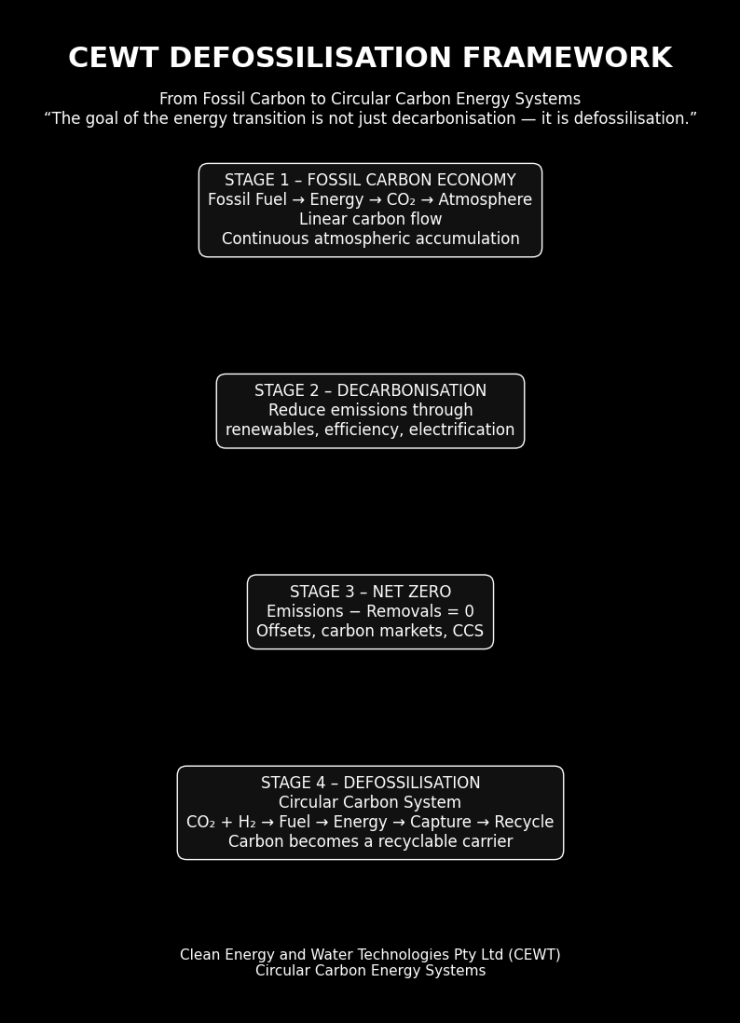
Net Zero Balances Carbon. Carbon Circulation Eliminates the Problem.
Suggested LinkedIn headline
Net Zero balances carbon.
Carbon Circulation prevents the problem in the first place.
LinkedIn Post Text
For more than a decade, climate policy has focused on Net Zero.
The idea is straightforward:
Emit CO₂ → Remove CO₂ → Balance the equation.
This framework has mobilised governments, corporations and investors around the world. But fundamentally, Net Zero is an accounting approach. It assumes emissions will occur and must later be offset, captured, or removed.
A different approach is possible.
Instead of balancing emissions after they occur, we can design energy systems where carbon never becomes waste in the first place.
This is the principle behind Carbon Recycling Technology (CRT).
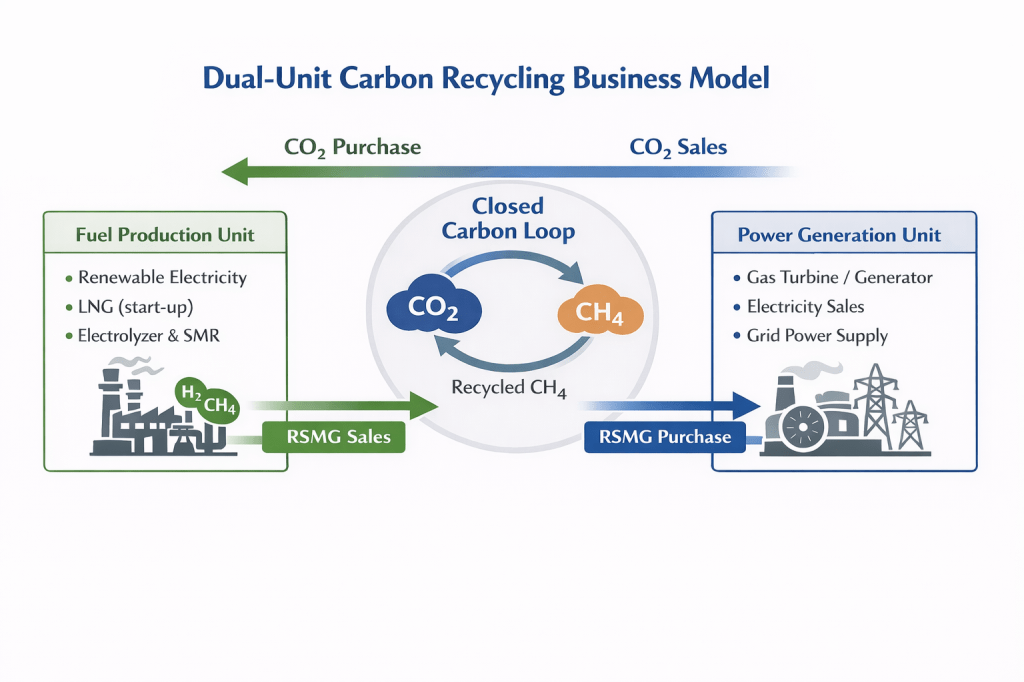
In CRT systems, captured CO₂ is combined with renewable hydrogen to produce renewable methane.
When methane is used for power generation or industrial energy, the resulting CO₂ is captured and recycled back into the system.
Carbon atoms, therefore, circulate continuously within the energy system.
Carbon becomes a recyclable carrier of energy, while renewable hydrogen provides the energy input that drives the cycle.
This shifts the conversation from:
Carbon accounting → Carbon system design
Instead of managing emissions after they occur, circular carbon systems prevent them at the source.
The next phase of the energy transition may therefore not simply be about achieving Net Zero.
It may be about building circular carbon energy systems.
Clean Energy and Water Technologies Pty Ltd (CEWT)
Advancing circular carbon energy systems for a resilient and sustainable future.
#CircularCarbon
#CarbonRecycling
#EnergyTransition
#Decarbonisation
#CleanEnergy
#NetZero
#EnergySystems
#IndustrialDecarbonisation


 Clean Energy and Water Technologies Pty Ltd