Skip navigation

Author Archives: ahilan@cewt.tech

Professional chemical engineer,specializing on clean energy and water technologies.He has more than 35 years of industrial experience in various process industries.Bulk of his experience were in R&D and commercialization.He has few innovative National and International patents on desalination and power generation. His latest patent is to store renewable energy such as solar, wind and geothermal in the form of SNG (synthetic natural gas) to generate base load power. You can eliminate the usage of fossil fuel and substitute with SNG with Zero Carbon emission. He is also a writer on Eastern philosophy, especially on Advaita Vedanta. He believes that science and Vedanta are two sides of the same coin. Science applies to this physical world, and it has its limitations. However, spirituality transcends science and the physical realm. It is your TRUE NATURE. Please check my LinkedIn profile.

Why and Where Future Capital

Must Flow

  • From Energy Transition to System Transformation
  • — CEWT

The Real Problem

  • Climate change is not just an energy problem.
  • It is a carbon system problem.

Carbon Is Embedded Everywhere

  • Solar panels, wind turbines, batteries, steel, plastics, chemicals.
  • Modern civilisation runs on carbon.

Where Capital Flows Today

  • Capital → Solar/Wind → Storage → Electricity
  • Gaps remain: heat, chemicals, baseload, carbon.

Where Capital Must Flow

  • Capital → Renewables → Hydrogen → Closed Carbon Loop → Renewable Fuels
  • Power + Heat + Chemicals integrated.

Why Capital Misflows

  • Technical, commercial, financial, ESG, and timing constraints
  • Prevent system-level investments.

System Shift Required

  • Open Loop: Extract → Use → Emit
  • Closed Loop: Capture → Reuse → Recycle

The Missing Layer

  • Renewable electricity alone is not enough.
  • We need renewable fuels for thermal and industrial energy.

Investment Thesis

  • Capital must shift from isolated assets to integrated systems.
  • Carbon must become a carrier, not waste.

Conclusion

  • The next wave of capital will define whether we fix the system—or reinforce its limits.
  • — CEWT

The world is not struggling with climate change because we lack renewable energy.

We are struggling because carbon is deeply embedded in the architecture of modern civilisation.

Fossil carbon is not just used for power generation. It sits underneath almost everything we depend on:

– Solar panels (materials, processing, supply chains)

– Wind turbines (resins, composites, steel)

– Batteries (mining, refining, chemical processing)

– Rare earth minerals (energy-intensive extraction and separation)

– Plastics, pharmaceuticals, fine chemicals, cosmetics

This is not an energy problem alone.

It is a carbon system problem.

That is why Net Zero feels so difficult—almost impossible.

Because we are trying to remove something that is structurally embedded across the entire system.

But here is the shift we need to understand:

The solution is not to eliminate carbon.

The solution is to change how carbon flows through the system.

Today, we operate an open loop:

Fossil carbon → extraction → use → emission → accumulation

What we need is a closed loop:

Carbon → capture → reuse → recycle → repeat

Until we redesign the system around a closed carbon loop,

emissions will continue—no matter how fast solar and wind grow.

Because renewable electricity alone does not solve:

– Industrial heat

– Chemical production

– Fertiliser systems

– Long-duration energy storage

The world doesn’t just need renewable electricity.

It needs renewable fuels.

Because thermal energy is still the dominant backbone of global industry.

Net Zero will not be achieved by replacing electrons alone.

It will be achieved when we redesign the system so that

carbon becomes a carrier—not a waste product.

That is the real transition.

This is not an oil crisis.

It’s something deeper — and far more structural.

It’s an energy system failure.


For decades, energy systems were built on a simple assumption:

Demand is predictable. Supply is controllable.

That world no longer exists.


Today, three forces are colliding:

AI is turning electricity into continuous demand

🌬️ Renewables are inherently intermittent

🔋 Storage is still short-duration

Individually, each works.

Together, they create instability.


We are now facing a mismatch that the system was never designed for:

  • Demand is becoming time-dependent and continuous
  • Supply is becoming variable and weather-driven

And we are trying to bridge that gap with incremental fixes.

More renewables.

More batteries.

More transmission.


But here’s the uncomfortable truth:

You cannot solve a structural problem with incremental solutions.


This is why the conversation around energy is starting to shift — quietly, but fundamentally.

From technology → to system architecture


At Clean Energy and Water Technologies (CEWT), we’ve been working on this problem from a different angle.

Not just how to generate clean energy.

But how to reshape energy so it behaves like the system needs it to.


Because the real challenge is not producing energy.

It is aligning energy with time.


This is where Carbon Recycling Technology (CRT) comes in.

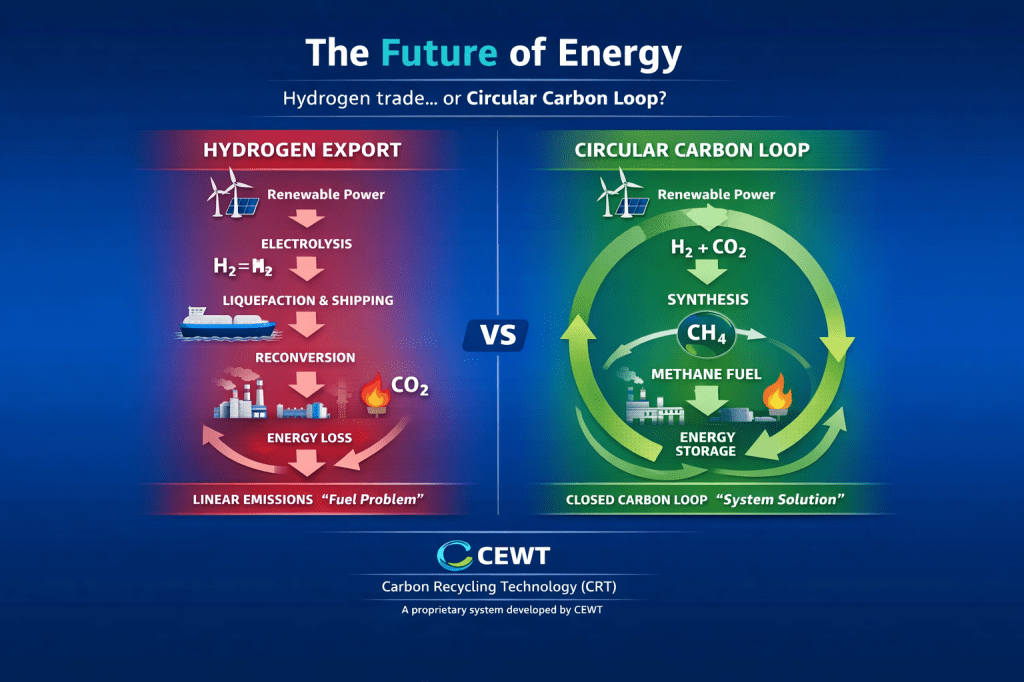
  • Renewable electricity is converted into hydrogen
  • Hydrogen combines with captured CO₂
  • The result is renewable methane (RNG) — a storable, dispatchable energy carrier

And when used, the CO₂ is captured and recycled again.


Carbon is no longer a liability.

It becomes a carrier.


This changes the equation:

Instead of forcing demand to follow supply,

Supply is reshaped to follow demand.


And that is the missing layer in today’s energy transition.


We are not just transitioning energy.

We are redesigning the system that carries it.


AI, industry, and global electrification are accelerating this reality.

The question is no longer whether change is needed.

It is whether we continue to optimise the old system —

or build the one that actually works.


There is no shortcut.

Closing the carbon loop is the only real path to defossilisation.


#EnergyTransition #AI #EnergySystems #Hydrogen #Decarbonisation #CRT #CEWT

This is not an oil crisis.

It’s something deeper — and far more structural.

It’s an energy system failure.


For decades, energy systems were built on a simple assumption:

Demand is predictable. Supply is controllable.

That world no longer exists.


Today, three forces are colliding:

AI is turning electricity into continuous demand

🌬️ Renewables are inherently intermittent

🔋 Storage is still short-duration

Individually, each works.

Together, they create instability.


We are now facing a mismatch that the system was never designed for:

  • Demand is becoming time-dependent and continuous
  • Supply is becoming variable and weather-driven

And we are trying to bridge that gap with incremental fixes.

More renewables.

More batteries.

More transmission.


But here’s the uncomfortable truth:

You cannot solve a structural problem with incremental solutions.


This is why the conversation around energy is starting to shift — quietly, but fundamentally.

From technology → to system architecture


At Clean Energy and Water Technologies (CEWT), we’ve been working on this problem from a different angle.

Not just how to generate clean energy.

But how to reshape energy so it behaves like the system needs it to.


Because the real challenge is not producing energy.

It is aligning energy with time.


This is where Carbon Recycling Technology (CRT) comes in.

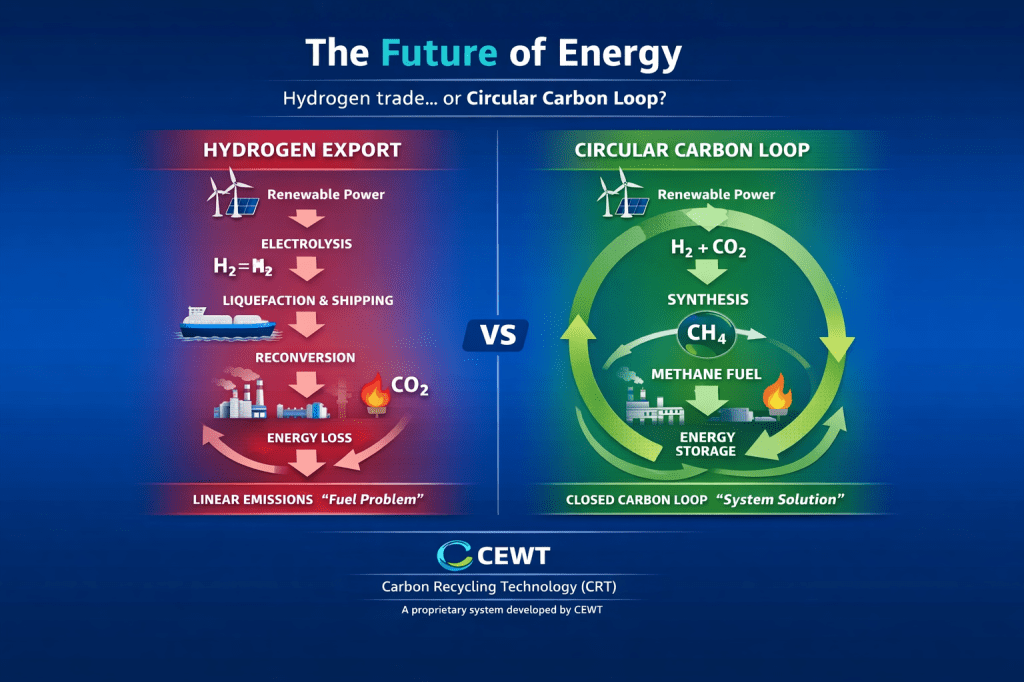
  • Renewable electricity is converted into hydrogen
  • Hydrogen combines with captured CO₂
  • The result is renewable methane (RNG) — a storable, dispatchable energy carrier

And when used, the CO₂ is captured and recycled again.


Carbon is no longer a liability.

It becomes a carrier.


This changes the equation:

Instead of forcing demand to follow supply,

Supply is reshaped to follow demand.


And that is the missing layer in today’s energy transition.


We are not just transitioning energy.

We are redesigning the system that carries it.


AI, industry, and global electrification are accelerating this reality.

The question is no longer whether change is needed.

It is whether we continue to optimise the old system —

or build the one that actually works.


There is no shortcut.

Closing the carbon loop is the only real path to defossilisation.


#EnergyTransition #AI #EnergySystems #Hydrogen #Decarbonisation #CRT #CEWT

Clean Energy and Water Technologies Pty Ltd (CEWT)

Energy Systems Insight Note
AI Load vs Grid Reality — A System Architecture Perspective

1. The Emerging Mismatch

Artificial Intelligence (AI), particularly at inference scale, introduces a new category of electricity demand.

While AI models are often evaluated based on efficiency per computation, the electrical grid experiences demand differently.

The grid sees:
• Continuous load accumulation over time 
• Cumulative demand from distributed inference 
• Persistent, baseload-like pressure 

Model efficiency is instantaneous — grid stress is time-integrated.

2. Why This Matters

As AI adoption accelerates, inference workloads behave like:
• Always-on services 
• Globally distributed compute 
• Latency-sensitive operations 

AI is no longer a discrete load. It becomes a continuous system force shaping demand.

3. Limits of Current Approaches

Current responses include:
• Time-of-use pricing 
• Real-time markets 
• Location-based signals 
• Limited workload shifting 

But these are incremental. The structural imbalance remains:

Renewables → intermittent 
Batteries → short-duration 
AI demand → continuous 

Pricing alone cannot solve this.

4. The System Architecture Shift

The next phase requires integrated system design.

CEWT’s Carbon Recycling Technology (CRT):
• Converts renewable electricity into renewable gas 
• Stores energy in molecular form 
• Dispatches energy when required 

This enables long-duration storage and demand-aligned supply.

5. Reframing the Problem

Instead of aligning demand to supply:

We must reshape supply to follow demand.

This is essential for AI-scale energy systems and industrial decarbonisation.

6. The Strategic Fork

Path 1: Incremental expansion 
• More renewables, storage, transmission 

Path 2: Architectural integration 
• Electrons + molecules 
• Long-duration storage 
• Demand-responsive systems

7. Conclusion

AI is not just a load — it is a system-shaping force.

It will either stress existing infrastructure or drive a transition toward integrated energy systems.

The outcome depends on whether we optimise incrementally or redesign fundamentally.


CEWT — Advancing Carbon Recycling Technology for integrated, dispatchable, zero-emission energy systems.

🌐 CEWT Foundation Series

CRT: ESG as an Engineered System

Most ESG today is treated as a reporting framework—

metrics, disclosures, and compliance.

But what if ESG was not something you report…

👉 But something you build into the system itself?

At CEWT, this is the foundation of Carbon Recycling Technology (CRT).


🔷 CRT is not just a technology.

👉 It is an ESG playbook—engineered into reality.


🟢 E — Environmental

Closed carbon loop

No new fossil input

Carbon is recycled, not emitted

🔵 S — Social

Energy security

Industrial continuity

Reliable, dispatchable power for real economies

⚙️ G — Governance

System-level transparency

Measurable inputs and outputs

No reliance on offsets—only physical accountability


👉 This is the shift:

From ESG as disclosure

To ESG as design

From targets and reporting

To systems that inherently deliver outcomes


🌱 CRT transforms ESG from a framework into an operating system.

Not theoretical.

Not aspirational.

But engineered, verifiable, and scalable.


#CEWT #CRT #ESG #Defossilisation #EnergyTransition #SystemThinking #NetZero #CleanEnergy