Skip navigation

Author Archives: ahilan@cewt.tech

Professional chemical engineer,specializing on clean energy and water technologies.He has more than 35 years of industrial experience in various process industries.Bulk of his experience were in R&D and commercialization.He has few innovative National and International patents on desalination and power generation. His latest patent is to store renewable energy such as solar, wind and geothermal in the form of SNG (synthetic natural gas) to generate base load power. You can eliminate the usage of fossil fuel and substitute with SNG with Zero Carbon emission. He is also a writer on Eastern philosophy, especially on Advaita Vedanta. He believes that science and Vedanta are two sides of the same coin. Science applies to this physical world, and it has its limitations. However, spirituality transcends science and the physical realm. It is your TRUE NATURE. Please check my LinkedIn profile.

FrCEWT | Investor Brief
Carbon Recycling Technology (CRT)

From Energy Crisis to Energy Sovereignty

EXECUTIVE SUMMARY

The global energy system is undergoing structural disruption driven by geopolitical instability and climate constraints.
This is not a temporary crisis — it is the breakdown of an outdated energy architecture.

For over a century, energy systems have operated as open loops:
Extract → Burn → Generate → Emit → Pollute

This model is no longer viable.

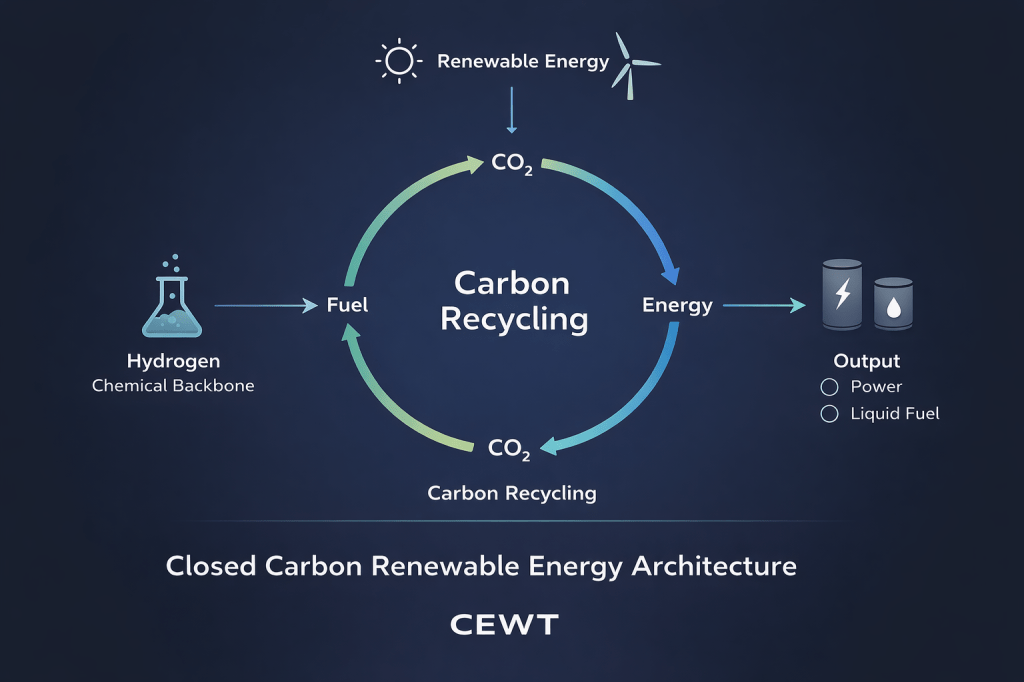
Carbon Recycling Technology (CRT), developed by Clean Energy and Water Technologies (CEWT), introduces a closed-loop energy architecture where carbon is continuously recycled rather than emitted.

CRT transforms captured CO₂ into renewable methane using green hydrogen, enabling dispatchable, zero-emission power generation while maintaining energy density and infrastructure compatibility.

This represents a paradigm shift from fuel substitution to system redesign.


THE OPPORTUNITY

• Global energy markets are facing volatility due to supply disruptions and geopolitical risk
• Industrial sectors require 24/7 power, heat, and molecular fuels
• Hydrogen alone faces storage, transport, and cost limitations
• Existing infrastructure is built around hydrocarbons

CRT addresses all four simultaneously.

It enables:
• Baseload renewable power
• Industrial heat continuity
• Molecular energy storage
• Compatibility with existing gas infrastructure


CORE TECHNOLOGY

CRT integrates:
• CO₂ capture
• Renewable hydrogen production
• Methanation (CO₂ + 4H₂ → CH₄ + 2H₂O)
• Gas turbine power generation

Carbon becomes a recyclable carrier.
Hydrogen becomes the energy input.
Methane becomes the storage medium.

The result is a perpetual carbon-energy loop.


INVESTMENT CASE

1. System-Level Innovation
CRT is not a single technology — it is an integrated energy architecture addressing power, heat, and fuel simultaneously.

2. Infrastructure Advantage
Leverages existing gas pipelines, storage, and turbines — reducing transition costs.

3. Energy Sovereignty
Enables nations to produce fuel domestically from CO₂ and renewable electricity.

4. Market Alignment
Aligned with global decarbonisation policies, carbon markets, and energy security priorities.

5. Scalability
Applicable across power generation, steel, chemicals, and desalination sectors.


STRATEGIC POSITIONING

CRT sits at the intersection of:
• Renewable energy
• Carbon management
• Synthetic fuels
• Industrial decarbonisation

It bridges the gap between intermittent renewables and continuous industrial demand.


WHY NOW

• Fossil fuel volatility is rising
• Hydrogen economics remain uncertain
• Carbon pricing is tightening globally
• Grid stability challenges are increasing

The current disruption is accelerating adoption of closed-loop systems.


CONCLUSION

The energy transition is not simply about replacing fuels.

It is about redesigning the system.

CRT enables that transition by closing the carbon loop — transforming a liability into a reusable asset.

This is not incremental improvement.

This is foundational change.


CONTACT
Clean Energy and Water Technologies Pty Ltd (CEWT)
Australia

om Energy Crisis to Energy Sovereignty
From Energy Crisis to Energy Sovereignty
EXECUTIVE SUMMARY

The global energy system is undergoing structural disruption driven by geopolitical instability and climate constraints.
This is not a temporary crisis — it is the breakdown of an outdated energy architecture.

For over a century, energy systems have operated as open loops:
Extract → Burn → Generate → Emit → Pollute

This model is no longer viable.

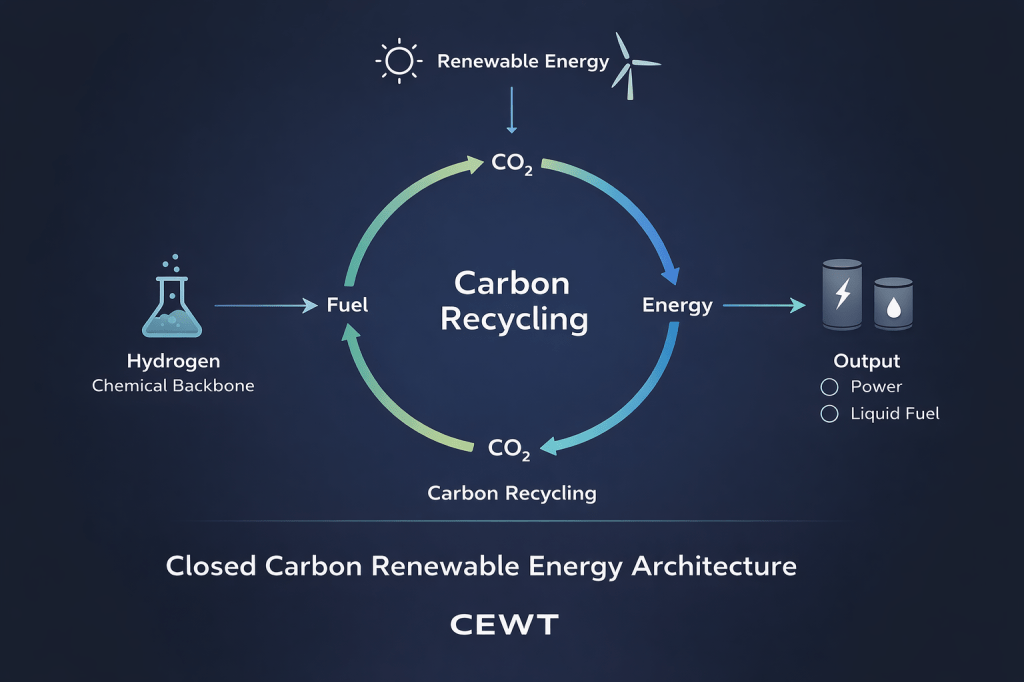
Carbon Recycling Technology (CRT), developed by Clean Energy and Water Technologies (CEWT), introduces a closed-loop energy architecture where carbon is continuously recycled rather than emitted.

CRT transforms captured CO₂ into renewable methane using green hydrogen, enabling dispatchable, zero-emission power generation while maintaining energy density and infrastructure compatibility.

This represents a paradigm shift from fuel substitution to system redesign.


THE OPPORTUNITY

• Global energy markets are facing volatility due to supply disruptions and geopolitical risk
• Industrial sectors require 24/7 power, heat, and molecular fuels
• Hydrogen alone faces storage, transport, and cost limitations
• Existing infrastructure is built around hydrocarbons

CRT addresses all four simultaneously.

It enables:
• Baseload renewable power
• Industrial heat continuity
• Molecular energy storage
• Compatibility with existing gas infrastructure


CORE TECHNOLOGY

CRT integrates:
• CO₂ capture
• Renewable hydrogen production
• Methanation (CO₂ + 4H₂ → CH₄ + 2H₂O)
• Gas turbine power generation

Carbon becomes a recyclable carrier.
Hydrogen becomes the energy input.
Methane becomes the storage medium.

The result is a perpetual carbon-energy loop.


INVESTMENT CASE

1. System-Level Innovation
CRT is not a single technology — it is an integrated energy architecture addressing power, heat, and fuel simultaneously.

2. Infrastructure Advantage
Leverages existing gas pipelines, storage, and turbines — reducing transition costs.

3. Energy Sovereignty
Enables nations to produce fuel domestically from CO₂ and renewable electricity.

4. Market Alignment
Aligned with global decarbonisation policies, carbon markets, and energy security priorities.

5. Scalability
Applicable across power generation, steel, chemicals, and desalination sectors.


STRATEGIC POSITIONING

CRT sits at the intersection of:
• Renewable energy
• Carbon management
• Synthetic fuels
• Industrial decarbonisation

It bridges the gap between intermittent renewables and continuous industrial demand.


WHY NOW

• Fossil fuel volatility is rising
• Hydrogen economics remain uncertain
• Carbon pricing is tightening globally
• Grid stability challenges are increasing

The current disruption is accelerating adoption of closed-loop systems.


CONCLUSION

The energy transition is not simply about replacing fuels.

It is about redesigning the system.

CRT enables that transition by closing the carbon loop — transforming a liability into a reusable asset.

This is not incremental improvement.

This is foundational change.


CONTACT
Clean Energy and Water Technologies Pty Ltd (CEWT)
Australia

CEWT | Investor Brief
Carbon Recycling Technology (CRT)

From Energy Crisis to Energy Sovereignty

EXECUTIVE SUMMARY

The global energy system is undergoing structural disruption driven by geopolitical instability and climate constraints.
This is not a temporary crisis — it is the breakdown of an outdated energy architecture.

For over a century, energy systems have operated as open loops:
Extract → Burn → Generate → Emit → Pollute

This model is no longer viable.

Carbon Recycling Technology (CRT), developed by Clean Energy and Water Technologies (CEWT), introduces a closed-loop energy architecture where carbon is continuously recycled rather than emitted.

CRT transforms captured CO₂ into renewable methane using green hydrogen, enabling dispatchable, zero-emission power generation while maintaining energy density and infrastructure compatibility.

This represents a paradigm shift from fuel substitution to system redesign.


THE OPPORTUNITY

• Global energy markets are facing volatility due to supply disruptions and geopolitical risk
• Industrial sectors require 24/7 power, heat, and molecular fuels
• Hydrogen alone faces storage, transport, and cost limitations
• Existing infrastructure is built around hydrocarbons

CRT addresses all four simultaneously.

It enables:
• Baseload renewable power
• Industrial heat continuity
• Molecular energy storage
• Compatibility with existing gas infrastructure


CORE TECHNOLOGY

CRT integrates:
• CO₂ capture
• Renewable hydrogen production
• Methanation (CO₂ + 4H₂ → CH₄ + 2H₂O)
• Gas turbine power generation

Carbon becomes a recyclable carrier.
Hydrogen becomes the energy input.
Methane becomes the storage medium.

The result is a perpetual carbon-energy loop.


INVESTMENT CASE

1. System-Level Innovation
CRT is not a single technology — it is an integrated energy architecture addressing power, heat, and fuel simultaneously.

2. Infrastructure Advantage
Leverages existing gas pipelines, storage, and turbines — reducing transition costs.

3. Energy Sovereignty
Enables nations to produce fuel domestically from CO₂ and renewable electricity.

4. Market Alignment
Aligned with global decarbonisation policies, carbon markets, and energy security priorities.

5. Scalability
Applicable across power generation, steel, chemicals, and desalination sectors.


STRATEGIC POSITIONING

CRT sits at the intersection of:
• Renewable energy
• Carbon management
• Synthetic fuels
• Industrial decarbonisation

It bridges the gap between intermittent renewables and continuous industrial demand.


WHY NOW

• Fossil fuel volatility is rising
• Hydrogen economics remain uncertain
• Carbon pricing is tightening globally
• Grid stability challenges are increasing

The current disruption is accelerating the adoption of closed-loop systems.


CONCLUSION

The energy transition is not simply about replacing fuels.

It is about redesigning the system.

CRT enables that transition by closing the carbon loop — transforming a liability into a reusable asset.

This is not an incremental improvement.

This is foundational change.


CONTACT
Clean Energy and Water Technologies Pty Ltd (CEWT)
Australia

We often talk about scale as the path to impact.

More capital.

More assets.

More capacity.

But in infrastructure and engineering systems, scale is not what creates the biggest change.

Leverage does.


Scale is about doing more with more.

Leverage is about doing more with less

by changing how the system behaves.


A single design improvement in a system doesn’t stay local.

It flows.

  • Through the process
  • Across the network
  • Into every downstream outcome

That’s why:

✔ A better water treatment design improves quality for entire communities

✔ A smarter energy system reduces costs across industries

✔ A more efficient process reshapes the economics of the whole value chain


Because the impact in real systems is not linear.

It is multiplicative.


The challenge is that most solutions today are still built around components:

  • A better turbine
  • A more efficient battery
  • A cleaner fuel

All important.

But limited — if the system itself remains unchanged.


Real transformation happens when we shift focus:

From optimising parts

➝ To redesigning the whole system


This is where leverage lives.

In architecture.

In integration.

In how energy, materials, and flows are connected.


And this is why:

System design always wins.

Not because scale doesn’t matter —

But because leverage determines how far scale can go.


The future won’t be built by adding more.

It will be built by designing better.


#SystemsThinking #Engineering #EnergyTransition #Infrastructure #Innovation #ClimateTech #Leverage

We often talk about scale as the path to impact.

More capital.

More assets.

More capacity.

But in infrastructure and engineering systems, scale is not what creates the biggest change.

Leverage does.


Scale is about doing more with more.

Leverage is about doing more with less

by changing how the system behaves.


A single design improvement in a system doesn’t stay local.

It flows.

  • Through the process
  • Across the network
  • Into every downstream outcome

That’s why:

✔ A better water treatment design improves quality for entire communities

✔ A smarter energy system reduces costs across industries

✔ A more efficient process reshapes the economics of the whole value chain


Because the impact in real systems is not linear.

It is multiplicative.


The challenge is that most solutions today are still built around components:

  • A better turbine
  • A more efficient battery
  • A cleaner fuel

All important.

But limited — if the system itself remains unchanged.


Real transformation happens when we shift focus:

From optimising parts

➝ To redesign the whole system


This is where leverage lives.

In architecture.

In integration.

In how energy, materials, and flows are connected.


And this is why:

System design always wins.

Not because scale doesn’t matter —

but because leverage determines how far scale can go.


The future won’t be built by adding more.

It will be built by designing better.


#SystemsThinking #Engineering #EnergyTransition #Infrastructure #Innovation #ClimateTech #Leverage

From Renewable Expansion to System Decarbonisation

Over the past decade, renewable energy deployment has scaled rapidly with strong institutional backing. While this has delivered meaningful progress in electricity decarbonisation, broader system-level outcomes remain incomplete.

Key Insight

Decarbonisation of electricity is not equivalent to decarbonisation of the economy. Industrial systems require continuous power, heat, and process stability that current investment patterns do not fully address.

Observed Gaps

• Industrial decarbonisation remains limited

• System complexity and duplication are increasing

• Dispatchable energy gaps persist

Strategic Risk

Without system-level alignment, continued capital deployment risks locking in inefficiencies, reducing industrial competitiveness, and diluting public value.

Policy Direction

• Shift from project metrics to system metrics

• Enable integrated energy architectures

• Prioritise industrial continuity

• Align funding with whole-of-economy outcomes

Conclusion

The next phase of climate finance must focus on integrated, resilient energy systems that support both decarbonisation and economic productivity.

Why and Where Future Capital

Must Flow

  • From Energy Transition to System Transformation
  • — CEWT

The Real Problem

  • Climate change is not just an energy problem.
  • It is a carbon system problem.

Carbon Is Embedded Everywhere

  • Solar panels, wind turbines, batteries, steel, plastics, chemicals.
  • Modern civilisation runs on carbon.

Where Capital Flows Today

  • Capital → Solar/Wind → Storage → Electricity
  • Gaps remain: heat, chemicals, baseload, carbon.

Where Capital Must Flow

  • Capital → Renewables → Hydrogen → Closed Carbon Loop → Renewable Fuels
  • Power + Heat + Chemicals integrated.

Why Capital Misflows

  • Technical, commercial, financial, ESG, and timing constraints
  • Prevent system-level investments.

System Shift Required

  • Open Loop: Extract → Use → Emit
  • Closed Loop: Capture → Reuse → Recycle

The Missing Layer

  • Renewable electricity alone is not enough.
  • We need renewable fuels for thermal and industrial energy.

Investment Thesis

  • Capital must shift from isolated assets to integrated systems.
  • Carbon must become a carrier, not waste.

Conclusion

  • The next wave of capital will define whether we fix the system—or reinforce its limits.
  • — CEWT

The world is not struggling with climate change because we lack renewable energy.

We are struggling because carbon is deeply embedded in the architecture of modern civilisation.

Fossil carbon is not just used for power generation. It sits underneath almost everything we depend on:

– Solar panels (materials, processing, supply chains)

– Wind turbines (resins, composites, steel)

– Batteries (mining, refining, chemical processing)

– Rare earth minerals (energy-intensive extraction and separation)

– Plastics, pharmaceuticals, fine chemicals, cosmetics

This is not an energy problem alone.

It is a carbon system problem.

That is why Net Zero feels so difficult—almost impossible.

Because we are trying to remove something that is structurally embedded across the entire system.

But here is the shift we need to understand:

The solution is not to eliminate carbon.

The solution is to change how carbon flows through the system.

Today, we operate an open loop:

Fossil carbon → extraction → use → emission → accumulation

What we need is a closed loop:

Carbon → capture → reuse → recycle → repeat

Until we redesign the system around a closed carbon loop,

emissions will continue—no matter how fast solar and wind grow.

Because renewable electricity alone does not solve:

– Industrial heat

– Chemical production

– Fertiliser systems

– Long-duration energy storage

The world doesn’t just need renewable electricity.

It needs renewable fuels.

Because thermal energy is still the dominant backbone of global industry.

Net Zero will not be achieved by replacing electrons alone.

It will be achieved when we redesign the system so that

carbon becomes a carrier—not a waste product.

That is the real transition.

This is not an oil crisis.

It’s something deeper — and far more structural.

It’s an energy system failure.


For decades, energy systems were built on a simple assumption:

Demand is predictable. Supply is controllable.

That world no longer exists.


Today, three forces are colliding:

AI is turning electricity into continuous demand

🌬️ Renewables are inherently intermittent

🔋 Storage is still short-duration

Individually, each works.

Together, they create instability.


We are now facing a mismatch that the system was never designed for:

  • Demand is becoming time-dependent and continuous
  • Supply is becoming variable and weather-driven

And we are trying to bridge that gap with incremental fixes.

More renewables.

More batteries.

More transmission.


But here’s the uncomfortable truth:

You cannot solve a structural problem with incremental solutions.


This is why the conversation around energy is starting to shift — quietly, but fundamentally.

From technology → to system architecture


At Clean Energy and Water Technologies (CEWT), we’ve been working on this problem from a different angle.

Not just how to generate clean energy.

But how to reshape energy so it behaves like the system needs it to.


Because the real challenge is not producing energy.

It is aligning energy with time.


This is where Carbon Recycling Technology (CRT) comes in.

  • Renewable electricity is converted into hydrogen
  • Hydrogen combines with captured CO₂
  • The result is renewable methane (RNG) — a storable, dispatchable energy carrier

And when used, the CO₂ is captured and recycled again.


Carbon is no longer a liability.

It becomes a carrier.


This changes the equation:

Instead of forcing demand to follow supply,

Supply is reshaped to follow demand.


And that is the missing layer in today’s energy transition.


We are not just transitioning energy.

We are redesigning the system that carries it.


AI, industry, and global electrification are accelerating this reality.

The question is no longer whether change is needed.

It is whether we continue to optimise the old system —

or build the one that actually works.


There is no shortcut.

Closing the carbon loop is the only real path to defossilisation.


#EnergyTransition #AI #EnergySystems #Hydrogen #Decarbonisation #CRT #CEWT

Is this your new site? Log in to activate admin features and dismiss this message
Log In