Skip navigation

Tag Archives: Energy

People in the chemical field will understand the concept of ‘irreversibility’. Certain chemical reactions can go only in one direction and but not in the reverse direction. But some reactions can go on either direction and we can manipulate such reactions to our advantages. This concept has been successfully used in designing many chemical reactions in the past and many innovative industrial and consumer products emerged out of it. But such irreversible reactions also have irreversible consequences because it can irreversibly damage the environment we live in. There is no way such damage can be reversed. That is why a new branch of science called ‘Green Chemistry’ is now emerging to address some of the damages caused by irreversible chemical reactions. It also helps to substitute many synthetic products with natural products. In the past many food colors were made out of coal-tar known as coal-tar dyes. These dyes are used even now in many commercial products. Most of such applications were merely based on commercial attractiveness rather than health issues. Many such products have deleterious health effects and few of them are carcinogenic. We learnt from past mistakes and moved on to new products with less health hazards. But the commercial world has grown into a power lobby who can even decide the fate of a country by influencing political leaders. Today our commercial and financial world has grown so powerful that they can even decides who can be the next president of a country rather than people and policies. They can even manipulate people’s opinion with powerful advertisements and propaganda tactics by flexing their financial muscles.

Combustion of fossil fuel is one such example of ‘irreversibility’ because once we combust coal, oil or  gas,  it will be decomposed into oxides of Carbon, oxide of  Nitrogen and also oxides of Sulfur and Phosphorous depending upon the source of fossil fuel  and purification methods used. These greenhouse gases once emitted into the atmosphere we cannot recover them back. Coal once combusted it is no longer a coal. This critical fact is going to decide our future world for generations to come. Can we bring back billions of tons of Carbon we already emitted into the atmosphere from the time of our industrial revolution? Politicians will pretend not to answer these question and financial and industries lobby will evade these question by highlighting the ‘advancement made by industrial revolutions’. People need electricity and they have neither time nor resources to find an alternative on their own. It is open and free for all. People can be skeptical about these issues because it is ‘inconvenient for them’ to change But can we sustain such a situation?

Irreversibility does not confine only to chemical reactions but also for the environment and sustainability because all are intricately interconnected.Minig industries have scared the earth, power plants polluted the air with greenhouse emission and chemical industries polluted water and these damages are irreversible. When minerals become metals, buried coal becomes power and water becomes toxic effluent then we leave behind an earth that will be uninhabitable for our future generations and all the living species in the world. Is it sustainable and can we call it progress and prosperity? Once we lose pristine Nature by our irreversible actions then that is a perfect recipe for a disaster and no science or technology can save human species from extinction. One need not be scientist to understand these simple facts of life. Each traditional land owners such as Aborigines of Australia or Indians of America and shamans of Indonesia have traditionally known and passed on their knowledge for generations. They too are slowly becoming extinct species in our scientific world because of our irreversible actions. Renewability is the key to sustainability because renewability does not cause irreversible damage to Nature.

Renewable Hydrogen offers the most potential energy source of the future for the following reasons. Hydrogen has the highest heat value compared to rest of the fossil fuels such as Diesel, petrol or butane. It does not emit any greenhouse gases on combustion. It can readily be generated from water using your roof mounted solar panels. The electrical efficiency of fuel cell using Hydrogen as a fuel is more than 55% compared to 35% with diesel or petrol engine. It is an ideal fuel that can be used for CHP applications. By properly designing a system for a home, one can generate power as well as use the waste heat to heat or air-condition your home. It offers complete independence from the grid and offers complete insulation from fluctuating oil and gas prices. By installing a renewable Hydrogen facility at your home, you can not only generate Electricity for your home but also fuel your Hydrogen car. The system can be easily automated so that it can take care of your complete power need as well as your fuel requirement for your Hydrogen car. Unlike Electric cars, you can fill two cylinders of a Hydrogen car which will give a mileage of 200miles.You can also charge your electric car with Fuel cell DC power.

Renewable Hydrogen can address all the problems we are currently facing with fossil fuel using centralized power generation and distribution. It will not generate any noise or create any pollution to the environment. It does not need large amount of water. With increasing efficiency of solar panels coming into the market the cost of renewable Hydrogen power will become competitive to grid power. Unlike photovoltaic power, the excess solar power is stored in the form of Hydrogen and there is no need for deep cycle batteries and its maintenance and disposal. It is a one step solution for all the energy problems each one of us is facing. The only drawback with any renewable energy source is its intermittent nature and it can be easily addressed by building enough storage capacity for Hydrogen. Storing large amount of energy is easy compared to battery storage.

The attached ‘You Tube’ video footage show how Solar Hydrogen can be used to power your home and fuel your Hydrogen car. Individual homes and business can be specifically designed based on their power and fuel requirements.

Carbon neutral biomass is becoming a potential alternative energy source for fossil fuels in our Carbon constrained economy. More and more waste –to-energy projects is implemented all over the world due to the availability of biomass on a larger scale; thanks to the increasing population and farming activities. New technological developments are taking place side by side to enhance the quality of Biogas for power generation. Distributed power generation using biogas is an ideal method for rural electrification especially, where grid power is unreliable or unavailable. Countries like India which is predominantly an agricultural country, requires steady power for irrigation as well as domestic power and fuel for her villages. Large quantity of biomass in the form of agriculture waste, animal wastes and domestic effluent from sewage treatment plants are readily available for generation of biogas. However, generation of biogas of specified quality is a critical factor in utilizing such large quantities of biomass. In fact, large quantity of biomass can be sensibly used for both power generations as well as for the production of value added chemicals, which are otherwise produced from fossil fuels, by simply integrating suitable technologies and methods depending upon the quantity and quality of biomass available at a specific location. Necessary technology is available to integrate biomass gasification plants with existing coal or oil based power plants as well as with chemical plants such as Methanol and Urea. By such integration, one can gradually change from fossil fuel economy to biofuel economy without incurring very large capital investments and infrastructural changes. For example, a coal or oil-fired power plant can be easily integrated with a large-scale biomass plant so that our dependency on coal or oil can be gradually eliminated.

Generation of biogas using anaerobic digestion is a common method. But this method generates biogas with 60% Methane content only, and it has to be enriched to more than 95% Methane content and free from Sulfur compounds, so that it can substitute piped natural gas with high calorific value or LPG (liquefied petroleum gas). Several methods of biogas purification are available but chemical-free methods such as pressurized water absorption or cryogenic separation or hollow fiber membrane separation are preferred choices.

The resulting purified biogas can be stored under pressure in tanks and supplied to each house through underground pipelines for heating and cooking. Small business and commercial establishments can generate their own power from this gas using spark-ignited reciprocating gas engines (lean burnt gas engines) or micro turbines or PAFCs (phosphoric acid fuel cells) and use the waste heat to air-condition their premises using absorption chillers. In tropical countries like India, such method of distributed power generation is absolutely necessary to eliminate blackouts and grid failures. By using this method, the rural population need not depend upon the state-owned grid supplies but generate their own power and generate their own gas, and need not depend on the supply of rationed LPG cylinders for cooking. If the volume of Bio-methane gas is large enough, then it can also be liquefied into a liquified bio-methane gas (LBG) similar to LNG and LPG. The volume of biomethane gas will be reduced by 600 times, on liquefaction. It can be distributed in small cryogenic cylinders and tanks just like a diesel fuel. The rural population can use this liquid bio-methane gas as a fuel for transportation like cars, trucks, buses, and farm equipment like tractors and even scooters and auto-rickshaws.

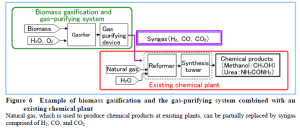
Alternatively, large-scale biomass can be converted into syngas by gasification methods so that resulting biomass can be used as a fuel as well as raw materials to manufacture various chemicals. By gasification methods, the biomass can be converted into a syngas (a mixture of Hydrogen and Carbon monoxide) and free from sulfur and other contaminants. Syngas can be directly used for power generation using engines and gas turbines.

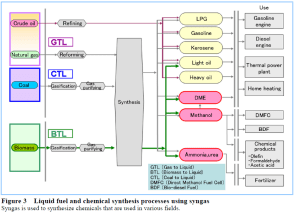
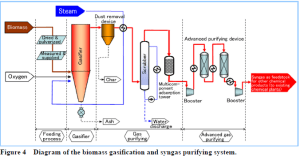
Hydrogen rich syngas is a more value added product and serves not only as a fuel for power generation, but also for cooking, heating and cooling. A schematic flow diagram Fig 3,  Fig4 and Fig 6 (Ref: Mitsubishi Heavy Industries Review) shows how gasification of biomass to syngas can  compete with existing fossil fuels for various applications such as for power generation, as a raw material for various chemical synthesis and as a fuel for cooking, heating and cooling and finally as a liquid fuel for transportation. Bio-gasification has a potential to transform our fossil fuel dependant world into Carbon-free world and to help us to mitigate the global warming.

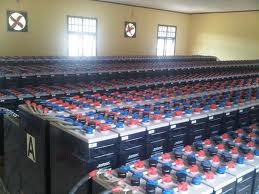
Batteries have become indispensable for energy storage in renewable energy systems such as solar and wind. In fact the cost of battery bank, replacements, operation and maintenance will exceed the cost of PV solar panels for off grid applications during the life cycle of 20 years. However, batteries are continued to be used by electric power utilities for the benefits of peak shaving and load leveling. Battery energy storage facilities give the dynamic benefits such as voltage and frequency regulation, load following, spinning reserve and power factor correction along with the ability to give peak power.

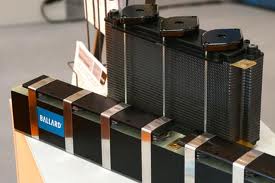
Fuel cell power generation is another attractive option for providing power for electric utilities and commercial buildings due to its high-efficiency and environmentally friendly nature. This type of power production is especially economical, where potential users are faced with high cost in electric power generation from coal or oil, or where environmental constraints are stringent, or where load constraints of transmission and distribution systems are so tight that their new installations are not possible. Both batteries and fuel cells have their own unique advantages to electric power systems. They also contain a great potential to back up severe PV power fluctuations under varying weather conditions.

Photovoltaic power outputs vary depending mainly upon solar insolation and cell temperature.  PV power generator may sometimes experience sharp fluctuations owing to intermittent weather conditions, which causes control problems such as load frequency control, generator voltage control and even system stability.  Therefore there is a need for backup power facilities in the PV power generation.   Fuel cells and batteries are able to respond very fast to load changes because their electricity is generated by chemical reactions. A 14.4kW lead acid battery running at 600A has greatest load gradient of 300 A/sec, a phosphoric-acid fuel cell system can match a demand that varies by more than half its rated output within 0.1 second. The dynamic response time of a 20kW solid-oxide fuel cell power plant is less than 4 second when a load increases from 1 to 100%, and it is less than 2 msec when a load decreases from 100 to 1%.  Factory assembled units provides fuel cell and battery power plants with short lead-time from planning to installation. This modular production enables them to be added in varying increments of capacity, to match the power plant capacity to expected load growth. In contrast, the installation of a single large conventional power plant may produce excess capacity for several years, especially if the load growth rate is low.  Due to their multiple parallel modular units and absence of combustion and electromechanical rotary devices, fuel cell and battery power plants are more reliable than any other forms of power generation. Fuel cells are expected to obtain performance reliability near 85%. Consequently, a utility that installs a number of fuel cell or battery power plants is able to cut its reserve margin capacity while maintaining a constant level of the system reliability. The electrochemical conversion processes of fuel cells and batteries are silent because they do not have any major rotating devices or combustion.  Water requirement for their operation is very little while conventional power plants require a massive amount of water for system cooling.

Therefore, they can eliminate water quality problems created by the conventional plants’ thermal discharges. Air pollutant emission levels of fuel cells and batteries are none or very little. Emissions of SO2 and NOx in the fuel cell power plant are 0.003 lb/MWh and 0.0004 lb/MWh respectively. Those values are projected to be about 1,000 times smaller than those of fossil-fuel power plants since fuel cells do not rely on combustion process. These environmentally friendly characteristics make it possible for those power plants to be located close to load centers in urban and suburban area. It can also cut energy losses and costs associated with transmission and distribution equipment. Their site near load centers may also cut the likelihood of power outage.

Electricity is produced in a storage battery by electro-chemical reactions. Similar chemical reactions take place in a fuel cell, but there is a difference between them with respect to fuel storage. In storage batteries chemical energy is stored in the positive/negative electrodes of the batteries. In fuel cells, however, the fuels are stored externally and need to be fed into the electrodes continuously when the fuel cells are operated to generate electricity.

Power generation in fuel cells is not limited by the Carnot Cycle in the view that they directly convert available chemical free energy to electrical energy than going through combustion processes.  Therefore fuel cell is a more efficient power conversion technology than the conventional steam-applying power generations. Fuel cell is a one-step process to generate electricity, the conventional power generator has several steps for electricity generation and each step incurs a certain amount of energy loss. Fuel cell power systems have around 40-60% efficiencies depending on the type of electrolytes. For example, the efficiencies of phosphoric-acid fuel cells and molten-carbonate fuel cells are 40-45% and 50-60%, respectively. Furthermore, the fuel cell efficiency is usually independent of size; small power plants run as efficiently as large ones. Battery power systems themselves have high energy efficiencies of nearly 80%, but their overall system efficiencies from fuel through the batteries to converted ac power are reduced to below 30%. This is due to energy losses taking place when one energy form is converted to another

A battery with a rated capacity of 200Ah battery will give less than 200 Ah. At less than 20A of discharge rates, the battery will give more that 200 Ah. The capacity of a battery is specified by their time rate of discharge. As the battery discharges, its terminal voltage, the product of the load current and the battery internal resistance gradually decreases. There is also a reduction in battery capacity with increasing rate of discharge. At 1-hr discharge rate, the available capacity is only 55% of that obtained at 20-hr rate. This is because there is insufficient time for the stronger acid to replace the weak acid inside the battery as the discharge proceeds.   For fuel cell power systems, they have equally high-efficiency at both partial and full loads. The customer’s demand for electrical energy is not always constant. So for a power utility to keep adjustment to this changing demand, either large base-load power plants must sometimes run at part load, or smaller peaking units must be used during periods of high demand. Either way, efficiency suffers or pollution increases. Fuel cell systems have a greater efficiency at full load and this high-efficiency is retained as load diminishes, so inefficient peaking generators may not be needed.

Fuel cells have an advantage over storage batteries in the respect of operational flexibility. Batteries need several hours for recharging after they are fully discharged. During discharge the batteries’ electrode materials are lost to the electrolyte, and the electrode materials can be recovered during the recharging process. Over time there is a net loss of such materials, which may be permanently lost when the battery goes through a deep discharge. The limited storage capacity of the batteries implies that it is impossible for them to run beyond several hours.

Fuel cells do not undergo such material changes. The fuel stored outside the cells can quickly be replenished, so they do not run down as long as the fuel can be supplied.   The fuel cells show higher energy density than the batteries when they run for more than 2 hours. It means that fuel cell power systems with relatively small weight and volume can produce large energy outputs. That will give the operators in central control centers for the flexibility needed for more efficient use of the capital-intensive fuel cell power plants.

In addition, where hydrogen storage is possible, renewable power sources can drive an electrolysis process to produce hydrogen gas during off-peak periods that will be used to run the fuel cells during peak demands. The usage of storage batteries in an electric utility industry is expected to increase for the purposes of load leveling at peak loads, real-time frequency control, and stabilizing transmission lines. When integrated with photovoltaic systems, the batteries are required to suppress the PV power fluctuations due to the changes of solar intensity and cell temperature. The fact that the PV power outputs change sharply under cloudy  weather conditions makes it hard to decide the capacity of the battery power plants since their discharging rates are not constant. For a lead-acid battery, the most applicable battery technology for photovoltaic applications to date, the depth of discharge should not exceed 80% because the deep discharge cycle reduces its effective lifetime. In order to prevent the deep discharge and to supplement varying the PV powers generated on cloudy weather days, the battery capacity must be large. Moreover, the large battery capacity is usually not fully used, but for only several days. Fuel cells integrated with photovoltaic systems can give smoother operation. The fuel cell system is capable of responding quickly enough to level the combined power output of the hybrid PV-fuel cell system in case of severe changes in PV power output. Such a fast time response capability allows a utility to lower its need for on-line spinning reserve. The flexibility of longer daily operation also makes it possible for the fuel cells to do more than the roles of gas-fired power plants. Gas turbines are not economical for a purpose of load following because their efficiencies become lower and operating costs get higher at less than full load conditions

Fuel cell does not emit any emission except water vapor and there is absolutely no carbon emission.  However, storage batteries themselves do not contain any environmental impacts even though the battery charging sources produce various emissions and solid wastes. When an Electrolyzer is used to generate Hydrogen on site to fuel the Fuel cell, the cost of the system comes down due to much reduction in the capacity of the battery. The specific cost of energy and NPC is lower than fully backed battery system.

During dismantling, battery power plants require a significant amount of care for their disposal to prevent toxic materials from spreading around. All batteries that are commercially viable or under development for power system applications contain hazardous and toxic materials such as lead, cadmium, sodium, sulfur, bromine, etc. Since the batteries have no salvage value and must be treated as hazardous wastes, disposal of spent batteries is an issue. Recycling batteries is encouraged and not placing them in a landfill. One method favoring recycling of spent batteries is regulation. Thermal treatment for the lead-acid and cadmium-containing batteries is needed to recover lead and cadmium. Sodium-sulfur and zinc bromine batteries are also required to be treated before disposal.

Both batteries and fuel cells are able to respond very fast to system load changes because they produce electricity by chemical reactions inside them. Their fast load-response capability can nicely support the sharp PV power variations resulted from weather changes.  However, there are subtle different attributes between batteries and fuel cells when they are applied to a PV power backup option. Power generation in fuel cell power plants is not limited by the Carnot Cycle, so they can meet high power conversion efficiency. Even taking into account the losses due to activation over potential and ohmic losses, the fuel cells still have high efficiencies from 40% to 60%. For example, efficiencies of PAFCs and MCFCs are 40-45% and 50-60% respectively. Battery power plants, however, themselves have high energy efficiency of nearly 80%, but the overall system efficiency from raw fuel through the batteries to the converted ac power is reduced to about 30%.

A battery’s terminal voltage gradually decreases as the battery discharges due to a proportional decrease of its current. A battery capacity reduces with increasing rate of discharge, so its full capacity cannot be used when it discharges at high rates. On the other hand, fuel cell power plants have equally high-efficiency at both partial and full loads. This feature allows the fuel cells to be able to follow a changing demand without losing efficiency. The limited storage capacity of batteries indicates that it is impossible for them to run beyond several hours. The batteries when fully discharged need several hours to be recharged.

For its use in PV power connections, it is as hard   to estimate the exact capacity of the batteries. In order to prevent the batteries’ deep discharge and to supplement the varying PV powers on some cloudy weather days, the battery capacity should be large, but that large capacity is not fully utilized on shiny days. For fuel cells, they do not contain such an operational time restriction as long as the fuel can be supplied. Thus, the fuel cell power plants can give operational flexibility with the operators in central control centers by utilizing them efficiently. As intermediate power generation sources, fuel cell power plants may replace coal-fired or nuclear units under forced outage or on maintenance. For the PV power backup the batteries’ discharge rate is irregular and their full capacity may usually not be consumed. So, it is difficult to design an ideal capacity of the battery systems for support of the PV power variations and to economically run them. Instead of batteries fuel cell power plants show diverse operational flexibility for either a PV power backup or a support of power system operation.
 

As the threat of global warming looms large, Governments and Industries are looking for innovative, alternative and renewable energy sources and energy efficiency solutions. But how many alternative energy sources are available and what are their potentials? How to cut our carbon footprint without making larger new investment? How to improve the energy efficiency of the existing systems so that we can increase energy output for the same amount of fuel input and cut the cost of energy? These are some of the fundamental questions Governments and industries are grappling with, for the past few years. We are used to generating cheap energy from coal, oil and gas at the cost of the environment for several decades. We are used to water supply free of cost or at negligible cost for several decades. Governments were able to survive year after year because they were able to supply these two fundamental requirements of the people namely, energy and water at low-cost. But this situation changed swiftly when scientists raised the alarm bells on carbon emission and global warming. Still many Governments, especially industrialized countries with large energy and water usage, are still playing ‘wait and watch’ game, because they cannot afford to increase the tariffs on power and water. Any such increase will make Governments unpopular and their re-election to the office doubtful.

The real alternative to fossil fuels is only solar energy, which is clean, reliable and abundant. All other forms of renewable sources such as wind, geothermal, ocean thermal energy and wave energy are only offshoot of solar energy. The prime source is still the sun and the source of energy is from the chain nuclear fusion reaction of Hydrogen atom. The radiation of this nuclear reaction in the sun has to travel an average distance of 93 million miles to reach the earth, yet it is enough to meet current energy need of  entire humanity by a factor of 20,000 times. But to convert sun’s light and heat energy into Electricity and other useful forms of energy, we need some rare materials which we never used in the past. They are called ‘rare earth materials’ because their available sources and supplies are rare on planet earth. But these exotic and rare earth materials are becoming indispensable in the development of renewable energy products and applications. The future growth of clean energy technologies depend on supply of such rare earth materials.

Fourteen elements and related materials were selected for a criticality assessment by US Government department of energy. Eight of these are rare earth metals, which are valued for their unique magnetic, optical and catalyst properties. The materials are used in clean energy technologies as follows. Lanthanum, cerium, praseodymium, neodymium, cobalt and lithium are used in electric vehicle batteries. Neodymium, praseodymium and dysprosium are used in magnets for electric vehicles and wind turbines. Samarium is also used in magnets. Lanthanum, cerium, europium, terbium and yttrium are used in phosphors for energy-efficient lighting. Indium, gallium and tellurium are used in solar cells. The materials were selected for study based on factors contributing to risk of supply disruption.

Though usage of such material is relatively small, it is anticipated that the growth of clean technologies will need a substantial quantity of these materials. Currently China is endowed with almost 95% of such rare materials in the world. These materials are available in the form of ores and minerals under the earth. They have to be mined, processed and extracted in a pure form so that they can be used in developing clean energy products of the future. We will discuss about such products and technologies in our future articles. The anomaly is the energy required to mine, process and extract these rare earth materials need energy and such energy to have to come only from the sun. It is once again Nature that comes to the rescue of human beings at such critical junctures.


We  acknowledge that solar energy is a potential renewable energy source of the future. The total energy need of the world is projected in the next 40 years to be 30 TW (terra watts) and only solar energy has a potential to meet the above demand. However, harnessing sun’s energy to its fullest potential is still a long way to go. Concentrated solar power (CSP) offers a greater hope to fill this gap. The main reason is the cost  advantage of CSP compared to PV solar and energy storage technologies and their costs.

The cost of PV solar has steadily decreased in the past few years. Though the cost of solar cell has come down to $0.75 per watt, the overall cost of the PV system is still around $ 3.00 per watt. This is due to the cost of encapsulation; interconnect wiring, mounting of panels, inverters and battery bank. The overall cost of the system will not come down drastically beyond a point. This makes PV solar still more expensive compared to conventional power generation using fossil fuels. People can understand the value of renewable energy and impending dangers of global warming due to greenhouse gases, but the final cost of energy will decide the future of energy sources.

In PV solar the sun’s light energy is directly converted into Electricity, but storing such energy using batteries have certain limitations. PV solar is suitable for small-scale operations but it may not be cost-effective for large-scale base load power generation. The best option will be to harness the sun’s thermal energy and store them and use them to generate power using the conventional and established methods such as steam or gas turbines. Once we generate thermal energy of required capacity then we have number of technologies to harness them into  useful forms. As we mentioned earlier, the thermal energy can trigger a chemical reaction such as formation of Ammonia by reaction between Hydrogen and Nitrogen under pressure, which will release a large amount of thermal energy by exothermic reaction. Such heat can be used to generate steam to run a stem turbine to generate power. The resulting ammonia can be split with concentrated solar power (CSP) into Hydrogen and Nitrogen and the above process can be repeated.

The same system can also be used to split commercial Ammonia into Hydrogen and Nitrogen. The resulting Hydrogen can be separated and stored under pressure. This Hydrogen can be used to fuel Fuel cell cars such as Honda FXC or to generate small-scale power for homes and offices.

By using CSP, there is potential of cost savings as much as 70% compared to PV solar system for the same capacity power generation on a larger scale. Focusing sun’s energy using large diameter parabolic troughs and concentrators, one can generate high temperatures.  Dishes can typically vary in size and configuration from a small diameter of perhaps 1 meter to much larger structures of a dozen or more meters in diameter.  Point focus dish concentrators are mounted on tracking systems that track the sun in two axes, directly pointing at the sun, and the receiver is attached to the dish at the focal point so that as the dish moves, the receiver moves with it.  These point focus systems can generate high temperatures exceeding 800ºC and even 1,800ºC.

The temperature required to run a steam turbine does not exceed 290C and it is quite possible to store thermal energy using mixture of molten salts with high Eutectic points and use them to generate steam. Such large-scale energy storage using lead-acid batteries and power generation using PV solar may not be economical. But it will be economical and technically feasible to harness solar thermal energy using CSP for large-scale base load power generation. It is estimated that the cost of such CSP will compete with traditional power generation using coal or oil in the near future.CSP has potential to generate cost-effective clean power as well as a fuel for transportation.

The city of Athens hosted its oldest tradition of lighting the Olympic torch for the 2012 London Olympic Games on Thursday in Olympia. The torch was lit by solar power; using parabolic mirror to redirect the sun’s light to light the flame with purest natural light. The thermal energy of sun’s light can be powerful when focused to a point and it can reach a temperature as much as 600C.The parabolic trough with reflective mirror focuses the sunlight on the tube called ‘collectors’ in which a fluid with high boiling point is circulated. The hot fluid in turn is used to convert water into steam in boiler. The hot oil transfers its heat to the water in a heat exchanger and returns back to the parabolic trough. It is a closed circuit system. The hot oil at 390C generates steam at 370C at 100 bar pressure, which is used to run a HP steam turbine. The standard steam condensing cycle generates power similar to fossil fuel fired power plant. A 50 Mw Trough plant in Israel (Negev Desert) is already in operation.

The capacity of such plant can be easily expanded by adding modular parabolic troughs and collectors and the plant can be designed to meet  specific power demands. This is a straight forward method to generate base load power using standard steam cycle. The efficiency of such system will be 41% maxium.However recently few companies are trying use a combined cycle. This increase the solar to heat efficiency from 50.5% to 53.6%.This nominal 50Mw power plant generates  a total peak power of 57.10Mw using a solar collection area of 310,028m2 with annual solar to electrical efficiency at 16.3% using a water-cooled condenser in the steam cycle. The cost of energy works out to $0.23 to $ 0.25 /kwhrs.

By using a central solar collection tower (Heliostat) and bottoming with Rankin/Kalina cycle ,it is estimated that the total installed cost can be reduced by 10%.The system can be configured from 2Mw up to 100Mw using both trough and tower system. The system can be installed in any remote, arid locations using air condensers, where cooling water is a problem. The estimated annual specific energy cost is less than 6 cents/kwhrs, comparable to low-cost fossil energy but with zero pollution and with zero carbon emission.

Solar thermal is a potential clean energy of the future for many countries around the world with yearlong sunshine with good intensisty.The solar thermal energy can also be used in many process industries where thermal heating is required. Solar salt pans can use solar thermal energy very efficiently to cut their production cycle. The concentrated brine can be used as a circulation fluid in solar collectors and also be used to generate power using low heat technologies like Kalina cycle, because concentrated salt brine can store thermal heat.

Gemasolar power in Spain is a base load power station supplying power for 25,000 homes 24×7 using molten salt (60% KNO3+40% NaNO3) as a thermal storage medium instead of batteries. Nine plants were built in 1980 in Mojave Desert with a combined capacity of 354 Mws.

Other examples of solar base load power plants are Blythe solar with capacity of 968Mw at Riverside County, California and Ivanpah power station with capacity of 370 Mw capacities in US. Large scale solar base load plants are no longer a theory but a commercial reality.

Direct solar lighting is also being introduced using fiber optics. The sun light is collected at a central point and directed through fiber optics to various rooms inside the building supplying direct sun light. This saves not only electricity but also provides natural light to work places because human body requires a certain amount of UV light exposure. Solar energy is here to stay and offer various clean energy solutions in the future.


Stanley Meyer, a freelance inventor from USA demonstrated a car that ran on water, according to an Equinox programme that was televised in 1995. Stane Meyer’s dune buggy ran 100 miles from 1 gallon of water. He claimed that water would be the fuel that could revolutionize the auto industry in America. However, his tragic death in 1998 brought the issue to a closure.  Many people and institutions are still trying to replicate his invention at least partly and claiming success.  He received a   number of patents based on his inventions. He worked nearly 30 years on his invention before he began to work on a book titled, “With the Lord, there is a purpose” describing his “faith walk” with the Lord to fulfill end-time Prophecy.  He continued with his speaking engagements throughout the world.  However, such ‘free energy’ devices are still not getting the approval of the larger scientific community as well as Government agencies for some reasons or other. According to Stanley Meyer, “the law of Physics establishes a proven function based on ‘Pre-set’ conditions…change any of the conditions and the Law no longer applies….A new law emerges in the consciousness of physics. Why? Because atoms possess intelligence—-Performing ‘what if’ logic function under different ‘preset’ conditions.” His claims were based on scientific principles and explanations.  Based on his invention, many of ‘Electrolyzing devices’ appeared in the market.  They supply Do It Yourself  kits that can be fitted into a car to cut Gasoline consumptions; but they do not entirely  substitute Gasoline like Stanley Meyer demonstrated. There are still missing pieces of information or claims. He was able to show and claim “Hydrogen fracturing process to disassociate water molecules by way of voltage simulation, ionization of combustible gases by electron ejection and then preventing the water formation during thermal ignition releasing a thermal explosive energy beyond ‘normal gas burns’ levels under control state… and such an atomic energy process is environmentally safe”.   He did not use ‘Heavy water’ called ‘Deuterium’ but normal water and controlled state and shown that the covalent bond of water can be broken using an electronic circuit using water as dielectric medium of a capacitor.  It uses a high voltage but a low current and the process is instantaneous.  It differs from the ‘Faraday’s law of electrolysis’ in a conventional sense. The scientific community seems to be a little more understanding with an open mind in recent times to such ‘free energy’ concepts and devices than in the past.  ‘Resonance electrolysis’ has been reported by few institutions and people as an alternative to ‘conventional water electrolysis’ to cut energy consumption. Decomposition of water into its molecules requires high temperature above 3000°C using a process known as ‘pyrolyis’ and a technique to separate the decomposed molecules from reunion for water formation.  Prof. Mizuna of Hokkaido University of Japan and his coworkers demonstrated ‘Plasma Electrolysis’ by an experiment which showed an evolution of anomalous amount of Hydrogen and oxygen sometimes as much as 80 times more than normal Faraday’s electrolysis of gas generation. Though such reaction requires a very high temperature they could not successfully measure the reaction temperatures during the experiments. They used a Platinum anode and Tungsten cathode and a provision to separate Hydrogen and oxygen gases. They concluded at the end of the experiment that the input voltage and the current efficiency were critical parameters.  On increasing the Voltage to several thousands, they said the current efficiency can exceed unity.  The anomalous release of gases indicates that the electrolysis is not a normal electrolysis but beyond that. (Ref:Mizuno, T., T. Akimoto, and T. Ohmori. Confirmation of anomalous hydrogen generation by plasma electrolysis. in 4th Meeting of Japan CF Research Society. 2003. Iwate, Japan: Iwate University) In all these experiments the gases coming out of the system are not at high temperature but at normal room temperature.  The chemistry of water molecule decomposition and plasma pyrolysis is not fully understood.  After all ‘Cold fusion’ seems to be plausible under certain conditions and it may be a panacea for the world’s energy problems.  When our energy requirement exceeds a limit due to a population explosion and industrialization then finding a solution becomes a daunting task. Mohandas Gandhi said: “There is enough for everybody’s need but not for everybody’s greed. Be the change what you wish to see in the world”.

Synthesis of Ammonia is one of the  remarkable achievements of Chemical engineering in forties .It is a precursor for Urea, the fertilizer  that  brought about ‘Green revolution’ in agriculture industry and helped to achieve record food production all over the world. It was a milestone in modern chemistry to synthesis a molecule containing I atom of Nitrogen and 3 atoms of Hydrogen, represented by NH3 called Ammonia. The HeberBosch process for the production of Ammonia is a well established mature, commercial technology.

The process uses a Hydrocarbon source such as Naphtha or Natural gas as the feed stock to generate a synthesis gas composed of Hydrogen and Carbondioxide.The gas mixture is separated into carbon dioxide and Hydrogen using PSA (pressure swing adsorption ) technology. The resulting Hydrogen is used to combine with Nitrogen to synthesize Ammonia.

The chemical reaction can be represented by the following equation.

N2 + 3H2 ———- 2 NH3

The above reaction takes place at a pressure of 100-200 bars and temperature of 300-500C in presence of  catalysts. It is an exothermic (heat releasing) reaction and the catalyst bed is cooled and maintained at 400C to be efficient.But this process of Hydrogen generation using Hydrocarbon emits greenhouse gases. Alternatively, Hydrogen can be generated using different methods using renewable energy sources using water electrolysis. Such process may be used in the future for this application.

Nitrogen is derived from atmospheric air. The air we breathe has about 79% of Nitrogen and 21% Oxygen. But these two gases can be separated by liquefying the air by cryogenic process and distilling them into two fractions. Alternatively, they can separated using pressure swing adsorption or membrane separation process, utilizing their density differences. In either way, Nitrogen can be separated from atmospheric air. By combining the above Hydrogen and Nitrogen, it is possible to synthesis Ammonia on a commercial-scale.

The ammonia can be easily split into Hydrogen and Nitrogen by passing Ammonia through a bed of Nickel catalyst at 200-400C as and when required to generate on site Hydrogen. This Hydrogen can be used for power generation or to run our cars using PEM Fuelcell.As we have seen previously, we are now looking for various sources of Hydrogen, and Ammonia is one of the promising sources for couple of reasons. The process and technology of Ammonia production, transportation and usage is well documented and has been practiced for few decades. It does not emit  greenhouse gases.Liquified Ammonia has been widely used in air-conditioning and refrigeration systems. Ammonia can be easily metered into any system directly from the cylinder.

It is easier to use Ammonia directly into a convention internal combustion engines in place of Gasoline and this technology has already been practiced in 1880. Ammonia is pungent and any leakage can be easily identified. The advantage of using Ammonia as a fuel in cars, it does not emit any smoke  but only water vapour.It can be admixed with Gasoline or used as 100% anhydrous Ammonia. It also helps in reduction of NO2 emission, especially is diesel engines.

Ammonia has a great potential as a source of future fuel provided the sources of Hydrogen comes from water using renewable technologies or by photo electrolysis using direct sunlight.

 Photovoltaic (PV) power is becoming popular worldwide as an alternative to grid power for various reasons. It gives an energy independence and freedom, it helps reduce greenhouse gas emission and combat global warming, it helps people taking advantage of various Government subsidies and incentives, and it also generates some revenue by selling surplus power back to the grid. At the end of the period you own the system and claim depreciation and some tax benefits. All these compelling factors may motivate people to opt for PV solar power. But you should also do some math and make a cost benefit analysis to choose a right system for you.

When there is a good sunshine day after day and throughout the year, PV solar is good proposition and can be really rewarding. Unfortunately that is not the reality. There may be many cloudy, rainy and fogging days in a year and your PV solar capacity may be overestimated or underestimated. You know the real data only after one or two years of life experience. It is a long-term financial and ethical decision one has to make and the decision should be absolutely right. You can make such a decision by carefully examining all the factors, not just by looking at the first cost but looking at operating and maintenance costs and all the costs and benefits associated with them.

Storage batteries are inevitable in PV solar systems, especially for grid independent systems. Even with grid connected PV solar system the design and installation of a correct battery bank, controllers and rectifier are important issues. In this article we will discuss about grid independent system because many developing countries in Africa and Asia do not have 24×7 uninterrupted grid power supplies. Many people living in islands have to manage their own power by using diesel generators. This is the stark reality.

Let us assume that you design a system assuming a daily average power consumption of 25,000 kwhrs/day, which is suitable even for a medium size family in US. We made an optimum design study between two  systems; first  containing PV solar,battery,controller for grid independent power supply; and second  system with PV solar, battery, water Electrolyzer,Hydrogen storage  and PEM Fuel cell and a rectifier for grid independent system,  based on the same power consumption of 25,000kwhrs/day. You can clearly see the difference between the two systems by the following data.This financial analysis was made assuming there is no Government subsidies and incentives.

Grid independent system with battery storage for 25,000kwhrs/day power:

Total NPV (net present value):$ 342,926

Levelized cost of energy: $2.94/kwhrs

Operating cost/yr: $22,764

Grid independent system with Hydrogen storage for 25,000kwhrs/day power:

Total NPV (net present value): $ 169,325

Levelized cost of energy : $ 1.452/kwhrs

Operating cost/yr: 8,330

The number of batteries required in the first case is 17 numbers. In the second case, number of batteries required is only 2.Obviously,  the levelized cost of power using  PV Hydrogen (storage) is less than 50% of the power generated using PV battery (storage) for the same energy consumption of 25,000kwhrs/day. The operating cost is only one-third for PV Hydrogen system compared to battery system. Batteries are indispensable in any renewable energy system but reducing their  numbers to the lowest level is important, when the life of the system varies from 25 years to 40 years. The numbers and the cost of batteries and their maintenance cost  will make all the difference.