Skip navigation

Tag Archives: Energy

FrCEWT | Investor Brief
Carbon Recycling Technology (CRT)

From Energy Crisis to Energy Sovereignty

EXECUTIVE SUMMARY

The global energy system is undergoing structural disruption driven by geopolitical instability and climate constraints.
This is not a temporary crisis — it is the breakdown of an outdated energy architecture.

For over a century, energy systems have operated as open loops:
Extract → Burn → Generate → Emit → Pollute

This model is no longer viable.

Carbon Recycling Technology (CRT), developed by Clean Energy and Water Technologies (CEWT), introduces a closed-loop energy architecture where carbon is continuously recycled rather than emitted.

CRT transforms captured CO₂ into renewable methane using green hydrogen, enabling dispatchable, zero-emission power generation while maintaining energy density and infrastructure compatibility.

This represents a paradigm shift from fuel substitution to system redesign.


THE OPPORTUNITY

• Global energy markets are facing volatility due to supply disruptions and geopolitical risk
• Industrial sectors require 24/7 power, heat, and molecular fuels
• Hydrogen alone faces storage, transport, and cost limitations
• Existing infrastructure is built around hydrocarbons

CRT addresses all four simultaneously.

It enables:
• Baseload renewable power
• Industrial heat continuity
• Molecular energy storage
• Compatibility with existing gas infrastructure


CORE TECHNOLOGY

CRT integrates:
• CO₂ capture
• Renewable hydrogen production
• Methanation (CO₂ + 4H₂ → CH₄ + 2H₂O)
• Gas turbine power generation

Carbon becomes a recyclable carrier.
Hydrogen becomes the energy input.
Methane becomes the storage medium.

The result is a perpetual carbon-energy loop.


INVESTMENT CASE

1. System-Level Innovation
CRT is not a single technology — it is an integrated energy architecture addressing power, heat, and fuel simultaneously.

2. Infrastructure Advantage
Leverages existing gas pipelines, storage, and turbines — reducing transition costs.

3. Energy Sovereignty
Enables nations to produce fuel domestically from CO₂ and renewable electricity.

4. Market Alignment
Aligned with global decarbonisation policies, carbon markets, and energy security priorities.

5. Scalability
Applicable across power generation, steel, chemicals, and desalination sectors.


STRATEGIC POSITIONING

CRT sits at the intersection of:
• Renewable energy
• Carbon management
• Synthetic fuels
• Industrial decarbonisation

It bridges the gap between intermittent renewables and continuous industrial demand.


WHY NOW

• Fossil fuel volatility is rising
• Hydrogen economics remain uncertain
• Carbon pricing is tightening globally
• Grid stability challenges are increasing

The current disruption is accelerating adoption of closed-loop systems.


CONCLUSION

The energy transition is not simply about replacing fuels.

It is about redesigning the system.

CRT enables that transition by closing the carbon loop — transforming a liability into a reusable asset.

This is not incremental improvement.

This is foundational change.


CONTACT
Clean Energy and Water Technologies Pty Ltd (CEWT)
Australia

om Energy Crisis to Energy Sovereignty

From Energy Crisis to Energy Sovereignty

EXECUTIVE SUMMARY

The global energy system is undergoing structural disruption driven by geopolitical instability and climate constraints.
This is not a temporary crisis — it is the breakdown of an outdated energy architecture.

For over a century, energy systems have operated as open loops:
Extract → Burn → Generate → Emit → Pollute

This model is no longer viable.

Carbon Recycling Technology (CRT), developed by Clean Energy and Water Technologies (CEWT), introduces a closed-loop energy architecture where carbon is continuously recycled rather than emitted.

CRT transforms captured CO₂ into renewable methane using green hydrogen, enabling dispatchable, zero-emission power generation while maintaining energy density and infrastructure compatibility.

This represents a paradigm shift from fuel substitution to system redesign.


THE OPPORTUNITY

• Global energy markets are facing volatility due to supply disruptions and geopolitical risk
• Industrial sectors require 24/7 power, heat, and molecular fuels
• Hydrogen alone faces storage, transport, and cost limitations
• Existing infrastructure is built around hydrocarbons

CRT addresses all four simultaneously.

It enables:
• Baseload renewable power
• Industrial heat continuity
• Molecular energy storage
• Compatibility with existing gas infrastructure


CORE TECHNOLOGY

CRT integrates:
• CO₂ capture
• Renewable hydrogen production
• Methanation (CO₂ + 4H₂ → CH₄ + 2H₂O)
• Gas turbine power generation

Carbon becomes a recyclable carrier.
Hydrogen becomes the energy input.
Methane becomes the storage medium.

The result is a perpetual carbon-energy loop.


INVESTMENT CASE

1. System-Level Innovation
CRT is not a single technology — it is an integrated energy architecture addressing power, heat, and fuel simultaneously.

2. Infrastructure Advantage
Leverages existing gas pipelines, storage, and turbines — reducing transition costs.

3. Energy Sovereignty
Enables nations to produce fuel domestically from CO₂ and renewable electricity.

4. Market Alignment
Aligned with global decarbonisation policies, carbon markets, and energy security priorities.

5. Scalability
Applicable across power generation, steel, chemicals, and desalination sectors.


STRATEGIC POSITIONING

CRT sits at the intersection of:
• Renewable energy
• Carbon management
• Synthetic fuels
• Industrial decarbonisation

It bridges the gap between intermittent renewables and continuous industrial demand.


WHY NOW

• Fossil fuel volatility is rising
• Hydrogen economics remain uncertain
• Carbon pricing is tightening globally
• Grid stability challenges are increasing

The current disruption is accelerating adoption of closed-loop systems.


CONCLUSION

The energy transition is not simply about replacing fuels.

It is about redesigning the system.

CRT enables that transition by closing the carbon loop — transforming a liability into a reusable asset.

This is not incremental improvement.

This is foundational change.


CONTACT
Clean Energy and Water Technologies Pty Ltd (CEWT)
Australia

CEWT | Investor Brief
Carbon Recycling Technology (CRT)

From Energy Crisis to Energy Sovereignty

EXECUTIVE SUMMARY

The global energy system is undergoing structural disruption driven by geopolitical instability and climate constraints.
This is not a temporary crisis — it is the breakdown of an outdated energy architecture.

For over a century, energy systems have operated as open loops:
Extract → Burn → Generate → Emit → Pollute

This model is no longer viable.

Carbon Recycling Technology (CRT), developed by Clean Energy and Water Technologies (CEWT), introduces a closed-loop energy architecture where carbon is continuously recycled rather than emitted.

CRT transforms captured CO₂ into renewable methane using green hydrogen, enabling dispatchable, zero-emission power generation while maintaining energy density and infrastructure compatibility.

This represents a paradigm shift from fuel substitution to system redesign.


THE OPPORTUNITY

• Global energy markets are facing volatility due to supply disruptions and geopolitical risk
• Industrial sectors require 24/7 power, heat, and molecular fuels
• Hydrogen alone faces storage, transport, and cost limitations
• Existing infrastructure is built around hydrocarbons

CRT addresses all four simultaneously.

It enables:
• Baseload renewable power
• Industrial heat continuity
• Molecular energy storage
• Compatibility with existing gas infrastructure


CORE TECHNOLOGY

CRT integrates:
• CO₂ capture
• Renewable hydrogen production
• Methanation (CO₂ + 4H₂ → CH₄ + 2H₂O)
• Gas turbine power generation

Carbon becomes a recyclable carrier.
Hydrogen becomes the energy input.
Methane becomes the storage medium.

The result is a perpetual carbon-energy loop.


INVESTMENT CASE

1. System-Level Innovation
CRT is not a single technology — it is an integrated energy architecture addressing power, heat, and fuel simultaneously.

2. Infrastructure Advantage
Leverages existing gas pipelines, storage, and turbines — reducing transition costs.

3. Energy Sovereignty
Enables nations to produce fuel domestically from CO₂ and renewable electricity.

4. Market Alignment
Aligned with global decarbonisation policies, carbon markets, and energy security priorities.

5. Scalability
Applicable across power generation, steel, chemicals, and desalination sectors.


STRATEGIC POSITIONING

CRT sits at the intersection of:
• Renewable energy
• Carbon management
• Synthetic fuels
• Industrial decarbonisation

It bridges the gap between intermittent renewables and continuous industrial demand.


WHY NOW

• Fossil fuel volatility is rising
• Hydrogen economics remain uncertain
• Carbon pricing is tightening globally
• Grid stability challenges are increasing

The current disruption is accelerating the adoption of closed-loop systems.


CONCLUSION

The energy transition is not simply about replacing fuels.

It is about redesigning the system.

CRT enables that transition by closing the carbon loop — transforming a liability into a reusable asset.

This is not an incremental improvement.

This is foundational change.


CONTACT
Clean Energy and Water Technologies Pty Ltd (CEWT)
Australia

This is not an oil crisis.

It’s something deeper — and far more structural.

It’s an energy system failure.


For decades, energy systems were built on a simple assumption:

Demand is predictable. Supply is controllable.

That world no longer exists.


Today, three forces are colliding:

AI is turning electricity into continuous demand

🌬️ Renewables are inherently intermittent

🔋 Storage is still short-duration

Individually, each works.

Together, they create instability.


We are now facing a mismatch that the system was never designed for:

  • Demand is becoming time-dependent and continuous
  • Supply is becoming variable and weather-driven

And we are trying to bridge that gap with incremental fixes.

More renewables.

More batteries.

More transmission.


But here’s the uncomfortable truth:

You cannot solve a structural problem with incremental solutions.


This is why the conversation around energy is starting to shift — quietly, but fundamentally.

From technology → to system architecture


At Clean Energy and Water Technologies (CEWT), we’ve been working on this problem from a different angle.

Not just how to generate clean energy.

But how to reshape energy so it behaves like the system needs it to.


Because the real challenge is not producing energy.

It is aligning energy with time.


This is where Carbon Recycling Technology (CRT) comes in.

  • Renewable electricity is converted into hydrogen
  • Hydrogen combines with captured CO₂
  • The result is renewable methane (RNG) — a storable, dispatchable energy carrier

And when used, the CO₂ is captured and recycled again.


Carbon is no longer a liability.

It becomes a carrier.


This changes the equation:

Instead of forcing demand to follow supply,

Supply is reshaped to follow demand.


And that is the missing layer in today’s energy transition.


We are not just transitioning energy.

We are redesigning the system that carries it.


AI, industry, and global electrification are accelerating this reality.

The question is no longer whether change is needed.

It is whether we continue to optimise the old system —

or build the one that actually works.


There is no shortcut.

Closing the carbon loop is the only real path to defossilisation.


#EnergyTransition #AI #EnergySystems #Hydrogen #Decarbonisation #CRT #CEWT

This is not an oil crisis.

It’s something deeper — and far more structural.

It’s an energy system failure.


For decades, energy systems were built on a simple assumption:

Demand is predictable. Supply is controllable.

That world no longer exists.


Today, three forces are colliding:

AI is turning electricity into continuous demand

🌬️ Renewables are inherently intermittent

🔋 Storage is still short-duration

Individually, each works.

Together, they create instability.


We are now facing a mismatch that the system was never designed for:

  • Demand is becoming time-dependent and continuous
  • Supply is becoming variable and weather-driven

And we are trying to bridge that gap with incremental fixes.

More renewables.

More batteries.

More transmission.


But here’s the uncomfortable truth:

You cannot solve a structural problem with incremental solutions.


This is why the conversation around energy is starting to shift — quietly, but fundamentally.

From technology → to system architecture


At Clean Energy and Water Technologies (CEWT), we’ve been working on this problem from a different angle.

Not just how to generate clean energy.

But how to reshape energy so it behaves like the system needs it to.


Because the real challenge is not producing energy.

It is aligning energy with time.


This is where Carbon Recycling Technology (CRT) comes in.

  • Renewable electricity is converted into hydrogen
  • Hydrogen combines with captured CO₂
  • The result is renewable methane (RNG) — a storable, dispatchable energy carrier

And when used, the CO₂ is captured and recycled again.


Carbon is no longer a liability.

It becomes a carrier.


This changes the equation:

Instead of forcing demand to follow supply,

Supply is reshaped to follow demand.


And that is the missing layer in today’s energy transition.


We are not just transitioning energy.

We are redesigning the system that carries it.


AI, industry, and global electrification are accelerating this reality.

The question is no longer whether change is needed.

It is whether we continue to optimise the old system —

or build the one that actually works.


There is no shortcut.

Closing the carbon loop is the only real path to defossilisation.


#EnergyTransition #AI #EnergySystems #Hydrogen #Decarbonisation #CRT #CEWT

Clean Energy and Water Technologies Pty Ltd (CEWT)

Energy Systems Insight Note
AI Load vs Grid Reality — A System Architecture Perspective

1. The Emerging Mismatch

Artificial Intelligence (AI), particularly at inference scale, introduces a new category of electricity demand.

While AI models are often evaluated based on efficiency per computation, the electrical grid experiences demand differently.

The grid sees:
• Continuous load accumulation over time 
• Cumulative demand from distributed inference 
• Persistent, baseload-like pressure 

Model efficiency is instantaneous — grid stress is time-integrated.

2. Why This Matters

As AI adoption accelerates, inference workloads behave like:
• Always-on services 
• Globally distributed compute 
• Latency-sensitive operations 

AI is no longer a discrete load. It becomes a continuous system force shaping demand.

3. Limits of Current Approaches

Current responses include:
• Time-of-use pricing 
• Real-time markets 
• Location-based signals 
• Limited workload shifting 

But these are incremental. The structural imbalance remains:

Renewables → intermittent 
Batteries → short-duration 
AI demand → continuous 

Pricing alone cannot solve this.

4. The System Architecture Shift

The next phase requires integrated system design.

CEWT’s Carbon Recycling Technology (CRT):
• Converts renewable electricity into renewable gas 
• Stores energy in molecular form 
• Dispatches energy when required 

This enables long-duration storage and demand-aligned supply.

5. Reframing the Problem

Instead of aligning demand to supply:

We must reshape supply to follow demand.

This is essential for AI-scale energy systems and industrial decarbonisation.

6. The Strategic Fork

Path 1: Incremental expansion 
• More renewables, storage, transmission 

Path 2: Architectural integration 
• Electrons + molecules 
• Long-duration storage 
• Demand-responsive systems

7. Conclusion

AI is not just a load — it is a system-shaping force.

It will either stress existing infrastructure or drive a transition toward integrated energy systems.

The outcome depends on whether we optimise incrementally or redesign fundamentally.


CEWT — Advancing Carbon Recycling Technology for integrated, dispatchable, zero-emission energy systems.

Clean Energy and Water Technologies Pty Ltd (CEWT)

ABN 61 691 320 028 | ACN 691 320 028

Technology Note

Why Carbon Recycling Technology (CRT) Is Structurally Superior for Green Iron Production

Date: March 2026

Prepared for: Government agencies, investors, industrial partners


Overview

Carbon Recycling Technology (CRT) enables zero-emission iron production by combining hydrogen-rich syngas reduction with a closed carbon loop.

Unlike hydrogen-only pathways that require large new infrastructure and massive electrolysis capacity, CRT preserves the proven gas-based reduction chemistry used in Direct Reduced Iron (DRI) systems while eliminating net carbon emissions.

This approach allows the transition to green iron production using existing industrial infrastructure with significantly lower energy and hydrogen requirements.


1. Uses Proven Gas-Based Iron Reduction Chemistry

CRT reduces iron ore using hydrogen-rich syngas (CO + H₂) generated through steam reforming.

This is the same fundamental chemistry used in natural-gas-based DRI processes such as those deployed globally by Midrex.

Advantages

  • Proven shaft-furnace technology
  • Established reduction kinetics
  • Mature industrial operating experience
  • Reduced technical risk

CRT therefore builds on existing metallurgical practice rather than introducing an entirely new process.


2. Achieves Zero Emissions Through Carbon Recycling

In conventional natural-gas DRI:

Natural Gas → Reduction → CO₂ released to atmosphere

In CRT:

Natural Gas / RNG → Reduction → CO₂ captured → recycled → Renewable Natural Gas (RNG)

The carbon atom, therefore, circulates continuously within the system, acting as a recyclable carrier rather than being emitted.

This closed molecular loop allows CRT to achieve net-zero emissions without eliminating carbon from the process chemistry.


3. Dramatically Lower Hydrogen Requirement

Hydrogen-only ironmaking requires hydrogen to supply both:

  • the reducing gas, and
  • the energy source for the process

This results in very large electrolysis capacity requirements.

CRT instead uses hydrogen-rich syngas, with only a small renewable hydrogen trim required to maintain the carbon recycling loop.

Benefits

  • significantly smaller electrolysers
  • lower renewable electricity demand
  • reduced hydrogen storage requirements
  • improved economic feasibility

4. Compatible With Existing Industrial Infrastructure

Hydrogen-only steelmaking requires major changes to industrial systems, including:

  • new hydrogen production infrastructure
  • new fuel supply networks
  • modified furnaces and process systems

CRT maintains compatibility with existing infrastructure, including:

  • gas reforming systems
  • DRI shaft furnaces
  • gas handling and distribution networks
  • high-temperature industrial heat systems

This allows decarbonisation to proceed faster and at lower capital cost.


Structural Advantage of CRT

Traditional decarbonisation approaches attempt to remove carbon from industrial energy systems.

CRT instead recycles carbon as a molecular energy carrier, while renewable hydrogen provides the incremental energy required to maintain the loop.

This architecture preserves the thermodynamic advantages of carbon-based fuels while eliminating net emissions.


Conclusion

Carbon Recycling Technology provides a practical pathway for green iron production by combining:

  • proven gas-based reduction chemistry
  • closed-loop carbon recycling
  • minimal hydrogen requirements
  • compatibility with existing infrastructure

This system architecture enables heavy industry to transition toward zero-emission production while maintaining operational reliability and economic viability.

Carbon Recycling Technology

Recently I filed a preliminary patent application on ‘decarbonisation’.
It is a holistic process that uses only seawater and sun to generate a base load power with zero emission using the principle of ‘circular economy’. Somebody asked me to explain this technology in a lay man’s language. It is similar to an example what I explained as follows:
Let me explain in a lay mans’s language. Imagine you fill your car with 50 lit  petrol and go on a trip. The petrol is a Hydrocarbon (chemical term).Suppose I fit a small equipment on the exhaust pipe of your car which will collect the exhaust gases in a liquid form and collect it. When you finish your trip you can remove that equipment which collected your exhaust in a liquid form and hand over to a small processing unit on the road side. The processing unit will convert that exhaust  liquid into Petrol once agin. You can fill your car with this new petrol and also fit your car with new exhaust collector and return back to your destination. It means there is a zero emission from your car. You need not convert your car into electric or do any modification at all. You don’t have to fill your car with new petrol. It is called CRT (carbon recycling technology). It means you don’t need any petrol at all except for the initial filling. Even that can be eliminated by extracting Carbon from sea water and synthesising a Carbon negative Petrol. No pollution at all because of zero emissions. It simply uses the same Carbon atom again and again by substituting the ‘fossil hydrogen’ with’ renewable hydrogen’ with absolutely no emissions. It fulfils all the requirement of a ‘circular economy’ and a Carbon -free atmosphere. What is unique about this technology is it derives Carbon from seawater (where CO2 has already been absorbed from industrial emissions) and converting into Carbon negative synthetic fuel (unlike Carbon neutral synthetic fuels which are made from CO2 emissions that encourages continuous usage of fossil fuels) with cleaner properties. An Oxy combustion will make it a unique fuel of the future. Our current focus is to generate a base load power(24 x7) without any energy storage at all. It is the only technology in the world that generates a base load power (24 x 7) and synthetic fuels such as aviation fuel, marine fuel, petrol, diesel and CNG using only Sun/wind and Seawater.

Generating electricity using fossil fuel is a well-established technology, that has been practiced over several decades all over the world, despite its low efficiency. But this technology inherited certain disadvantages even before it was commercialized such as post combustion emissions, large amount of waste heat, and water intensity. Millions of people died of Carbon pollution over decades. Large scale usage of water both inland and on shore power stations created shortage of drinking water in many parts of the world resulting in desalination technologies creating its own environmental issues. Large scale mining of coal and unsustainable exploitation of oil and gas both on shore and off shore caused enormous environmental pollution. However, such emissions were completely ignored while the world celebrated the discovery of electro-magnetism, steam engine and petrochemicals. Millions of people were employed, and industries grew worldwide. Energy became synonymous with security of a nation. Population grew exponentially. However, we have reached a point in the history of mankind and all great discoveries once acclaimed as human achievements have started a new painful chapter of warming globe and changing climate for new generations to deal with. It is a great challenge of our time, but new generation can take this challenge and convert them into opportunities. The past lessons can show them a new clean and sustainable pathway while dealing with ever increasing population growth.

The challenge for the new generation is to curtail and eliminate Carbon pollution completely while meeting the energy demand in a time bound manner because we are running out of time. Currently renewable energy generation is too low to meet these challenges within the time frame to avert disastrous consequences scientists predict. Renewable Hydrogen is a potential substitute for fossil fuel to eliminate Carbon pollution but that will not solve our current problem soon because renewable energy generation is too small and too slow while our energy demand is huge. Battery technology is only a storage technology and without a base load power generation all other forms of technologies will not meet our current challenges. I am not discounting the potential of renewable energy and its critical role in the future energy mix but that alone will not solve the current crisis. Hydrogen is a weak and unstable atom and it requires a backbone such as Carbon. That is why Hydrogen do not exist in a free state in Nature, but it exists in the form of water or natural gas. Therefore, it is only logical to convert renewable hydrogen into renewable natural gas so that it can be used as a fuel as we have been using for decades. It does not require to create a special type of infrastructure such as required for Hydrogen or any storage technologies.

Our focus should be to achieve Zero Carbon emission in the shortest time scale possible while generating a base load power of 24 x7 using a renewable energy source. It looks like a daunting task but, it is not too big a challenge to overcome. In fact, the technologies are already available, and we are almost there to achieve the above, but governments should understand the challenge and its gravity and extend all the support it requires. Government around the world should implement the following with great urgency to achieve the above objectives.

1.Tax Carbon with immediate effect and minimum tax should be $500/ Mt of CO2 emitted. It should be centrally monitored by government agencies with appropriate technology implementations.

  1. Encourage Oxy combustion technologies for coal, oil and gas-based power plants with incentives to eliminate emissions pollution and reduce the cost of Carbon capture.
  2. Encourage large scale deployment of super critical Carbon dioxide power generation technologies with liberal grants and low interest loans for research and development of super critical CO2 technologies using Brayton cycle using fossil fuels with Zero Carbon emission.

4.Encourage large scale deployment of SNG plants using CO2 and renewable Hydrogen.

By using the above steps all fossil fuel-based power plants existing and operating can be converted and continue to generate base load power 24 x7 with Zero Carbon Emission within a time frame. Simultaneously it will generate large scale renewable hydrogen and renewable synthetic natural gas which can generate base load power with Zero Carbon emission. Such Zero emission power plants can then power all electric and fuel cell cars and eliminate Carbon pollution completely from our roads. The above implementation will create millions of jobs worldwide!

The greatest advantage of these technologies is to recycle Carbon indefinitely while generating power using renewable natural gas with Zero Carbon emission and fresh fossil fuel usage will be gradually eliminated from our planet earth.


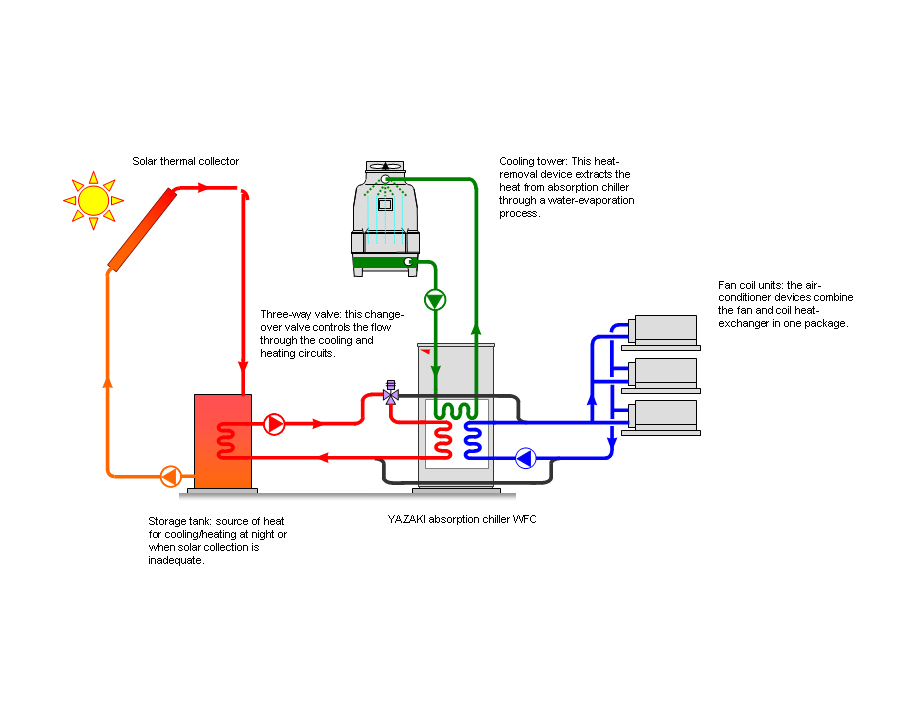
solar absorption chillersAir conditioning makes up bulk of the power usage, especially in tropical countries where the sun is shining almost throughout the year and the humidity levels are high. It makes a perfect sense to use solar heat to cool homes, business and factories. Many air-conditioning systems are commercially available using simple roof top PV solar panels to generate electric power to run an electric window air-conditioners. This system uses commercially available solar panels and window air-conditioners and uses solar power to generate electricity to run the compressor and the blower in the air-con unit. This system requires large storage battery to store adequate electricity to run your air-conditioners for specified period. Otherwise it requires a large area of solar panels to meet the demand. The efficiency of such systems can be improved using DC operated compressors and fans. However, renewable energy such as solar is still expensive to run air-conditioners because of high initial investment cost, though it may be economical in the long run as the cost of solar panels and accessories slowly come down over a time. Moreover such systems are limited to small air condition capacities.

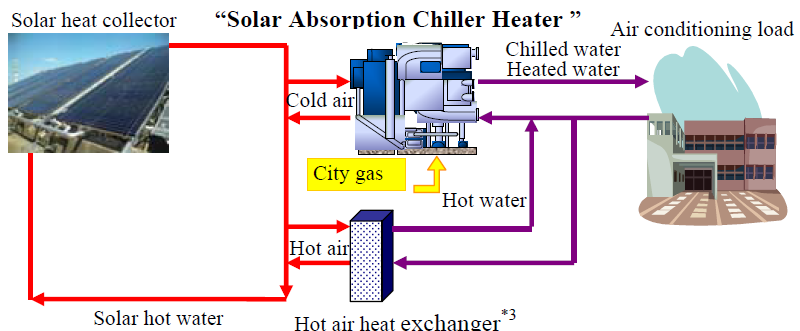
solar chillers-typical apacitiessolar absorption chillerFor large air-conditioning requirements such as business and factories, we need a system that uses solar heat directly to air-condition the premises with higher efficiency and thermal storage capabilities. Designing such a system is not very difficult because most of the components necessary to install such systems are readily available. One can install an air-conditioning system based on 100% solar thermal heat with molten salt thermal storage. Alternatively, a hybrid system can be installed based on solar heat without a thermal storage but using   city gas supply. Many countries use gas for heating during winter seasons but do not use gas during summer. These countries can use a hybrid (solar-gas) system to air-condition their premises and avoid peak electric usage during summer seasons thereby avoiding electrical black-outs. The advantage with such system is they can also be used for heating the premises during winter season. With changing climate due to global warming many warm countries like India also experiences cold temperatures during winter season. For example New Delhi in India has experienced a sharp drop in temperature up to 15-20c during winter from earlier winters.

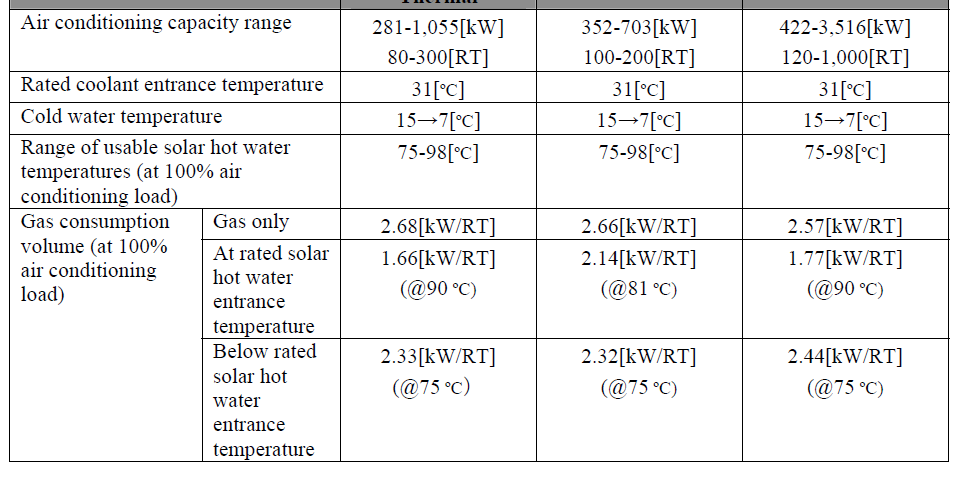
Solar cooling systems to date have used waste heat gas absorption chiller heaters, which utilize the waste heat from cogeneration systems (CGS) for the cold water. However, these chiller heaters with their established technologies are devices designed for the effective use stable CGS high-temperature waste heat, so they cannot accommodate the preferential use of solar heat when solar hot water temperatures suddenly change from large variations in the heat collector temperatures due to changes in the weather. The new solar absorption chiller heaters are now specially designed for the effective use of low-temperature solar heat to address this problem and improve the energy conservation effect from solar cooling system. Hot water at less than 90C can be used for such systems and typical chillers with their rated specification are shown in the figures.solar trough

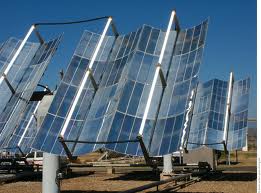
The efficiency of the system can be vastly improved by using parabolic solar concentrators, up to 27 times higher than ordinary flat plate solar collectors resulting in conversion efficiency up to 85% in heating and cooling. By selecting a natural refrigerant such as R717 we can save the environment from ozone depletion. Such systems offer flexibility to use exhaust heat, natural gas along with solar thermal storage up to 220C (phase transition temperature).The system offers an attractive return on investment, electricity savings and Carbon pollution reduction. The system can be designed from 5TR up to 200TR refrigeration capacity for 100% solar and up to 1000TR for a solar-gas hybrid systems. The solar thermal system with molten salt storage is versatile in its application because the same system can be designed for heating or cooling or on-site power generation for continuous applications.

.

The recent debate between the presidential nominees in US election has revealed their respective positions on their policies for an energy independent America. Each of them have articulated how they will increase the oil and gas production to make America energy independent, which will  also incidentally create number of jobs in an ailing economy. Each one of them will be spending a billion dollar first, in driving their messages to the voting public. Once elected, they will explore oil and gas aggressively that will make America energy independent. They will also explore solar and wind energy potentials simultaneously to bridge any shortfall. Their policies   seem to be unconcerned with global warming and its impact due to emission of GHG but, rather aggressive in making America an energy independent by generating an unabated emission of GHG in the future. Does it mean an ‘energy independent America’ will spell a doom to the world including US?

The best option for America to become energy independent will be to focus  on energy efficiency of existing technologies and systems, combining renewable fossil fuel energy mix, base load renewable  power and storage technologies, substituting Gasoline with Hydrogen using renewable energy sources. The future investment should be based on sustainable renewable energy sources than fossil fuel. But current financial and unemployment situation in US will force the new president to increase the conventional and unconventional oil and gas production than renewable energy production, which will be initially expensive with long pay pack periods but will eventually meet the energy need in a sustainable way. The net result of their current policies will be an enhanced emission of GHG and acceleration of global warming. But the energy projections in the U.S. Energy Information Administration’s (EIA’s) Annual Energy Outlook 2012 (AEO2012) projects a reduced GHG emission.

According to Annual Energy Outlook 2012 report:

“The projections in the U.S. Energy Information Administration’s (EIA’s) Annual Energy Outlook 2012 (AEO2012) focus on the factors that shape the U.S. energy system over the long-term. Under the assumption that current laws and regulations remain unchanged throughout the projections, the AEO2012 Reference case provides the basis for examination and discussion of energy production, consumption, technology, and market trends and the direction they may take in the future. It also serves as a starting point for analysis of potential changes in energy policies. But AEO2012 is not limited to the Reference case. It also includes 29 alternative cases, which explore important areas of uncertainty for markets, technologies, and policies in the U.S. energy economy. Many of the implications of the alternative cases are discussed in the “Issues in focus” section of this report.

Key results highlighted in AEO2012 include continued modest growth in demand for energy over the next 25 years and increased domestic crude oil and natural gas production, largely driven by rising production from tight oil and shale resources. As a result, U.S. reliance on imported oil is reduced; domestic production of natural gas exceeds consumption, allowing for net exports; a growing share of U.S. electric power generation is met with natural gas and renewable; and energy-related carbon dioxide emissions stay below their 2005 level from 2010 to 2035, even in the absence of new Federal policies designed to mitigate greenhouse gas (GHG) emissions.

The rate of growth in energy use slows over the projection period, reflecting moderate population growth, an extended economic recovery, and increasing energy efficiency in end-use applications.


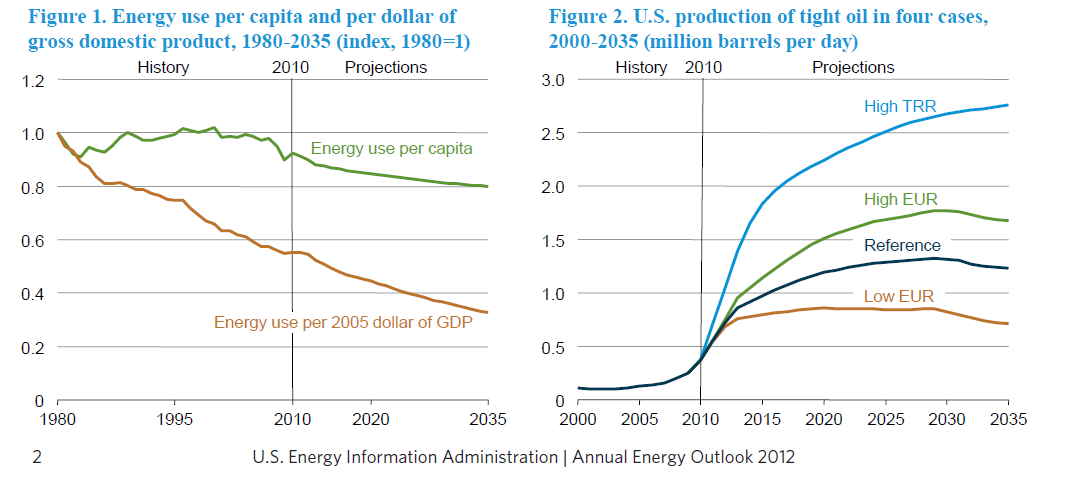
Overall U.S. energy consumption grows at an average annual rate of 0.3 percent from 2010 through 2035 in the AEO2012 Reference case. The U.S. does not return to the levels of energy demand growth experienced in the 20 years before the 2008- 2009 recession, because of more moderate projected economic growth and population growth, coupled with increasing levels of energy efficiency. For some end uses, current Federal and State energy requirements and incentives play a continuing role in requiring more efficient technologies. Projected energy demand for transportation grows at an annual rate of 0.1 percent from 2010 through 2035 in the Reference case, and electricity demand grows by 0.7 percent per year, primarily as a result of rising energy consumption in the buildings sector. Energy consumption per capita declines by an average of 0.6 percent per year from 2010 to 2035 (Figure 1). The energy intensity of the U.S. economy, measured as primary energy use in British thermal units (Btu) per dollar of gross domestic product (GDP) in 2005 dollars, declines by an average of 2.1 percent per year from 2010 to 2035. New Federal and State policies could lead to further reductions in energy consumption. The potential impact of technology change and the proposed vehicle fuel efficiency standards on energy consumption are discussed in “Issues in focus.”

Domestic crude oil production increases

Domestic crude oil production has increased over the past few years, reversing a decline that began in 1986. U.S. crude oil production increased from 5.0 million barrels per day in 2008 to 5.5 million barrels per day in 2010. Over the next 10 years, continued development of tight oil, in combination with the ongoing development of offshore resources in the Gulf of Mexico, pushes domestic crude oil production higher. Because the technology advances that have provided for recent increases in supply are still in the early stages of development, future U.S. crude oil production could vary significantly, depending on the outcomes of key uncertainties related to well placement and recovery rates. Those uncertainties are highlighted in this Annual Energy Outlook’s “Issues in focus” section, which includes an article examining impacts of uncertainty about current estimates of the crude oil and natural gas resources. The AEO2012 projections considering variations in these variables show total U.S. crude oil production in 2035 ranging from 5.5 million barrels per day to 7.8 million barrels per day, and projections for U.S. tight oil production from eight selected plays in 2035 ranging from 0.7 million barrels per day to 2.8 million barrels per day (Figure 2).

With modest economic growth, increased efficiency, growing domestic production, and continued adoption of nonpetroleum liquids, net imports of petroleum and other liquids make up a smaller share of total U.S. energy consumption

U.S. dependence on imported petroleum and other liquids declines in the AEO2012 Reference case, primarily as a result of rising energy prices; growth in domestic crude oil production to more than 1 million barrels per day above 2010 levels in 2020; an increase of 1.2 million barrels per day crude oil equivalent from 2010 to 2035 in the use of biofuels, much of which is produced domestically; and slower growth of energy consumption in the transportation sector as a result of existing corporate average fuel economy standards. Proposed fuel economy standards covering vehicle model years (MY) 2017 through 2025 that are not included in the Reference case would further cut projected need for liquid imports.

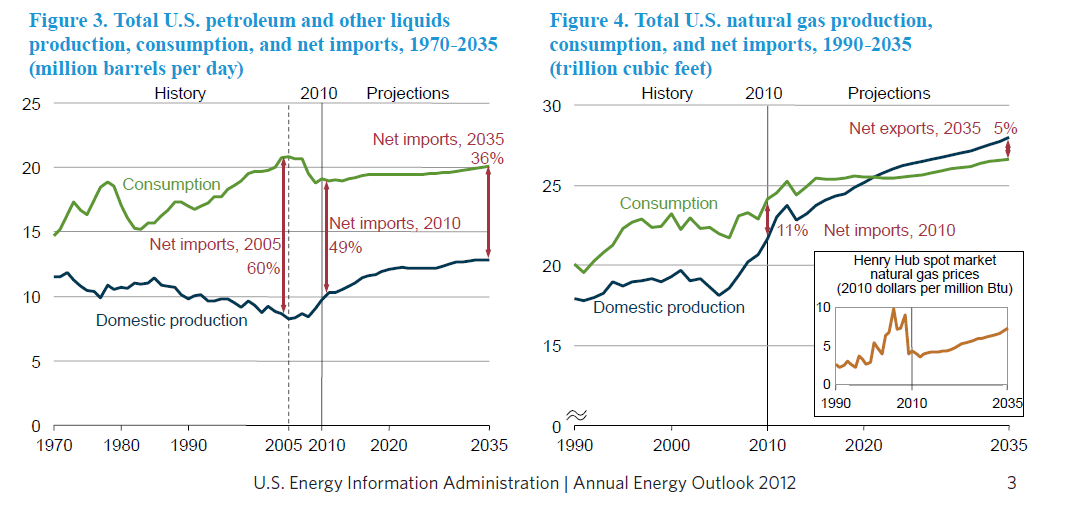
Although U.S. consumption of petroleum and other liquid fuels continues to grow through 2035 in the Reference case, the reliance on imports of petroleum and other liquids as a share of total consumption decline. Total U.S. consumption of petroleum and other liquids, including both fossil fuels and biofuels, rises from 19.2 million barrels per day in 2010 to 19.9 million barrels per day in 2035 in the Reference case. The net import share of domestic consumption, which reached 60 percent in 2005 and 2006 before falling to 49 percent in 2010, continues falling in the Reference case to 36 percent in 2035 (Figure 3). Proposed light-duty vehicles (LDV) fuel economy standards covering vehicle MY 2017 through 2025, which are not included in the Reference case, could further reduce demand for petroleum and other liquids and the need for imports, and increased supplies from U.S. tight oil deposits could also significantly decrease the need for imports, as discussed in more detail in “Issues in focus.”

Natural gas production increases throughout the projection period, allowing the United States to transition from a net importer to a net exporter of natural gas

Much of the growth in natural gas production in the AEO2012 Reference case results from the application of recent technological advances and continued drilling in shale plays with high concentrations of natural gas liquids and crude oil, which have a higher value than dry natural gas in energy equivalent terms. Shale gas production increases in the Reference case from 5.0 trillion cubic feet per year in 2010 (23 percent of total U.S. dry gas production) to 13.6 trillion cubic feet per year in 2035 (49 percent of total U.S. dry gas production). As with tight oil, when looking forward to 2035, there are unresolved uncertainties surrounding the technological advances that have made shale gas production a reality. The potential impact of those uncertainties results in a range of outcomes for U.S. shale gas production from 9.7 to 20.5 trillion cubic feet per year when looking forward to 2035.

As a result of the projected growth in production, U.S. natural gas production exceeds consumption early in the next decade in the Reference case (Figure 4). The outlook reflects increased use of liquefied natural gas in markets outside North America, strong growth in domestic natural gas production, reduced pipeline imports and increased pipeline exports, and relatively low natural gas prices in the United States.

Power generation from renewable and natural gas continues to increase

In the Reference case, the natural gas share of electric power generation increases from 24 percent in 2010 to 28 percent in 2035, while the renewable share grows from 10 percent to 15 percent. In contrast, the share of generation from coal-fired power plants declines. The historical reliance on coal-fired power plants in the U.S. electric power sector has begun to wane in recent years.

Over the next 25 years, the share of electricity generation from coal falls to 38 percent, well below the 48-percent share seen as recently as 2008, due to slow growth in electricity demand, increased competition from natural gas and renewable generation, and the need to comply with new environmental regulations. Although the current trend toward increased use of natural gas and renewable appears fairly robust, there is uncertainty about the factors influencing the fuel mix for electricity generation. AEO2012 includes several cases examining the impacts on coal-fired plant generation and retirements resulting from different paths for electricity demand growth, coal and natural gas prices, and compliance with upcoming environmental rules.

While the Reference case projects 49 gigawatts of coal-fired generation retirements over the 2011 to 2035 period, nearly all of which occurs over the next 10 years, the range for cumulative retirements of coal-fired power plants over the projection period varies considerably across the alternative cases (Figure 5), from a low of 34 gigawatts (11 percent of the coal-fired generator fleet) to a high of 70 gigawatts (22 percent of the fleet). The high-end of the range is based on much lower natural gas prices than those assumed in the Reference case; the lower end of the range is based on stronger economic growth, leading to stronger growth in electricity demand and higher natural gas prices. Other alternative cases, with varying assumptions about coal prices and the length of the period over which environmental compliance costs will be recovered, but no assumption of new policies to limit GHG emissions from existing plants, also yield cumulative retirements within a range of 34 to 70 gigawatts. Retirements of coal-fired capacity exceed the high-end of the range (70 gigawatts) when a significant GHG policy is assumed (for further description of the cases and results, see “Issues in focus”).

Total energy-related emissions of carbon dioxide in the United States stay below their 2005 level through 2035

Energy-related carbon dioxide (CO2) emissions grow slowly in the AEO2012 Reference case, due to a combination of modest economic growth, growing use of renewable technologies and fuels, efficiency improvements, slow growth in electricity demand, and increased use of natural gas, which is less carbon-intensive than other fossil fuels. In the Reference case, which assumes no explicit Federal regulations to limit GHG emissions beyond vehicle GHG standards (although State programs and renewable portfolio standards are included), energy-related CO2 emissions grow by just over 2 percent from 2010 to 2035, to a total of 5,758 million metric tons in 2035 (Figure 6). CO2 emissions in 2020 in the Reference case are more than 9 percent below the 2005 level of 5,996 million metric tons, and they still are below the 2005 level at the end of the projection period. Emissions per capita fall by an average of 1.0 percent per year from 2005 to 2035.

Projections for CO2 emissions are sensitive to such economic and regulatory factors due to the pervasiveness of fossil fuel use in the economy. These linkages result in a range of potential GHG emissions scenarios. In the AEO2012 Low and High Economic Growth cases, projections for total primary energy consumption in 2035 are, respectively, 100.0 quadrillion Btu (6.4 percent below the Reference case) and 114.4 quadrillion Btu (7.0 percent above the Reference case), and projections for energy-related CO2 emissions in 2035 are 5,356 million metric tons (7.0 percent below the Reference case) and 6,117 million metric tons (6.2 percent above the Reference case)”.  (Ref:U.S. Energy Information Administration).
Is this your new site? Log in to activate admin features and dismiss this message
Log In