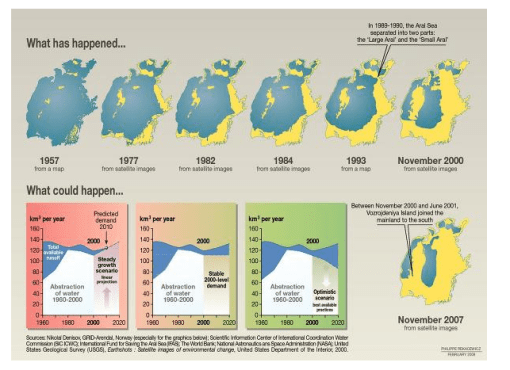
The arctic ice cover is steadily shrinking over a period opening new polar shipping routes. Recently a Norwegian ship was carrying a LNG Carrierto Japan through Russia, marking the beginning of new polar shipping route. There was a short documentary film on disappearance of an entire Aral Sea from the map, due to evaporation, caused by construction of dams by Russian authorities restricting the flow of rivers into Aral Sea. These dramatic events are happening right in front of our eyes. Yet, there are many Governments and people around the world are still questioning whether Global warming is real and is it man-made? Well, people do not accept science when it come to global warming because it causes them much inconvenience and embarrassment for Governments. They do not want to face the reality but prefer to postpone it for another day. This is what happening with super powers and industrialized countries in the world. But how long can they sustain such skepticism and postpone urgent actions that are necessary to save the future generation of mankind?
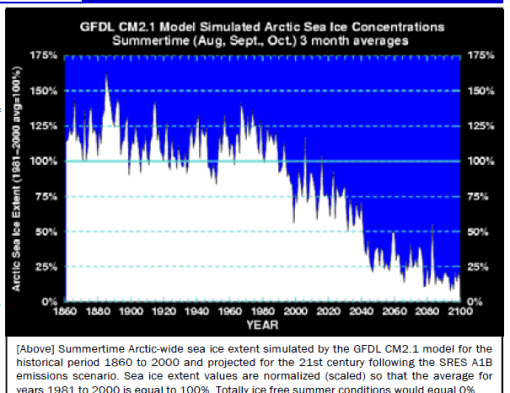
• Arctic sea ice is projected to decline dramatically over the 21st century, with little late summer sea ice remaining by the year 2100.
• The simulated 21st century Arctic sea ice decline is not smooth, but has periods of large and small changes.
• The Arctic region responds sensitively to past and future global climate forcing, such as changes in atmospheric greenhouse gas levels. Its surface air temperature is projected to warm at a rate about twice as fast as the global average.
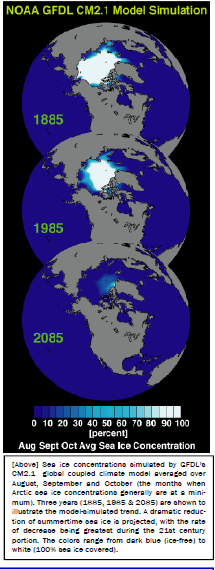
Attached Sea ice concentrations simulated by GFDL’s CM2.1 global coupled climate model averaged over August, September and October (the months when Arctic sea ice concentrations generally are at a minimum). Three years (1885, 1985 & 2085) are shown to illustrate the model-simulated trend. A dramatic reduction of summertime sea ice is projected, with the rate of decrease being greatest during the 21st century part. The colors range from dark blue (ice-free) to white (100% sea ice covered).
“Satellite observations show that Arctic sea ice extent has declined over the past three decades [e.g., NOAA magazine, 2006]. Global climate model experiments, such as those conducted at NOAA’s Geophysical Fluid Dynamics Laboratory (GFDL), project this downward trend to continue and perhaps accelerate during the 21st century.
The Arctic is a region that is projected to warm at about twice the rate of the global average [Winton, 2006a] – a phenomenon sometimes called “Arctic amplification”. As Arctic temperatures rise, sea ice melts—a change that in turn affects other aspects of global climate.
While beyond the scope of GFDL’s climate model simulations, other research suggests that Arctic sea ice changes can impact a broad range of factors — from altering key elements of the Arctic biosphere (plants and animals, marine and terrestrial, including polar bears and fish), to opening polar shipping routes, to shifting commercial fishing patterns, etc.
An Ice-Free Arctic in Summer
The three panel’s attachments are snapshots of how late summer Northern Hemisphere sea ice concentrations vary in time in a GFDL CM2.1 climate model simulation. The figures depict
Sea ice concentration – a measure of how much of the ocean area is covered by sea ice, and the climate model variable that is most similar to what a satellite observes.
By the late 21st century, the GFDL computer model experiments project that the Arctic becomes almost ice-free during the late summer. But during the long Arctic winters (not shown) the sea ice grows back, though thinner than is simulated for the 20th century. The rate at which the modeled 21st century Arctic warming and sea ice melting occurs is rapid compared to that seen in historical observations. Abrupt Arctic changes are of particular concern for human and ecosystem adaptations and are a subject of much current research (Winton 2006B).
The modeled summertime Arctic sea ice extent (the size of the area covered by sea ice) does not very smoothly in time, as a good deal of year-to-year variability superimposed on the downward trend. This can be seen in the graph to the right and also in animations found at www.gfdl.noaa.gov/research/climate/highlights.
By the end of the 21st century, the modeled summer sea ice extent usually is less than 20% of the simulated for 1981 to 2000. The Arctic sea ice results shown here are not unique to the GFDL climate model. Generally similar results are produced by computer models developed at several other international climate modeling centers. Though some uncertainties in model projections of future climate remain, results such as these, taken together with observations that document late 20th century Arctic sea ice shrinkage, make the Arctic a region that will continue to be studied and watched closely, as atmospheric greenhouse gas levels increase.
Climate implications of shrinking summer sea ice Melting sea ice can influence the climate through a process known as the ice-albedo feedback. Much of the sunlight reflected by sea ice returns to space and is unavailable to heat the climate system. As the sea ice melts, the surface darkens and absorbs more of this energy. This, in turn, can lead to greater melting. This is referred to as a “positive feedback loop” because an initial change (sea ice melting) triggers other responses in the system that eventually acts to enhance the original change (inducing more sea ice melting).
At GFDL, research has focused on the role of the ice-albedo feedback in the enhancing simulated Arctic warming and on the potential for this positive feedback loop to lead to abrupt changes [Winton, 2006a]. A somewhat complex picture has emerged that shows the ice-albedo feedback as a contributor, but not necessarily the dominant factor in determining why modeled Arctic surface air temperatures warm roughly twice as fast as the global average. It also has been found that, for the range of temperature increases likely to occur in the 21st century, the Arctic ice-albedo feedback adjusts smoothly as the model’s ice declines, by reducing the ice cover at progressively earlier times in the sunlit season. This smooth adjustment maintains a fairly constant amplification of Arctic temperature change on global average warming.
The details of how Arctic feedback processes act in climate models at various modeling centers differ, and so analysis and computer model development work continues to better understand and to cut uncertainties in Arctic climate change simulations.”
While many scientists are alarmed by the widening expanse of open water in the Arctic, blaming it on global warming, shippers see a new international route. The MV Nordic Barents is lugging 40,000 tonnes of iron ore from Norway to China on a shortcut through melting ice – and is making a little history in the process. It is the first non-Russian commercial vessel to attempt a non-stop crossing of a route that skirts the receding Arctic ice cap.
Business Times, Singapore report (6 September 2010):
The MV Nordic Barents is lugging 40,000 tonnes of iron ore from Norway to China on an Arctic Ocean shortcut through melting ice – and is making a little history in the process.
Steaming east along Russia’s desolate northern coast, the ship departed on Saturday as the first non-Russian commercial vessel to attempt a non-stop crossing of a route that skirts the receding Arctic ice cap.
‘We’re pretty much going over the top,’ said John Sanderson, the Australian CEO of the Norwegian mine where the iron ore comes from.
By using the northern route from Europe to Asia, the Nordic Barents could save eight days and 5,000 nautical miles of travel thought to be worth hundreds of thousands of dollars to the owners of its cargo.
While many scientists are alarmed by the widening expanse of open water that the ship will traverse, blaming it on global warming, shippers see a new international route.
Sanderson’s ASX-listed Northern Iron Ltd has sent 15 ships to China since it began mining in the northern Norwegian town of Kirkenes last October. All steamed south, then east through the Suez Canal or around the Cape of Good Hope.
To reach Chinese steel mills hungry for ore, they had to brave pirates in the Indian Ocean.
The Arctic route is no picnic either. On Saturday the polar ice sheet remained almost as big as the US mainland. But over the summer it has shrunk about as far from the Russian coast as it did during the biggest Arctic melt on record, in 2007, according to the Nansen Environmental and Remote Sensing Center.
And the Russians are waking up to the business potential of a route that was mostly reserved for domestic commercial vessels in the past.
‘Suddenly there is an opening that gives this part of the world an advantage,’ said Felix H Tschudi, whose shipping company is Northern Iron’s largest shareholder.
Willy Oestreng, chairman of research group Ocean Futures, called the trip of the Nordic Barents ‘historic’.
‘The western world is starting to show an interest and a capability to use that route,’ he said.
Two days after Russia and Norway agreed last April to settle a 40-year-old dispute over economic zones in the Barents Sea, government and business leaders of the two countries met in Kirkenes to sweep away hurdles to international shipping.
Russian law still requires icebreaker escort even where ice danger is small, due to a lack of onshore mechanical or medical support. But fees and rules are starting to loosen.
‘Russian companies and Russian authorities are now ready to assist,’ said Mikhail Belkin, assistant general manager of the state-owned Rosatomflot ice breaking fleet.
Lots of Russian vessels have plied the passage, and two German ships traversed it last year with small cargos delivered to Russian ports. But the Nordic Barents, an ice-class Danish bulk carrier chartered by Tschudi, is the first non-Russian ship with permission to pass without stopping.
Rosatomflot has assigned two 75,000-horsepower icebreakers to the vessel for about 10 days of the three-week voyage.
Tschudi won’t say how much Rosatomflot is charging but praised it as ‘cooperative, service-minded and pragmatic.’
‘Today the route is basically competitive with the Suez Canal, and we can subtract the piracy risk,’ he said.
Excluding icebreaking fees, a bulk ship that takes the Arctic route from Hamburg to Yokohama can save more than US$200,000 in fuel and canal expenses, Mr. Oestreng said. — Reuter.
Disappearance of Aral Sea from he map.
“In the 1960s, the Soviet Union undertook a major water diversion project on the arid plains of Kazakhstan, Uzbekistan, and Turkmenistan. The region’s two major rivers, fed by snowmelt and precipitation in faraway mountains, were used to transform the desert into farms for cotton and other crops. Before the project, the Syr Darya and the Amu Darya rivers flowed down from the mountains, cut northwest through the Kyzylkum Desert, and finally pooled together in the lowest part of the basin. The lake they made, the Aral Sea, was once the fourth largest in the world.
Although irrigation made the desert bloom, it devastated the Aral Sea. This series of images from the Moderate Resolution Imaging Spectroradiometer (MODIS) on NASA’s Terra satellite documents the changes. At the start of the series in 2000, the lake was already a fraction of its 1960 extent (black line). The Northern Aral Sea (sometimes called the Small Aral Sea) had separated from the Southern (Large) Aral Sea. The Southern Aral Sea had split into eastern and western lobes that remained tenuously connected at both ends.
By 2001, the southern connection had been severed, and the shallower eastern part retreated rapidly over the next several years. Especially large retreats in the eastern lobe of the Southern Sea appear to have occurred between 2005 and 2009, when drought limited and then cut off the flow of the Amu Darya. Water levels then fluctuated annually between 2009 and 2012 in alternately dry and wet years.
As the lake dried up, fisheries and the communities that depended on them collapsed. The increasingly salty water became polluted with fertilizer and pesticides. The blowing dust from the exposed lakebed, contaminated with agricultural chemicals, became a public health hazard. The salty dust blew off the lakebed and settled onto fields, degrading the soil. Croplands had to be flushed with larger and larger volumes of river water. The loss of the moderating influence of such a large body of water made winters colder and summers hotter and drier.
In a last-ditch effort to save some of the lake, Kazakhstan built a dam between the northern and southern parts of the Aral Sea. Completed in 2005, the dam was basically a death sentence for the southern Aral Sea, which was judged to be beyond saving. All of the water flowing into the desert basin from the Syr Darya now stays in the Northern Aral Sea. Between 2005 and 2006, the water levels in that part of the lake rebounded significantly and very small increases are visible throughout the rest of the time period. The differences in water color are due to changes in sediment.”


 ahilan@cewt.tech

 Clean Energy and Water Technologies Pty Ltd