Skip navigation

Tag Archives: Climate change

FrCEWT | Investor Brief
Carbon Recycling Technology (CRT)

From Energy Crisis to Energy Sovereignty

EXECUTIVE SUMMARY

The global energy system is undergoing structural disruption driven by geopolitical instability and climate constraints.
This is not a temporary crisis — it is the breakdown of an outdated energy architecture.

For over a century, energy systems have operated as open loops:
Extract → Burn → Generate → Emit → Pollute

This model is no longer viable.

Carbon Recycling Technology (CRT), developed by Clean Energy and Water Technologies (CEWT), introduces a closed-loop energy architecture where carbon is continuously recycled rather than emitted.

CRT transforms captured CO₂ into renewable methane using green hydrogen, enabling dispatchable, zero-emission power generation while maintaining energy density and infrastructure compatibility.

This represents a paradigm shift from fuel substitution to system redesign.


THE OPPORTUNITY

• Global energy markets are facing volatility due to supply disruptions and geopolitical risk
• Industrial sectors require 24/7 power, heat, and molecular fuels
• Hydrogen alone faces storage, transport, and cost limitations
• Existing infrastructure is built around hydrocarbons

CRT addresses all four simultaneously.

It enables:
• Baseload renewable power
• Industrial heat continuity
• Molecular energy storage
• Compatibility with existing gas infrastructure


CORE TECHNOLOGY

CRT integrates:
• CO₂ capture
• Renewable hydrogen production
• Methanation (CO₂ + 4H₂ → CH₄ + 2H₂O)
• Gas turbine power generation

Carbon becomes a recyclable carrier.
Hydrogen becomes the energy input.
Methane becomes the storage medium.

The result is a perpetual carbon-energy loop.


INVESTMENT CASE

1. System-Level Innovation
CRT is not a single technology — it is an integrated energy architecture addressing power, heat, and fuel simultaneously.

2. Infrastructure Advantage
Leverages existing gas pipelines, storage, and turbines — reducing transition costs.

3. Energy Sovereignty
Enables nations to produce fuel domestically from CO₂ and renewable electricity.

4. Market Alignment
Aligned with global decarbonisation policies, carbon markets, and energy security priorities.

5. Scalability
Applicable across power generation, steel, chemicals, and desalination sectors.


STRATEGIC POSITIONING

CRT sits at the intersection of:
• Renewable energy
• Carbon management
• Synthetic fuels
• Industrial decarbonisation

It bridges the gap between intermittent renewables and continuous industrial demand.


WHY NOW

• Fossil fuel volatility is rising
• Hydrogen economics remain uncertain
• Carbon pricing is tightening globally
• Grid stability challenges are increasing

The current disruption is accelerating adoption of closed-loop systems.


CONCLUSION

The energy transition is not simply about replacing fuels.

It is about redesigning the system.

CRT enables that transition by closing the carbon loop — transforming a liability into a reusable asset.

This is not incremental improvement.

This is foundational change.


CONTACT
Clean Energy and Water Technologies Pty Ltd (CEWT)
Australia

om Energy Crisis to Energy Sovereignty

From Energy Crisis to Energy Sovereignty

EXECUTIVE SUMMARY

The global energy system is undergoing structural disruption driven by geopolitical instability and climate constraints.
This is not a temporary crisis — it is the breakdown of an outdated energy architecture.

For over a century, energy systems have operated as open loops:
Extract → Burn → Generate → Emit → Pollute

This model is no longer viable.

Carbon Recycling Technology (CRT), developed by Clean Energy and Water Technologies (CEWT), introduces a closed-loop energy architecture where carbon is continuously recycled rather than emitted.

CRT transforms captured CO₂ into renewable methane using green hydrogen, enabling dispatchable, zero-emission power generation while maintaining energy density and infrastructure compatibility.

This represents a paradigm shift from fuel substitution to system redesign.


THE OPPORTUNITY

• Global energy markets are facing volatility due to supply disruptions and geopolitical risk
• Industrial sectors require 24/7 power, heat, and molecular fuels
• Hydrogen alone faces storage, transport, and cost limitations
• Existing infrastructure is built around hydrocarbons

CRT addresses all four simultaneously.

It enables:
• Baseload renewable power
• Industrial heat continuity
• Molecular energy storage
• Compatibility with existing gas infrastructure


CORE TECHNOLOGY

CRT integrates:
• CO₂ capture
• Renewable hydrogen production
• Methanation (CO₂ + 4H₂ → CH₄ + 2H₂O)
• Gas turbine power generation

Carbon becomes a recyclable carrier.
Hydrogen becomes the energy input.
Methane becomes the storage medium.

The result is a perpetual carbon-energy loop.


INVESTMENT CASE

1. System-Level Innovation
CRT is not a single technology — it is an integrated energy architecture addressing power, heat, and fuel simultaneously.

2. Infrastructure Advantage
Leverages existing gas pipelines, storage, and turbines — reducing transition costs.

3. Energy Sovereignty
Enables nations to produce fuel domestically from CO₂ and renewable electricity.

4. Market Alignment
Aligned with global decarbonisation policies, carbon markets, and energy security priorities.

5. Scalability
Applicable across power generation, steel, chemicals, and desalination sectors.


STRATEGIC POSITIONING

CRT sits at the intersection of:
• Renewable energy
• Carbon management
• Synthetic fuels
• Industrial decarbonisation

It bridges the gap between intermittent renewables and continuous industrial demand.


WHY NOW

• Fossil fuel volatility is rising
• Hydrogen economics remain uncertain
• Carbon pricing is tightening globally
• Grid stability challenges are increasing

The current disruption is accelerating adoption of closed-loop systems.


CONCLUSION

The energy transition is not simply about replacing fuels.

It is about redesigning the system.

CRT enables that transition by closing the carbon loop — transforming a liability into a reusable asset.

This is not incremental improvement.

This is foundational change.


CONTACT
Clean Energy and Water Technologies Pty Ltd (CEWT)
Australia

CEWT | Investor Brief
Carbon Recycling Technology (CRT)

From Energy Crisis to Energy Sovereignty

EXECUTIVE SUMMARY

The global energy system is undergoing structural disruption driven by geopolitical instability and climate constraints.
This is not a temporary crisis — it is the breakdown of an outdated energy architecture.

For over a century, energy systems have operated as open loops:
Extract → Burn → Generate → Emit → Pollute

This model is no longer viable.

Carbon Recycling Technology (CRT), developed by Clean Energy and Water Technologies (CEWT), introduces a closed-loop energy architecture where carbon is continuously recycled rather than emitted.

CRT transforms captured CO₂ into renewable methane using green hydrogen, enabling dispatchable, zero-emission power generation while maintaining energy density and infrastructure compatibility.

This represents a paradigm shift from fuel substitution to system redesign.


THE OPPORTUNITY

• Global energy markets are facing volatility due to supply disruptions and geopolitical risk
• Industrial sectors require 24/7 power, heat, and molecular fuels
• Hydrogen alone faces storage, transport, and cost limitations
• Existing infrastructure is built around hydrocarbons

CRT addresses all four simultaneously.

It enables:
• Baseload renewable power
• Industrial heat continuity
• Molecular energy storage
• Compatibility with existing gas infrastructure


CORE TECHNOLOGY

CRT integrates:
• CO₂ capture
• Renewable hydrogen production
• Methanation (CO₂ + 4H₂ → CH₄ + 2H₂O)
• Gas turbine power generation

Carbon becomes a recyclable carrier.
Hydrogen becomes the energy input.
Methane becomes the storage medium.

The result is a perpetual carbon-energy loop.


INVESTMENT CASE

1. System-Level Innovation
CRT is not a single technology — it is an integrated energy architecture addressing power, heat, and fuel simultaneously.

2. Infrastructure Advantage
Leverages existing gas pipelines, storage, and turbines — reducing transition costs.

3. Energy Sovereignty
Enables nations to produce fuel domestically from CO₂ and renewable electricity.

4. Market Alignment
Aligned with global decarbonisation policies, carbon markets, and energy security priorities.

5. Scalability
Applicable across power generation, steel, chemicals, and desalination sectors.


STRATEGIC POSITIONING

CRT sits at the intersection of:
• Renewable energy
• Carbon management
• Synthetic fuels
• Industrial decarbonisation

It bridges the gap between intermittent renewables and continuous industrial demand.


WHY NOW

• Fossil fuel volatility is rising
• Hydrogen economics remain uncertain
• Carbon pricing is tightening globally
• Grid stability challenges are increasing

The current disruption is accelerating the adoption of closed-loop systems.


CONCLUSION

The energy transition is not simply about replacing fuels.

It is about redesigning the system.

CRT enables that transition by closing the carbon loop — transforming a liability into a reusable asset.

This is not an incremental improvement.

This is foundational change.


CONTACT
Clean Energy and Water Technologies Pty Ltd (CEWT)
Australia

This is not an oil crisis.

It’s something deeper — and far more structural.

It’s an energy system failure.


For decades, energy systems were built on a simple assumption:

Demand is predictable. Supply is controllable.

That world no longer exists.


Today, three forces are colliding:

AI is turning electricity into continuous demand

🌬️ Renewables are inherently intermittent

🔋 Storage is still short-duration

Individually, each works.

Together, they create instability.


We are now facing a mismatch that the system was never designed for:

  • Demand is becoming time-dependent and continuous
  • Supply is becoming variable and weather-driven

And we are trying to bridge that gap with incremental fixes.

More renewables.

More batteries.

More transmission.


But here’s the uncomfortable truth:

You cannot solve a structural problem with incremental solutions.


This is why the conversation around energy is starting to shift — quietly, but fundamentally.

From technology → to system architecture


At Clean Energy and Water Technologies (CEWT), we’ve been working on this problem from a different angle.

Not just how to generate clean energy.

But how to reshape energy so it behaves like the system needs it to.


Because the real challenge is not producing energy.

It is aligning energy with time.


This is where Carbon Recycling Technology (CRT) comes in.

  • Renewable electricity is converted into hydrogen
  • Hydrogen combines with captured CO₂
  • The result is renewable methane (RNG) — a storable, dispatchable energy carrier

And when used, the CO₂ is captured and recycled again.


Carbon is no longer a liability.

It becomes a carrier.


This changes the equation:

Instead of forcing demand to follow supply,

Supply is reshaped to follow demand.


And that is the missing layer in today’s energy transition.


We are not just transitioning energy.

We are redesigning the system that carries it.


AI, industry, and global electrification are accelerating this reality.

The question is no longer whether change is needed.

It is whether we continue to optimise the old system —

or build the one that actually works.


There is no shortcut.

Closing the carbon loop is the only real path to defossilisation.


#EnergyTransition #AI #EnergySystems #Hydrogen #Decarbonisation #CRT #CEWT

This is not an oil crisis.

It’s something deeper — and far more structural.

It’s an energy system failure.


For decades, energy systems were built on a simple assumption:

Demand is predictable. Supply is controllable.

That world no longer exists.


Today, three forces are colliding:

AI is turning electricity into continuous demand

🌬️ Renewables are inherently intermittent

🔋 Storage is still short-duration

Individually, each works.

Together, they create instability.


We are now facing a mismatch that the system was never designed for:

  • Demand is becoming time-dependent and continuous
  • Supply is becoming variable and weather-driven

And we are trying to bridge that gap with incremental fixes.

More renewables.

More batteries.

More transmission.


But here’s the uncomfortable truth:

You cannot solve a structural problem with incremental solutions.


This is why the conversation around energy is starting to shift — quietly, but fundamentally.

From technology → to system architecture


At Clean Energy and Water Technologies (CEWT), we’ve been working on this problem from a different angle.

Not just how to generate clean energy.

But how to reshape energy so it behaves like the system needs it to.


Because the real challenge is not producing energy.

It is aligning energy with time.


This is where Carbon Recycling Technology (CRT) comes in.

  • Renewable electricity is converted into hydrogen
  • Hydrogen combines with captured CO₂
  • The result is renewable methane (RNG) — a storable, dispatchable energy carrier

And when used, the CO₂ is captured and recycled again.


Carbon is no longer a liability.

It becomes a carrier.


This changes the equation:

Instead of forcing demand to follow supply,

Supply is reshaped to follow demand.


And that is the missing layer in today’s energy transition.


We are not just transitioning energy.

We are redesigning the system that carries it.


AI, industry, and global electrification are accelerating this reality.

The question is no longer whether change is needed.

It is whether we continue to optimise the old system —

or build the one that actually works.


There is no shortcut.

Closing the carbon loop is the only real path to defossilisation.


#EnergyTransition #AI #EnergySystems #Hydrogen #Decarbonisation #CRT #CEWT

Clean Energy and Water Technologies Pty Ltd (CEWT)

ABN 61 691 320 028 | ACN 691 320 028

Technology Note

Why Carbon Recycling Technology (CRT) Is Structurally Superior for Green Iron Production

Date: March 2026

Prepared for: Government agencies, investors, industrial partners


Overview

Carbon Recycling Technology (CRT) enables zero-emission iron production by combining hydrogen-rich syngas reduction with a closed carbon loop.

Unlike hydrogen-only pathways that require large new infrastructure and massive electrolysis capacity, CRT preserves the proven gas-based reduction chemistry used in Direct Reduced Iron (DRI) systems while eliminating net carbon emissions.

This approach allows the transition to green iron production using existing industrial infrastructure with significantly lower energy and hydrogen requirements.


1. Uses Proven Gas-Based Iron Reduction Chemistry

CRT reduces iron ore using hydrogen-rich syngas (CO + H₂) generated through steam reforming.

This is the same fundamental chemistry used in natural-gas-based DRI processes such as those deployed globally by Midrex.

Advantages

  • Proven shaft-furnace technology
  • Established reduction kinetics
  • Mature industrial operating experience
  • Reduced technical risk

CRT therefore builds on existing metallurgical practice rather than introducing an entirely new process.


2. Achieves Zero Emissions Through Carbon Recycling

In conventional natural-gas DRI:

Natural Gas → Reduction → CO₂ released to atmosphere

In CRT:

Natural Gas / RNG → Reduction → CO₂ captured → recycled → Renewable Natural Gas (RNG)

The carbon atom, therefore, circulates continuously within the system, acting as a recyclable carrier rather than being emitted.

This closed molecular loop allows CRT to achieve net-zero emissions without eliminating carbon from the process chemistry.


3. Dramatically Lower Hydrogen Requirement

Hydrogen-only ironmaking requires hydrogen to supply both:

  • the reducing gas, and
  • the energy source for the process

This results in very large electrolysis capacity requirements.

CRT instead uses hydrogen-rich syngas, with only a small renewable hydrogen trim required to maintain the carbon recycling loop.

Benefits

  • significantly smaller electrolysers
  • lower renewable electricity demand
  • reduced hydrogen storage requirements
  • improved economic feasibility

4. Compatible With Existing Industrial Infrastructure

Hydrogen-only steelmaking requires major changes to industrial systems, including:

  • new hydrogen production infrastructure
  • new fuel supply networks
  • modified furnaces and process systems

CRT maintains compatibility with existing infrastructure, including:

  • gas reforming systems
  • DRI shaft furnaces
  • gas handling and distribution networks
  • high-temperature industrial heat systems

This allows decarbonisation to proceed faster and at lower capital cost.


Structural Advantage of CRT

Traditional decarbonisation approaches attempt to remove carbon from industrial energy systems.

CRT instead recycles carbon as a molecular energy carrier, while renewable hydrogen provides the incremental energy required to maintain the loop.

This architecture preserves the thermodynamic advantages of carbon-based fuels while eliminating net emissions.


Conclusion

Carbon Recycling Technology provides a practical pathway for green iron production by combining:

  • proven gas-based reduction chemistry
  • closed-loop carbon recycling
  • minimal hydrogen requirements
  • compatibility with existing infrastructure

This system architecture enables heavy industry to transition toward zero-emission production while maintaining operational reliability and economic viability.

Carbon Recycling Technology

Recently I filed a preliminary patent application on ‘decarbonisation’.
It is a holistic process that uses only seawater and sun to generate a base load power with zero emission using the principle of ‘circular economy’. Somebody asked me to explain this technology in a lay man’s language. It is similar to an example what I explained as follows:
Let me explain in a lay mans’s language. Imagine you fill your car with 50 lit  petrol and go on a trip. The petrol is a Hydrocarbon (chemical term).Suppose I fit a small equipment on the exhaust pipe of your car which will collect the exhaust gases in a liquid form and collect it. When you finish your trip you can remove that equipment which collected your exhaust in a liquid form and hand over to a small processing unit on the road side. The processing unit will convert that exhaust  liquid into Petrol once agin. You can fill your car with this new petrol and also fit your car with new exhaust collector and return back to your destination. It means there is a zero emission from your car. You need not convert your car into electric or do any modification at all. You don’t have to fill your car with new petrol. It is called CRT (carbon recycling technology). It means you don’t need any petrol at all except for the initial filling. Even that can be eliminated by extracting Carbon from sea water and synthesising a Carbon negative Petrol. No pollution at all because of zero emissions. It simply uses the same Carbon atom again and again by substituting the ‘fossil hydrogen’ with’ renewable hydrogen’ with absolutely no emissions. It fulfils all the requirement of a ‘circular economy’ and a Carbon -free atmosphere. What is unique about this technology is it derives Carbon from seawater (where CO2 has already been absorbed from industrial emissions) and converting into Carbon negative synthetic fuel (unlike Carbon neutral synthetic fuels which are made from CO2 emissions that encourages continuous usage of fossil fuels) with cleaner properties. An Oxy combustion will make it a unique fuel of the future. Our current focus is to generate a base load power(24 x7) without any energy storage at all. It is the only technology in the world that generates a base load power (24 x 7) and synthetic fuels such as aviation fuel, marine fuel, petrol, diesel and CNG using only Sun/wind and Seawater.

climate change# salinity #ocean acidification # water vapor #flooding # bushfires
Irreversible climate change and human failure !
Increasing ocean salinity, decreasing ocean pH, increasing CO2 concentration and water vapor in the atmosphere will irreversibly change the climate. All the above four parameters are directly attributed to human activity and they are inter-related. Warming ocean and increasing evaporation in some parts of the world, large scale (billions of m3/day) discharge of highly concentrated saline effluent from seawater desalination plants around the world, unabated emission of CO2 and water vapor by burning fossil fuels, ocean acidification by CO2 absorption are directly connected with human activities. NASA is monitoring seawater salinity and water vapor concentration in the atmosphere using special satellites while NOAA is monitoring ocean acidification and salinity of the oceans. They can only provide information and warnings but it is up to relevant government authorities to act. Failure to act will cost lives and the economy and the world is already witnessing them. Oil and gas companies are now using a new slogan (carbon capture and storage or sequestration and reuse) to prolong continuity of fossil fuels. “carbon capture” guarantees continuity of “Carbon emissions”. The real solution is to “decarbonize our air and sea” and recycle Carbon internally in a closed system not “carbon capture or reuse and claim Carbon neutrality”. These projects will exacerbate climate change if we fail to decarbonize air and sea using renewable Hydrogen. An estimated 2000 billion tons of CO2 is already available in air and sea since the industrial revolution and there is no need for any fresh fossil fuel. We are facing “irreversible climate change and human failure to address them in a timely manner”. Bold leadership and political will while monitoring ‘misleading players’ and penalizing emitters by imposing Carbon tax will be the key.
Please check:https://lnkd.in/gv2Ba99

“The intuitive mind is a sacred gift and the rational mind is a faithful servant.We have created a society  that honors the servant and has forgotten the gift” – Albert Einstein.

United Nation’s panel on climate change (IPCC) recently confirmed that climate change is real, it is man-made and it is irreversible and if nations do not act now then they will have to face catastrophic climate events in the future. They were categorical and unequivocal in their statements this time. They have come to this conclusion because science has not demonstrated how to   capture carbon emission and sequester them under the earth using current technologies. Scientists neglected carbon emissions while generating power using fossil fuels for decades because they had no idea what would be the consequences of such emissions in the future. It is a clear example how a human mind has a limited capacity to conceive an idea “holistically” but has a capacity to satisfy human needs temporarily without knowing the unforeseeable consequences. When human beings interfere with Nature in the name of Science there are consequences to face and a price to pay because Nature is nothing but the manifestation of the highest intelligence. A real science can be no further than asserting this truth. Ignorance when combined with greed can be a deadly combination and the consequences will be costly and to be paid dearly by generations to come. Carbon emission and climate change is one such issue. Science has improved human life on earth in so many ways but at the same time they also have created many side effects which can be identified only after decades of their use. When they are identified it is often too late and causes irreversible damage to system or nature. Any irreversible change human beings cause in Nature will have its own consequences. Science has shown Carbon is the backbone of all organic matter on planet earth whether it is DNA of a human being or a glittering diamond from deep under the earth. The same Carbon reveals the age of a skeleton of a Dinosaur  buried millions of years ago. Science is a powerful tool but it also has two sides, benign and malign. The power to discriminate between the good and bad is the fundamental pre-requisite of science. Carbon plays an indispensible role in the natural world due to its unique atomic structure and ease with which it can build molecules especially with hydrogen. That is why hydrocarbon is playing such an important role in human civilization and it is not easy to substitute it with another candidate without a long term research and development work. But we have a very short time to discover a substitute for hydrocarbon which can serve our current purposes. Few nuclear power plants around the world can satisfy the growing demand for the electricity without any carbon emission but their long term consequences are unknown. The result of a thermo-nuclear explosion over Hiroshima and Nagasaki are the grim reminder of such consequences. When earth converts organic matter into a fossil over a period of millions of years deep under the earth, it gives us a clue why Nature has buried them and not left them on the surface of the earth. But that did not deter human beings from digging them out and burning them to generate heat to meet their temporary energy needs without realizing the long term consequences of such actions. Many technologies have become obsolete over a period of time for various reasons but some of them lingered long enough to create long lasting consequences and there are many evidences in history to emphasize this truth. Power generation using fossil fuel is one such clear example of a technological bungle. It only confirms the inadequacy of human knowledge.  It also reveals the temporary nature of such inventions stemming from temporary nature of human life. Science also has changed dramatically in the last few decades and it no longer serves the original purpose of unraveling and understanding the mysteries of Nature but caters and serves to the greed and dominance of selected rich and powerful people and the nations in the world. Science has become a tool to create material wealth and power rather than to understand nature and apply them into our lives in a compatible way and to enrich human life. These experiences have taught one important lesson. Any scientific discovery when applied in real life must be “holistic” and be compatible with Nature and should follow Natural laws. When science becomes a wealth creating tool then any knowledge born out of such science can only serve to create wealth often at the cost of Nature. That is why rich and powerful corporate and nations spend billions of dollars in such wealth creating discoveries rather than on discoveries that address human problems of the world that may not return their investment in time. The anomaly is more they invest on wealth creating science more damage they cause to earth and human life. Such discoveries serve only one purpose namely “the wealth creation “. Wealth and power has overtaken science and knowledge. Climate change has become a serious issue and it is absolutely clear that CO2 in the atmosphere has increased to the current level for the first time in millions of years and human beings have contributed greatly to this increase. Yet, nations around the world are unable to come to-gather and agree on how to reduce such emissions. The only way to solve this issue is to use Science as a tool which created this problem in the first place. When steam engine was invented it was considered as the dawn of industrial revolution: when electricity generation using electro-magnetism was invented it was hailed as a land mark in scientific development. When power was generated using fossil fuel to accelerate the industrial growth very little attention was paid to the carbon emission. When huge quantities of sea water was used to cool the cooling towers in fossil fuel powered or nuclear power plants very little attention was paid to the discharge of effluent in to the sea. When large desalination plants were set up to quench the thirst of oil rich countries very little attention was paid to the toxic discharge of effluent in to the sea. What was missing in all the above developments was the negligence of Nature by discharge of emissions or effluents into the Natural world. We have taken Nature for granted and treated her with great indignity and contempt. Few decades ago Scientists were able to make remarkable discoveries using only their mind as a tool and theorizing certain concepts. They were abstract in nature but were validated whenever applied in practice. There were no big investments by Governments or companies on scientific discoveries, no Intellectual property portfolios, no personal ownership, no disputes on infringement as to who owns and what. Today scientific inventions and intellectual properties are the biggest assets and monopolies of few corporate and nations.  Several hundred billions are spent on patents, trademarks and copy rights to stamp their authorities and ownerships. But where such knowledge came from? Who pays for the consequences of ill -conceived scientific discoveries that prove disastrous in the long run? Who can sue them when such technologies are passed on to several generations without knowing their long term consequences? Science is now suggesting methods to address carbon emission using various renewable energy sources such as solar, wind, biomass etc. But these methods often use capital intensive equipments to use such energy even though Nature provides them free of cost. Such equipments also require large energy input to produce which again comes from fossil fuel maintaining the level of CO2 in the atmosphere. The investment on renewable energy has come down by nearly 70% according to latest news and many countries are gearing up to step up their fossil fuel production in the name of “energy security” simply because they have become “addicted “to old ways of living. In fact there is too much at stake for these countries and they are stubbornly sticking to old ideas. Science has become useless in addressing climate change because it is no longer about science but about nation’s security and maintaining material wealth of the citizens of a particular nation and the popularity of politicians among the ignorant masses and  winning their elections and holding to their power. Sun is the only source of energy on the planet earth and all other forms of energy such as wind and biomass etc are only by-products of sun.  Current power generating technologies heavily depends of conversion of thermal energy into electrical energy and the source of thermal energy is by fossil fuel or nuclear. Recently light energy from sun is converted directly into electrical energy using photovoltaics. They also use thermal energy of the sun using solar concentrators to generate power in conventional way using turbines. But high initial cost, lack of energy storage technologies and intermittent nature of renewable sources increases the cost of energy compared to conventional coal fired power and alternative energy has created an uncertainty in the power industry. Energy industry is now at the cross road and it has divided people into two categories; one group accepts science of global warming and climate change and advocate substituting fossil fuel with carbon free energy sources and another group express skepticism over climate science and support fossil fuel energy sources in order to continue and maintain the industrial growth and employment. If countries like US and Australia who have rich deposits of high grade coal and depend heavily on coal based power plants and industries then they have an option to increase the efficiency of coal utilization by way of emission reduction. For example they can reduce carbon emission substantially using gasification technologies. In fact, under certain special conditions it is possible to generate syngas from coal with highest Hydrogen content (even up to CO: H2 ratio of 20:80).This will increase not only the calorific value of syngas but also reduce carbon emission. Companies like GE, USA are developing special gas turbines for syngas with high hydrogen content. Alternatively conversion of coal into synthetic natural gas (SNG) can reduce the carbon emission without dispensing with coal completely. Renewable hydrogen is a potential long term substitute for fossil fuel both for power industry and transportation. But it requires special handling due to its high explosive nature and it is often easier to handle it with a mix of hydrocarbon such as Methane or Carbon monoxide. Fuel cell is an emerging technology that can use hydrogen for power generation as well as for transportation. However it requires expensive catalysts and they are currently confined to smaller applications in power industry. Fuel cell opens up a new way to generate electricity by simply stripping electrons from a hydrogen atom with Platinum and allowing the resulting proton exchange by special membranes in a cell converting chemical energy into an electrical energy. It is certainly a breakthrough in power generation but there is a long way to go before commercializing them on larger scale. It seems Carbon will continue to play an important role for years to come due to its unique nature in the natural world. But high carbon intensity fuel such as coal and current methods of direct combustion will have to be abandoned and substituted with SNG or Syn gas with high hydrogen content by gasifying coal. By this way hydrogen can be introduced into the current energy mix without substantial deviation from using coal while maintaining the carbon emission well within the limit. However a long term strategy will require complete substitution of fossil fuel with renewable hydrogen or with completely a new method of electricity generation such as Fuel cell without using a thermal energy.  Electricity is nothing but a flow of electrons and techniques that are currently used in Fuel cell such as proton exchange membrane should be developed using low cost catalyst and materials on a much larger scale to substitute fossil fuel completely. It is clear that power generation technology should be delinked with using carbon source or combustion for that matter. Combustion of hydrogen electrochemically is an elegant solution but lot of research and development is required. But the stark reality is climate is already changing and the climate change is irreversible and we have to use science to adopt our lives to the changing climate in the future. We cannot capture the carbon and bury them under the earth as Nature does because Nature has not taught us how to do it in a short span of time. The impact of climate change can be minimized or averted depending upon how fast carbon emission is reduced using new technologies. Climate change is an important lesson from which the scientific community should learn how not to interfere with Nature without a complete understanding of it. Sun shine and clean air are not just for rich and powerful but to the entire humanity on the planet. Any scientific discovery should be “holistic” and compatible with Nature and easily accessible to all human beings. Solar and biomass are emerging as alternative technologies to tackle climate change but these simple and holistic solutions were in fact practiced for decades in rural India. Farmers in India feed their cattle with cellulosic fibers (polysaccharides) as a feed and use their waste in the form of “solar” dried cakes (cow dung cakes) as a fuel that has a calorific value of 2100kj (Wikipedia). They also use the waste to generate Methane by anaerobic digestion. These technologies are not new but the challenge is they should to be built on large commercial scales to meet the demand of the growing population in a holistic way. Industrialized countries are now trying to convert the same cellulose (polysaccharides) into industrial alcohol instead of converting corn starch. When plants grow by photosynthesis using sun, it generates starch, lignin, cellulose as well as fatty acids in oil seeds.  It is important to understand that Nature provides them as food for human beings and animals and not as a raw material to generate fuel or energy and that is why “holistic solutions” are the key for the survival of science and technology as well as humanity in the future.

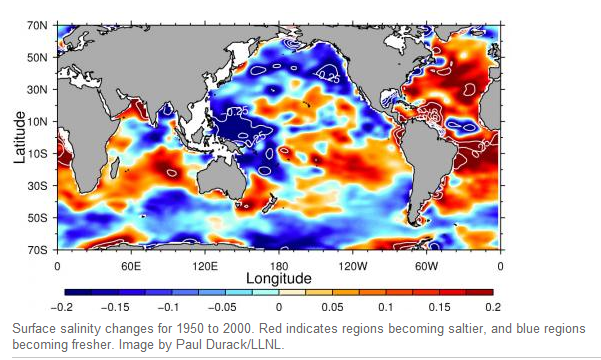
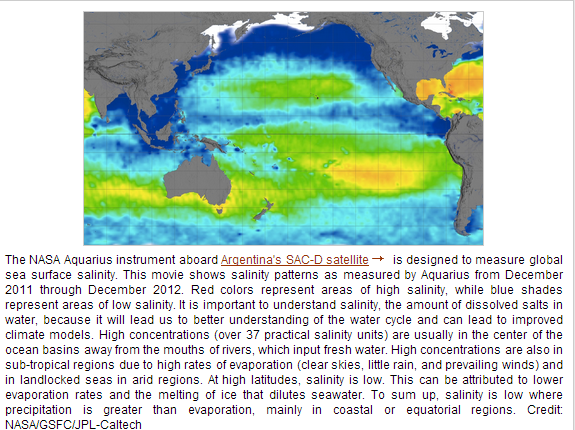
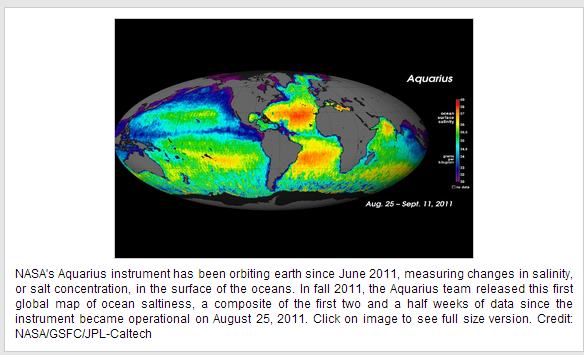
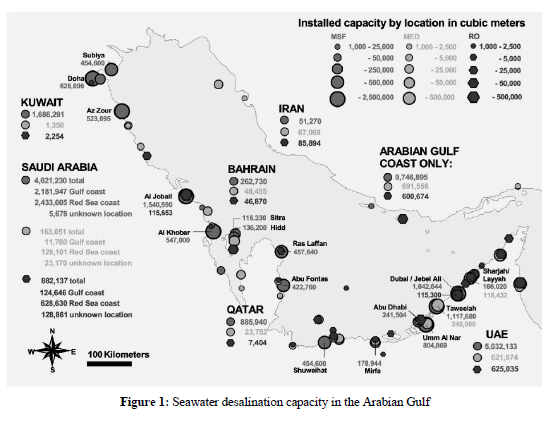
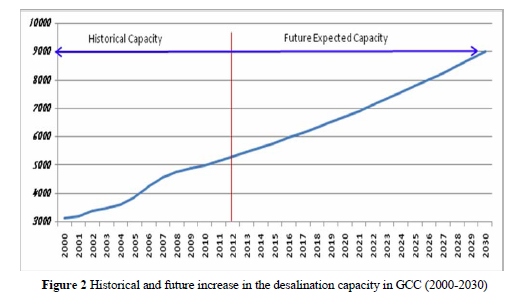
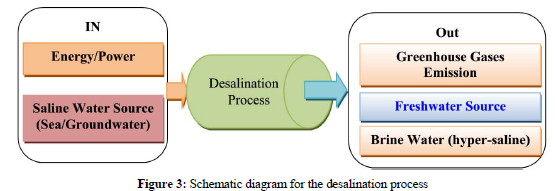
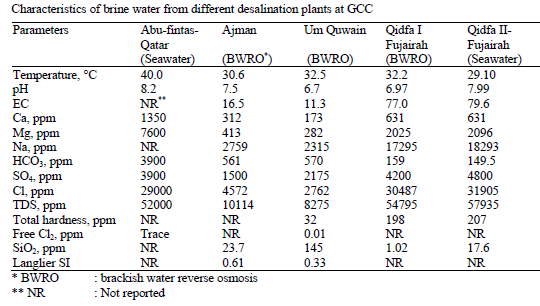
salinity of oceansuface salinity changeMeasurement of surface salinityGlobal conveyor beltNASA's aquariusDesalination capacity in GulfFuture desalination capacity-projectedDesalination processBrine characterstics from desal plantsThere is a growing evidence that shows increasing salinity of seawater affects the “water cycle” resulting in climate change. Apart from the natural cycle, the highly saline brine discharged from man-made “desalination” plants around the world also contributes to the increasing salinity of seawater. There are only few desalination plants suppliers world-wide who build such large-scale desalination plants and they use only decades old desalination technologies. They recover 35% of fresh water and discharge 65% highly concentrated, toxic effluent back into the sea. Their main focus of innovation is to cut the energy consumption because it is an energy intensive process. Such energy comes mainly from fossil fuels. The result is unabated Carbon emission, toxic brine discharge into the ocean, warm saline water discharge into the ocean from “once through cooling towers” from co-located power and desalination plants. Currently about 5000 million cubic meters of fresh water is generated  yearly from seawater desalination plants around the world; this capacity is expected to increase to 9000 million cubic meter per year by 2030.The brine outfall from desalination plants will amount to a staggering 30 billion cubic meters/yr. Such a huge volume of saline water with salinity ranging 70,000 ppm up to 95,000 ppm will certainly alter the water chemistry of the ocean. Desalination plant suppliers  are not interested in “innovation” that can recover fresh water without “polluting” the sea. They rather justify using “environmental impact study” which invariably concludes there is absolutely no impact on environment and any toxic discharge into the sea is “harmless”. This practice is going on for decades without any check. Dwindling fish population world–wide is a direct impact of such discharge. Financial institutions such as world bank, Asian development bank etc are willingly finance such projects without questioning such technologies and their impact on marine environment. Their focus is only “return on investment”–the only criteria that is required for funding and not the “cost and benefit analysis”. A detailed analysis will reveal  “handful of rich and powerful” Governments and individuals  can influence the world’s climate  intentionally or unintentionally. The same “rich and powerful” can shun any innovations “that might threaten their business model” and “ nip such innovations or inventions at their bud” because they simply do not believe in Research and Development or unwilling to direct their “cash flow” into R&D because they do not want any  threat for their existing technologies. There are very few financial professionals who can think “outside the box” or predict their financial impact due to innovative technologies of the future. Their financial decisions reflect the sentiments of the financial institutions, namely “the return on investment”.

“When you read about human-induced climate change it’s often about melting glaciers and sea ice, increasing frequency of heat waves and powerful storms. Occasionally you’ll hear about the acidification of the oceans too. What you don’t often hear about is the saltiness of the seas. But according to a new piece of research just published inGeophysical Research Letters that is changing too.The saltiness, or salinity, of the oceans is controlled by how much water is entering the oceans from rivers and rain versus how much is evaporating, known as ‘The Water Cycle’. The more sunshine and heat there is, the more water can evaporate, leaving the salts behind in higher concentrations in some places. Over time, those changes spread out as water moves, changing the salinity profiles of the oceans. Oceanographers from Scripps Institution of Oceanography and Lawrence Livermore National Laboratory fingerprinted salinity changes from 1955 to 2004 from 60 degrees south latitude to 60 degrees north latitude and down to the depth of 700 meters in the Atlantic, Pacific and Indian oceans.

They found salinity changes that matched what they expected from such natural changes as El Niño or volcanic eruptions (the latter can lower evaporation by shading and cooling the atmosphere).

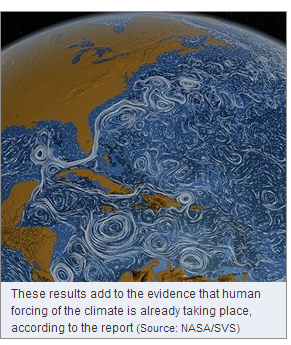
Next the ocean data was compared to 11,000 years of ocean data generated by simulations from 20 of the latest global climate models. When they did that they found that the changes seen in the oceans matched those that would be expected from human forcing of the climate. When they combined temperature changes with the salinity, the human imprint is even clearer, they reported.“These results add to the evidence that human forcing of the climate is already taking place, and already changing the climate in ways that will have a profound impact on people throughout the world in coming decades,” the oceanographers conclude.”

(Ref: Larry O’Hanlon, Discovery News)

Salinity


Although everyone knows that seawater is salty, few know that even small variations in ocean surface salinity (i.e., concentration of dissolved salts) can have dramatic effects on the water cycle and ocean circulation. Throughout Earth’s history, certain processes have served to make the ocean salty. The weathering of rocks delivers minerals, including salt, into the ocean. Evaporation of ocean water and formation of sea ice both increase the salinity of the ocean. However these “salinity raising” factors are continually counterbalanced by processes that decrease salinity such as the continuous input of fresh water from rivers, precipitation of rain and snow, and melting of ice.


Salinity & The Water Cycle 

Understanding why the sea is salty begins with knowing how water cycles among the ocean’s physical states: liquid, vapor, and ice. As a liquid, water dissolves rocks and sediments and reacts with emissions from volcanoes and hydrothermal vents. This creates a complex solution of mineral salts in our ocean basins. Conversely, in other states such as vapor and ice, water and salt are incompatible: water vapor and ice are essentially salt free.

Since 86% of global evaporation and 78% of global precipitation occur over the ocean, ocean surface salinity is the key variable for understanding how fresh water input and output affects ocean dynamics. By tracking ocean surface salinity we can directly monitor variations in the water cycle: land runoff, sea ice freezing and melting, and evaporation and precipitation over the oceans. 

Salinity, Ocean Circulation & Climate

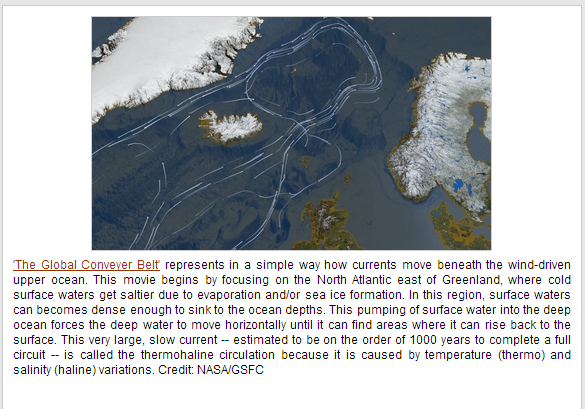
Surface winds drive currents in the upper ocean. Deep below the surface, however, ocean circulation is primarily driven by changes in seawater density, which is determined by salinity and temperature. In some regions such as the North Atlantic near Greenland, cooled high-salinity surface waters can become dense enough to sink to great depths. The ‘Global Conveyor Belt’ visualization (below) shows a simplified model of how this type of circulation would work as an interconnected system.
The ocean stores more heat in the uppermost three (3) meters than the entire atmosphere. Thus density-controlled circulation is key to transporting heat in the ocean and maintaining Earth’s climate. Excess heat associated with the increase in global temperature during the last century is being absorbed and moved by the ocean. In addition, studies suggest that seawater is becoming fresher in high latitudes and tropical areas dominated by rain, while in sub-tropical high evaporation regions, waters are getting saltier. Such changes in the water cycle could significantly impact not only ocean circulation but also the climate in which we live.

(Ref: NASA earth science)

The four main forces that control the earth’s climate are “Sea, Sun, Moon and earth’s rotation”  and  interference by human beings will alter the equilibrium of the system. In order to keep up its equilibrium, Nature is forced to change the climate unpredictably with devastating effects. We cannot underestimate the pollution caused by human beings because they are capable of altering the Nature’s equilibrium over a period no matter how “miniscule” (parts per millions or billions) the pollution may be. Any future investment on large-scale infrastructures should take into account the “human induced climate change” in their model and projections, failing which “climate change” will prove them wrong and the consequences will be dire.

Reference :  Environmental Impacts of Seawater Desalination: Arabian Gulf Case Study

Mohamed A. Dawoud1 and Mohamed M. Al Mulla

1 Water Resources Department, Environment Agency, Abu Dhabi, United Arab

Emirates

2Ministry of Environment and Water, Dubai, United Arab Emirates
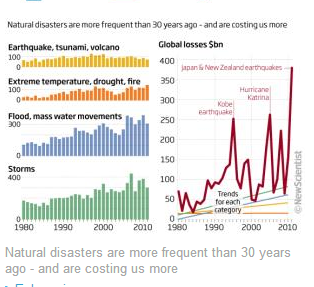
The climate is changing with increasing global warming caused by man-made Carbon emission. The economic impact of global warming can no longer be ignored by Governments around the world because it is impacting their budget bottom lines. Weather is becoming unpredictable. Even if Meteorological department predicts a disaster 24 hrs in advance, there is nothing Governments can do to prevent human and economic losses within a short span of time but evacuate people to safety leaving behind all their properties. Governments are forced to allocate funds for disaster management every year caused by severe draughts, unprecedented snow falls, and coastal erosion by rising sea levels, flash flooding, inundation and power black outs. We often hear people saying,” we were completely taken by surprise by this event and we have never seen anything like this in the last 50 years” after every naturals disasters explaining the nature and scale of disasters. Nature is forcing Governments to allocate more funds for disaster managements and such allocations have reached unprecedented levels. The cost of natural disasters around the world in 2011 was estimated at $ 400 billion and in 2012 it was estimated at $160 billion. The only way to fund these disasters is to tax Carbon pollution which causes global warming. Countries should take long-term decisions that will save their current and future generations to come.  They should understand how Carbon is emitted and what the best way to curb such emissions is. It is a global issue and its requires a collective solution.  There is no use of pricing Carbon when economic recession can jeopardize the pricing mechanism? Global warming is a moral and social issue and not just an economic issue.

Developed countries have emitted bulk of the Carbon since industrial revolution while developing countries such as India and China were emitting less carbon in spite of their vast population due to their lowest per capita consumption. But that trend has now changed with rapid industrialization and economic growth of India and China and other developing economies. Australia is still a leading emitter of Carbon in the world in spite of their low population because of their high energy consumption, availability of cheap and high quality Coal and increasing mining, industrial and agricultural activities. That is why Australia is one of the first few countries who introduced Carbon tax while rest of the countries is still debating about it. Now it is clear that Carbon emission is directly proportional to industrial, economic and population growth of a country and it can be easily quantified based on the growth rate of each country. It is time countries agree to cut their Carbon emissions to sustainable levels with a realistic Carbon pricing mechanism and sign a world-wide treaty through UN.

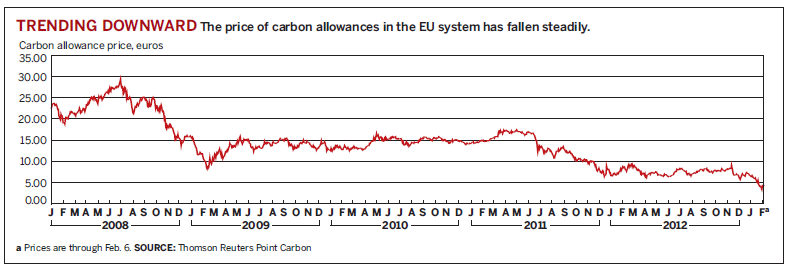
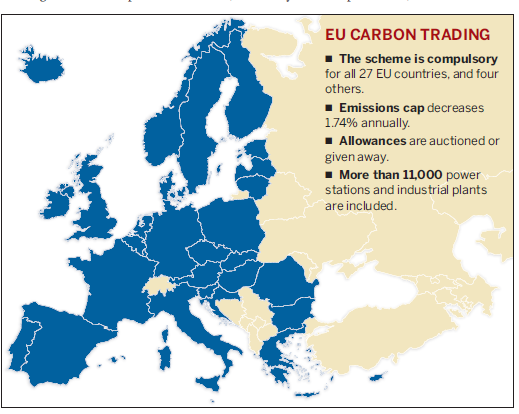
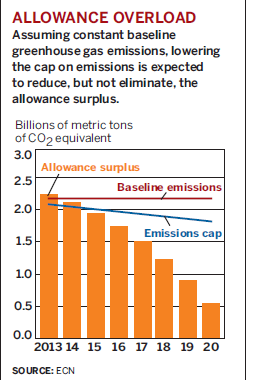
“THE EUROPEAN UNION carbon emissions trading scheme—the biggest in the world and the heart of Europe’s climate- change program—is in dire straits. The scheme’s carbon price has collapsed. The primary reason: The economic recession has suppressed manufacturing, thereby reducing emissions and creating a huge over- supply of carbon emissions allowances. Carbon trading is a market approach to reducing greenhouse gas emissions in which each facility involved is given an emissions cap for the year, and each year that cap is reduced. A firm must record and report its facilities’ emissions and must obtain allowances for its total emissions. An allowance permits a facility to emit 1 metric ton of carbon dioxide or its carbon equal; some allowances are given for free by the government, others can be bought at auction or from other firms. If a facility exceeds its cap, the company operating it has options: It can cut emissions, buy allowances from other companies, or get allowance offsets by reducing emissions at another pollution source. The cost of an allowance is referred to as the car-bon price and is driven by market conditions such as supply and demand. If the low-carbon price continues, the region’s ability to meet long-term reduction targets for greenhouse gas emissions will be severely hampered because the trading scheme will fail to provide money for clean-tech programs and incentive for manfacturers to adopt cleaner technologies. The trading scheme is a key component of the EU’s climate-change strategy because about 40% of all greenhouse gases emit-ted in the region fall under EU’s control. The mandatory scheme applies to 11,000 industrial installations, including power plants and major chemical facilities, across all 27 member states, as well as in Croatia, Iceland, Liechtenstein, and Norway. The aviation sector has been included in the scheme, but its active participation has been deferred to allow for an international agreement on aviation emissions, which is expected to be concluded in the fall. The goal of the European Commission, the EU’s administrative body and the architect of the emissions trading scheme, is to reduce all greenhouse gas emissions by 20% from 1990 levels by 2020. To contribute toward this goal, the trading scheme has targeted a 21% cut in the emissions of participating sectors by 2020 from a 2005 baseline. In recent weeks, however, the EU carbon price dropped to a new low of $5.20 for each metric ton allowance of CO2, down from a high of $23 in 2011. This is despite an annual reduction of the EU emissions cap of 1.74% through 2020 and the introduction on Jan. 1 of a new phase of the scheme requiring companies to purchase allowances. AT ITS CURRENT carbon price, the EU emission scheme’s role in encouraging chemical firms to ditch fossil fuels and adopt greener technologies “is meaningless,” says André Veneman, director of sustainability at AkzoNobel. Many of the industry’s investments in low-carbon technologies that are marginally financially viable also will likely be delayed, he says. Without a strong carbon price, the underlying push to clean-tech in the EU will come only from the price of oil, Veneman adds. Veneman and other experts say that a carbon price of between $68 and $135 is required if industry as a whole is to be forced to shift onto a new low-carbon footing. Yvo de Boer, special global adviser for climate change and sustainability for KPMG—an audit, tax, and advisory firm—and form EUROPEAN SCHEME IS IN FREE FALL Record-low CARBON PRICE threatens to derail transition away from fossil fuels and ability to meet climate-change targets.” Source: EUROPEAN SCHEME IS IN FREE FALL Record-low CARBON PRICE threatens to derail transition away from fossil fuels and ability to meet climate-change targets ALEX SCOTT, C&EN LONDO

The burden of Carbon tax should be borne by both power generators as well as consumers. Even if the Carbon tax is imposed on emitters it will eventually be passed on to consumers. Either way the cost of energy will increase steeply or there is no way to avoid such escalation if we want to keep up our power consumption levels or our current life style. In other words people will have to pay penalty for polluting the air either by generating or consuming power that causes Carbon pollution. All developed countries that have polluted the atmosphere with Carbon emission should be taxed retrospectively from the time of industrial revolution so that emerging countries need not bear the full cost of global warming. Such a fund should be used for developing renewable and clean energy technologies or to purchase Carbon allowances. Current mechanism of Carbon pricing does not penalize countries who caused the global warming in the first place for hundreds of years but penalizes only countries who now accelerate the rate of Carbon emission. Such an approach is a gross injustice on the emerging economies and not at all pragmatic. Most of the developed countries are currently facing economic recession resulting in plummeted Carbon price. This will only encourage existing Carbon emitters to emit Carbon cheaply and penalize Renewable energy and clean energy technologies with higher tariffs and drive them to extinction. In spite of Carbon level in the atmosphere exceeding 400 ppm according to the latest report, the world is helpless to cut the Carbon emission anytime sooner making our planet vulnerable to catastrophic natural disasters. Countries that are reluctant to pay Carbon tax will pay for Natural disasters which may be many times costlier than Carbon tax. Countries like US, European Union, Japan, Australia the largest power consumers and countries like Saudi Arabia, Russia, Venezuela, Iran, Iraq, Libya the largest oil producers should bear the cost of Carbon pollution that caused the globe to warm sine industrial revolution. Such a fund should be used in developing innovative Renewable energy and clean energy technologies of the future. More than anything else the rich and powerful countries should declare global warming as a moral issue of the twenty-first century and take some bold and hard economic decisions to save the planet earth..Allowance overloadCarbon pricing downward trendcost of Natural disatersEU carbon trading


Is this your new site? Log in to activate admin features and dismiss this message
Log In